In today’s competitive electronics market, regulatory compliance is not optional—it’s essential. One of the most overlooked yet critical areas in product development is EMI/EMC pre-compliance testing. If your device is not tested for electromagnetic interference (EMI) and electromagnetic compatibility (EMC) early on, you may face costly delays, product redesigns, or failed certifications.
This blog will help you understand what EMI/EMC pre-compliance testing is, why it matters, and how to get started with the right tools and processes.
What is EMI/EMC Pre-Compliance Testing?
EMI/EMC pre-compliance testing is the process of evaluating a product’s electromagnetic behavior before submitting it for formal regulatory testing. It checks if a device:
- Emits unwanted electromagnetic radiation (EMI)
- Can operate correctly in the presence of electromagnetic disturbances (EMC)
Pre-compliance testing is done in-house or at local labs using cost-effective instruments to identify and fix problems early in the development cycle.
Why Pre-Compliance Testing Matters
Skipping pre-compliance testing can lead to:
- Certification failure at accredited labs (CISPR, FCC, IEC, etc.)
- Delays in launch due to product redesigns
- Increased development cost due to repeated testing and rework
- Market rejection if devices interfere with other systems or fail in real-world use
By identifying EMI/EMC issues during the design phase, you save time, money, and reputation.
When to Do EMI/EMC Pre-Compliance Testing
- During early hardware prototyping
- After integrating switch-mode power supplies, microcontrollers, RF modules
- Before sending final prototypes for certification
- When adding connectivity (Wi-Fi, BLE, LTE) to existing designs
The earlier you test, the easier and cheaper it is to fix.
Key Instruments for EMI/EMC Pre-Compliance Testing
| Tool |
Purpose |
Brands Available via Revine |
| Spectrum Analyzer |
Measure radiated and conducted emissions |
Anritsu, RIGOL |
| Near-field Probes |
Locate sources of EMI on PCB |
TekBox, RF Explorer |
| LISN (Line Impedance Stabilization Network) |
Simulate AC line conditions for testing conducted emissions |
Teseq, Rohde & Schwarz |
| EMC Test Software |
Automate measurements and generate reports |
RIGOL S1210, EMCView |
| TEM Cells or Chambers |
Isolate device during emissions testing |
Available on request |
| Antennas (Loop, Biconical, Log-Periodic) |
Measure radiated emissions in far field |
ETS-Lindgren, TDK |
Revine Technologies provides access to these tools and can help you build a full pre-compliance test bench.
Types of Pre-Compliance Testing
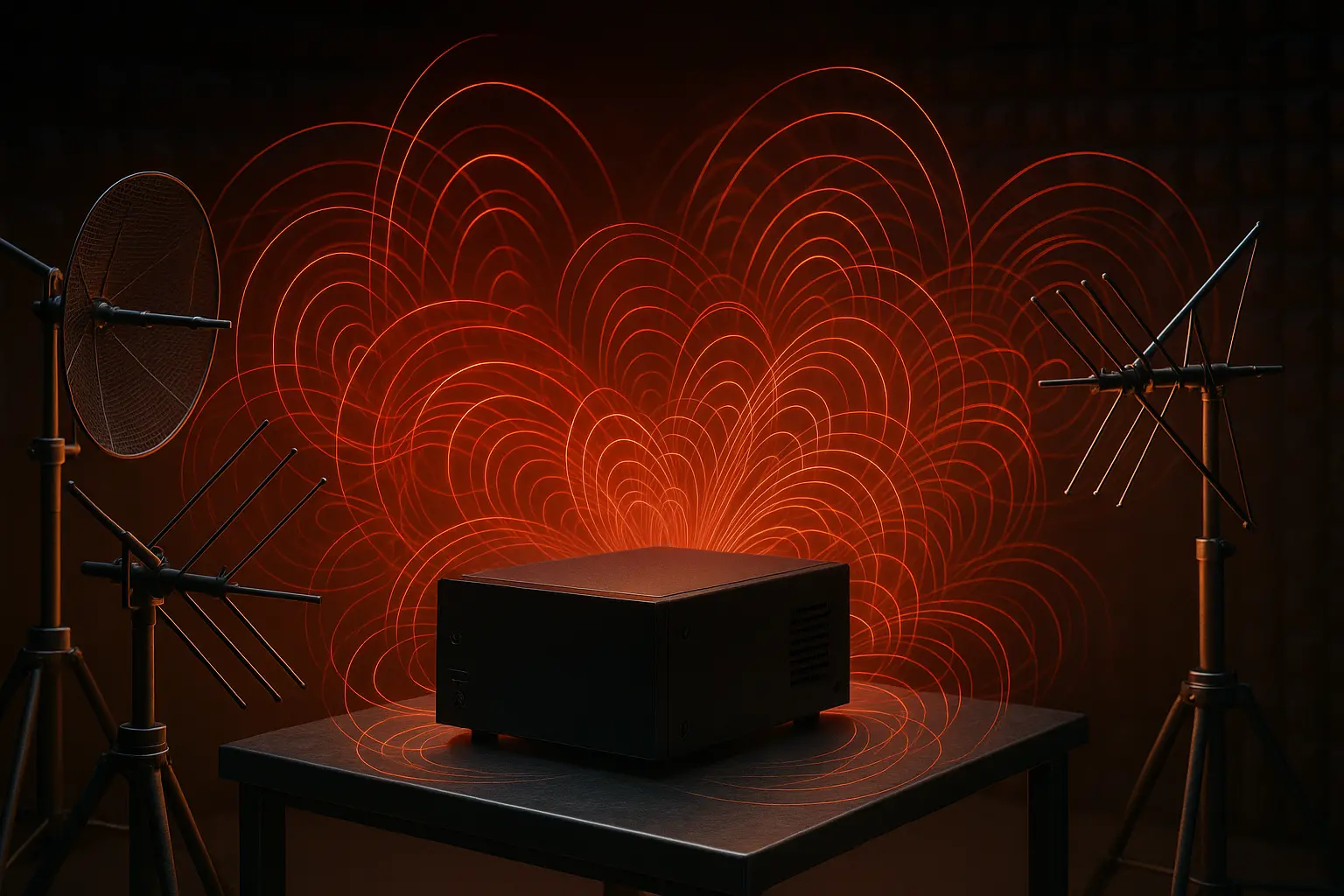
Measures electromagnetic radiation emitted by your device into the surrounding environment.
Test Tools:
- Spectrum Analyzer
- Antennas (loop, biconical)
- Near-field probes
- Test chamber or open test site
Measures interference conducted through power or signal lines.
Test Tools:
- LISN
- Spectrum Analyzer
- Isolation transformers
- Shielded enclosures
Verifies if your device can tolerate external radiated signals without malfunctioning.
Step-by-Step: How to Get Started with Pre-Compliance Testing
Know which global standard applies to your product:
- CISPR 11, 22
- EN 55032/35
- FCC Part 15
- IEC 61000 series
Start with:
- Spectrum analyzer with pre-amplifier
- Near-field probe set
- LISN and isolation equipment
- Shielded room or quiet lab environment
Use near-field probes to scan PCBs and cables. Adjust layout, shielding, or filtering based on emission hotspots.
Compare emissions before and after fixes. Use test software for consistent measurements.
Once confident, send the final unit for full EMI/EMC compliance testing.
Industries That Rely on Pre-Compliance Testing
- Consumer Electronics: Phones, routers, home appliances
- Automotive: ECUs, infotainment systems, electric vehicle controllers
- Medical Devices: Patient monitors, diagnostics, wearables
- Industrial Automation: PLCs, control units, robotics
- Defense & Aerospace: Communication devices, sensors, avionics
Each of these sectors faces strict EMI/EMC requirements and risks serious penalties for non-compliance.
Common EMI/EMC Design Challenges
- Poor PCB layout and grounding
- No filtering on power lines
- Long, unshielded cables
- Unintentional antenna structures in enclosures
- Switching noise from DC-DC converters
Pre-compliance testing helps you catch and correct these before final certification.
How Revine Technologies Supports EMI/EMC Pre-Compliance
Revine Technologies helps companies across India build and maintain EMI/EMC pre-compliance labs with:
- EMI/EMC analyzers and probes from global brands
- Test software and automated measurement solutions
- LISNs, chambers, and antennas for accurate simulation
- Integration of test benches in universities, R&D labs, and manufacturing units
- On-site setup and engineer training for your in-house team
Whether you're building your first compliance lab or scaling for production-level testing, we offer personalized support and turnkey solutions.
Conclusion
EMI/EMC pre-compliance testing is not just a technical step—it’s a strategic advantage. It reduces risk, saves money, and accelerates your path to market. With the right tools and guidance, even small labs and startups can conduct reliable pre-compliance tests without outsourcing everything.
Partner with Revine Technologies to build a smart, efficient, and scalable EMI/EMC testing workflow for your electronic products.