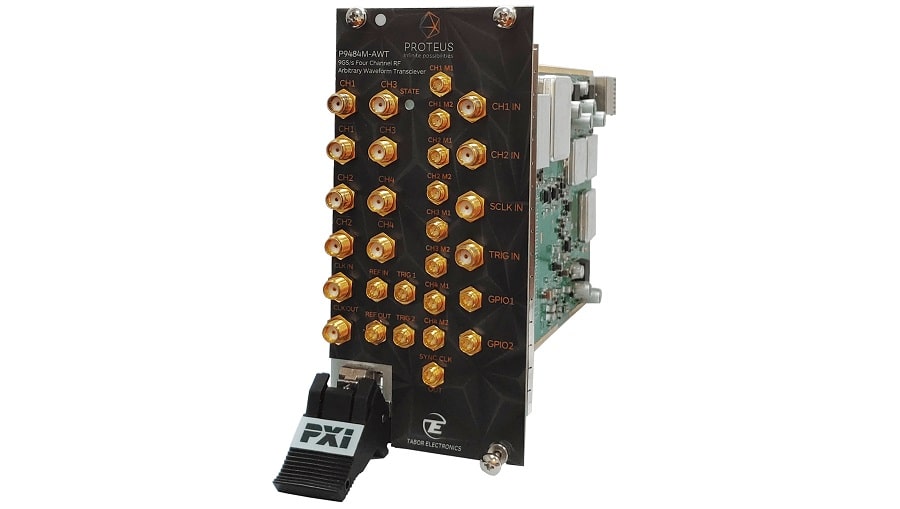
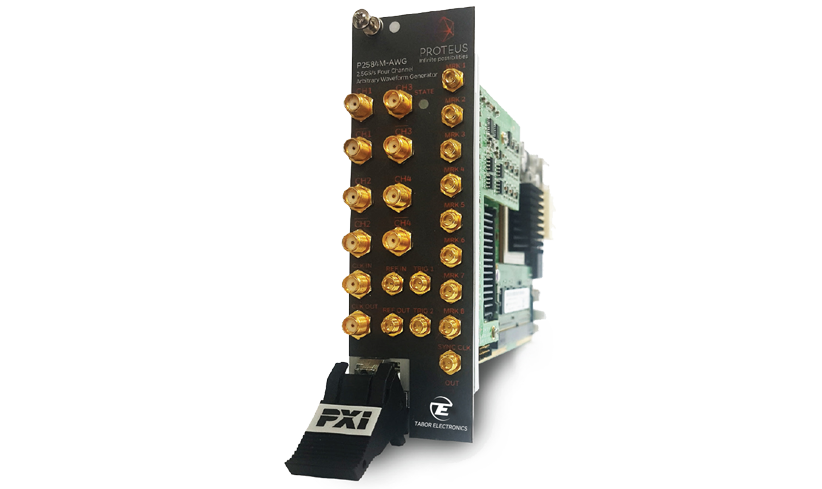
Tabor Proteus RF AWG Models: Arbitrary Waveform Generation for Advanced RF and Quantum Applications
Welcome to Revinetech's elite cat...
Tabor Proteus RF AWG Models: Arbitrary Waveform Generation for Advanced RF and Quantum Applications
Welcome to Revinetech's elite category for Tabor Proteus RF AWG Models. The Proteus series represents the pinnacle of arbitrary waveform generation (AWG) technology, engineered specifically to meet the stringent demands of high-frequency and ultra-high-speed applications. These instruments are indispensable for engineers and researchers in quantum computing, advanced radar, electronic warfare (EW), complex medical imaging, and wideband telecommunications (5G/6G).
You are seeking cutting-edge test equipment that delivers unrivaled sampling rates, wide analog bandwidth, and highly synchronized multi-channel outputs for complex signal synthesis. Our selection features the complete range of Tabor Proteus RF AWG Modules, available in benchtop and PXIe formats. Trust Revinetech to provide the genuine Tabor Proteus solution that offers superior fidelity, massive processing power, and the flexible architecture required to master your most challenging RF and quantum signal generation needs.
Why Tabor Proteus AWGs Lead in High-Frequency Synthesis
The Tabor Proteus platform is fundamentally different from conventional AWGs, leveraging a breakthrough architecture that integrates FPGA technology with high-speed digital-to-analog converters (DACs) to achieve unmatched performance density and flexibility.
Unprecedented Speed and Signal Fidelity
The core strength of the Proteus AWG lies in its ultra-high sampling rate and exceptional spectral purity, making it the ideal source for wideband signals:
-
Ultra-High Sample Rates: Proteus models achieve continuous sampling rates in the Gigahertz (GS/s) range. This is essential for synthesizing wideband signals, direct RF generation, and creating signals with extremely fast rise/fall times.
-
Low Phase Noise and Spurious Content: The instruments are engineered to maintain exceptional spectral purity. Low phase noise is critical for testing sensitive receivers and ensuring the stimulus signal does not compromise measurement integrity in quantum and radar applications.
-
Wide Analog Bandwidth: Capable of generating signals with analog bandwidths into the GHz range, allowing for direct generation of complex RF signals without requiring external up-conversion.
Integrated Processing and Scalability
Proteus models feature an integrated FPGA (Field-Programmable Gate Array) that acts as a powerful dedicated processor, accelerating complex tasks and enabling sophisticated, real-time control:
-
Real-Time Data Manipulation: The integrated FPGA allows for sophisticated waveform sequencing, real-time data modulation, and complex processing directly on the module, drastically reducing latency and offloading the host PC.
-
Multi-Channel Synchronization: The architecture inherently supports highly accurate multi-channel operation, ensuring nanosecond-level timing and phase coherence across multiple outputs, crucial for phased array radar and quantum control systems.
-
Deep Memory and Sequencing: Provides massive waveform memory (often measured in billions of points) to store long, complex, or non-repetitive arbitrary sequences required for advanced simulation and testing.
Exploring the Tabor Proteus RF AWG Categories
Our catalogue features the specialized lines of Tabor Proteus AWG Models, categorized by their form factor and integration environment.
Tabor Proteus PXIe Modules
These modules are designed for seamless integration into Automated Test Equipment (ATE) systems, leveraging the high-speed PXI Express bus:
-
High Channel Density: PXIe format allows for the integration of numerous, synchronized Proteus channels within a single chassis, maximizing rack space and throughput for high-channel-count applications.
-
Fast Data Transfer: Utilizing the high-speed PCIe bus ensures rapid transfer of large waveform files, supporting complex test sequence updates and high-speed arbitrary waveform streaming.
-
System Synchronization: Leverages the PXI backplane's common 10 MHz reference clock and trigger lines for precise timing alignment across all PXI instruments.
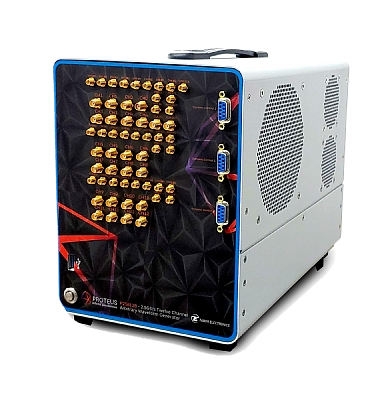
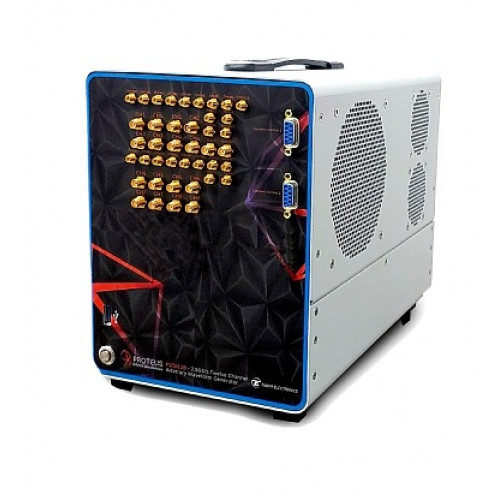
Tabor Proteus Benchtop Instruments
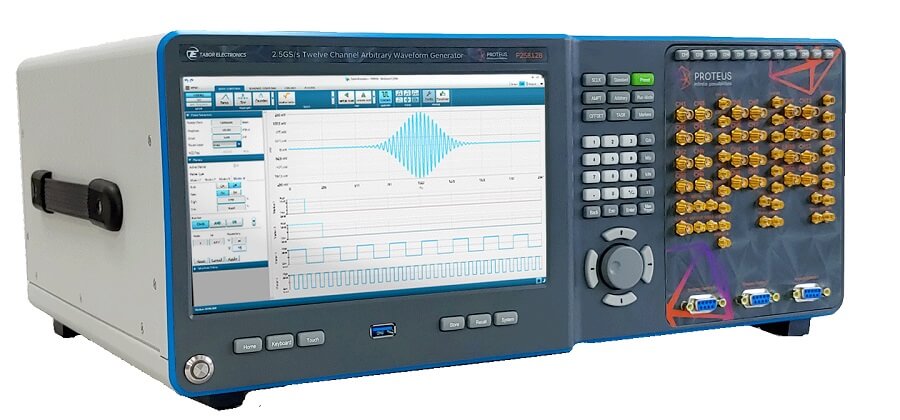
These standalone instruments offer the same extreme performance in a dedicated benchtop enclosure, ideal for R&D labs and manual testing environments:
-
Dedicated User Interface: Features an intuitive front-panel interface, often with a large touchscreen display, simplifying manual control, waveform creation, and sequence programming without relying solely on a PC.
-
Standard Connectivity: Provides full support for standard communication interfaces (LAN, USB, GPIB) for remote control and integration into semi-automated benchtop setups.
-
Portability and Flexibility: Offers the highest performance available from a portable unit, easily transferable between different lab locations.
Integrated Features for Advanced Signal Generation
Proteus AWGs incorporate advanced features that streamline the complex generation of RF and quantum signals, ensuring superior accuracy and performance.
-
Digital Up-Conversion (DUC): Advanced signal processing features allow for efficient up-conversion and direct generation of RF carriers at high frequencies, simplifying the test setup.
-
Master/Slave Synchronization: Optimized synchronization protocols enable the linking of multiple Proteus units to easily scale the channel count while maintaining perfect phase coherence.
-
Software Tools: Comprehensive software support, including dedicated waveform creation tools and standardized drivers (IVI, LabVIEW, Python), simplifies programming and accelerates test development.
Partner with Revinetech for Tabor Proteus Excellence
Selecting the ideal Tabor Proteus RF AWG Model requires assessing the required sample rate (GS/s), analog bandwidth, and the necessity of integrated FPGA processing. Revinetech is your authorized source for the complete Tabor Proteus portfolio. Our technical specialists are ready to assist you in matching the certified performance, high fidelity, and modular flexibility of the right Proteus solution to your specific quantum, radar, and high-speed communication demands.
Achieve unrivaled signal synthesis in the RF and microwave domain. Browse our catalogue of Tabor Proteus RF AWG Models today, compare the best PXIe and benchtop units, and contact us for expert advice and a personalized quote.
Frequently Asked Questions (FAQs)
What is the key advantage of the Tabor Proteus AWG's integrated FPGA?
The key advantage is real-time processing and low latency. The integrated FPGA allows the Proteus AWG to execute complex waveform sequencing, conditional looping, and real-time data modulation directly on the instrument, minimizing latency and freeing the host computer from demanding tasks.
Why are high sample rates (GS/s) essential for RF AWGs like the Proteus?
High sample rates are essential because they determine the maximum frequency and bandwidth the AWG can generate. The high GS/s rate of Proteus enables direct RF generation and the synthesis of extremely wideband signals, which are mandatory for testing modern radar and 5G/6G communication systems.
What does "direct RF generation" mean for the Tabor Proteus?
Direct RF generation means the Proteus AWG can create high-frequency RF signals directly at the DAC output, eliminating the need for external analog up-conversion stages (mixers and local oscillators). This simplifies the test setup, reduces cost, and improves signal fidelity.
How does the Proteus support quantum computing applications?
The Proteus AWG supports quantum computing by providing highly synchronized, phase-coherent multi-channel outputs with extremely low phase noise and high resolution. This is vital for generating the precise, complex microwave control pulses required to manipulate and read out quantum bits (qubits).
Does the Tabor Proteus support both benchtop and PXIe formats?
Yes. The Tabor Proteus architecture is available in both formats, allowing users to choose the platform that best fits their needs: PXIe for high-density, automated test systems, and dedicated benchtop enclosures for R&D and manual laboratory work.