PMK Probe Positioners: Precision Hands-Free Measurement Solutions
Welcome to Revinetech's dedicated category for PMK Probe Positioner...
PMK Probe Positioners: Precision Hands-Free Measurement Solutions
Welcome to Revinetech's dedicated category for PMK Probe Positioners. In the delicate and detailed work of electronic debugging, analysis, and circuit testing, maintaining a stable, hands-free connection between the oscilloscope probe and the test point is essential. PMK probe positioners are precision mechanical devices engineered to hold probes securely on small surface-mount devices (SMD), complex integrated circuits (ICs), and dense circuit boards, freeing the engineer's hands to operate the instrument or modify the circuit.
You are seeking robust, stable, and highly adjustable mechanical aids that guarantee reliable, repeatable contact for high-frequency measurements. Our selection features the complete range of PMK positioners, including lightweight magnetic bases, flexible articulated arms, and specialized holders for precise signal acquisition. Trust Revinetech to provide the genuine PMK positioner solution that delivers superior stability, high-resolution movement, and the essential ergonomic support required for detailed, modern electronic testing.
Why PMK Probe Positioners Are Vital for Modern Debugging
The shrinking size of electronic components makes manual probing difficult and unreliable, especially during high-speed measurements where slight movement can introduce noise or errors. PMK positioners solve these critical usability and accuracy issues.
Enhancing Accuracy and Stability
The primary function of a PMK probe positioner is to eliminate human error and movement artifacts from the measurement process:
-
Hands-Free Operation: Freeing the engineer's hands allows for easier control of the oscilloscope, manipulation of circuit parameters, or review of documentation, greatly speeding up the debugging process.
-
Reliable Contact: Positioners maintain consistent, steady contact pressure, which is crucial for low-inductance ground connections and high-frequency signal integrity. Unstable contact introduces noise and signal reflections.
-
Fine Adjustment: Positioners offer high-resolution, precise movement control (often micrometer-level), allowing the probe tip to be accurately placed on tiny SMD components or fine-pitch IC leads.
Ergonomics and Versatility
PMK designs its positioners for maximum utility and comfort in the lab environment:
-
Universal Compatibility: Positioners are designed to securely hold a wide range of probe styles, including PMK's high-speed active probes, differential probes, and passive probes, ensuring flexibility across the entire test bench.
-
Flexible Mounting: Solutions include weighted bases, non-magnetic bases, or secure vacuum systems, adapting to different workbench materials and test setups.
-
Optimized Workflow: By providing a stable visual platform, the positioner allows engineers to use microscopes or cameras for close-up monitoring of the probe tip placement.
Exploring the PMK Probe Positioner Categories
Our catalogue features the specialized lines of PMK positioners, categorized by their mounting method, adjustment precision, and complexity.
Magnetic Base Positioners
These are the standard, versatile workhorses for general lab use on ferromagnetic (steel) surfaces:
-
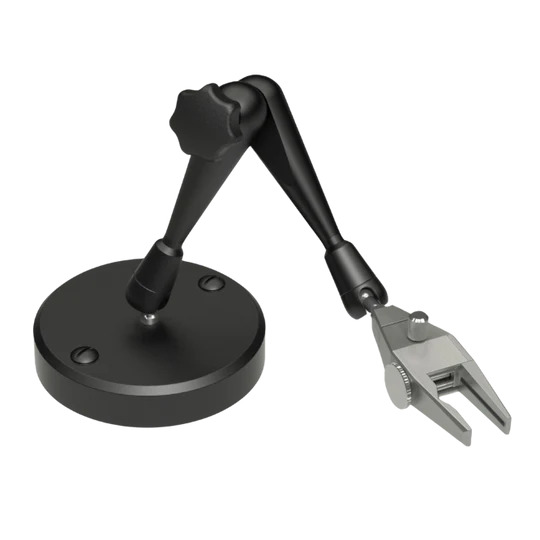
Strong Magnetic Base: Provides a robust, stable anchor point on the workbench or custom jig, ensuring the positioner does not shift during measurement.
-
Flexible Arms: Often feature articulated or flexible arms for quick, general positioning over the test board.
Advanced Vacuum and Weighted Base Positioners
Designed for non-ferromagnetic materials and high-precision contact:
-
Weighted Bases: Heavy, stable bases provide secure positioning on non-magnetic surfaces (e.g., aluminum, plastic).
-
Vacuum Bases: Utilizing a micro-vacuum system to securely anchor the positioner to smooth, non-magnetic surfaces, guaranteeing stability for critical measurements.
-
Micromanipulators: High-precision systems that offer fine mechanical control, essential for placing probes on extremely small, fine-pitch components (e.g., QFN/QFP packages).
Specialized Probe Holders and Accessories
PMK offers various specialized components to complete the hands-free setup:
-
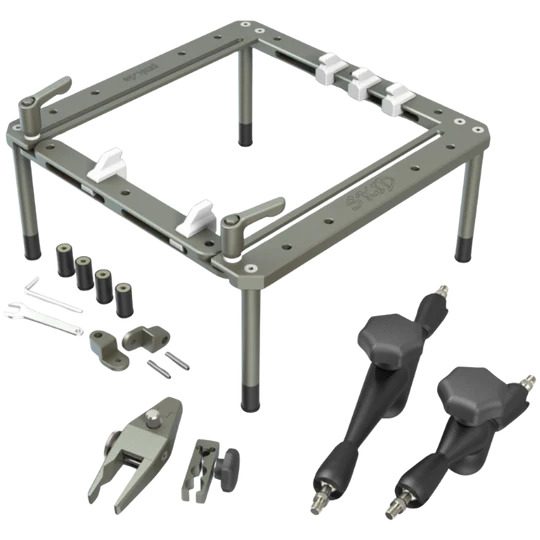
PCB Holders and Jigs: Specialized fixtures that securely hold the circuit board in place, providing a stable platform for the positioners.
-
Low-Inductance Ground Connections: Accessories designed to establish short, reliable, low-inductance ground connections between the probe and the test board, which is essential for preserving high-speed signal integrity.
Integrated Features for Reliable Measurement
PMK positioners incorporate features that streamline workflow and guarantee stability during complex analysis.
-
Insulated Components: Non-conductive arms and components prevent accidental short circuits between test points.
-
Quick-Release Mechanisms: Allows for fast, one-handed removal and repositioning of the probe without disturbing the positioner's base setting.
-
Compatibility: Engineered to seamlessly interface with PMK's extensive range of probe tips and ground accessories.
Partner with Revinetech for PMK Positioner Assurance
Selecting the ideal PMK Probe Positioner requires assessing the material of your workbench (magnetic vs. non-magnetic), the required precision of movement (micrometer vs. general positioning), and the frequency of the signals being measured. Revinetech is your authorized source for the complete PMK probe and accessory portfolio. Our technical specialists are ready to assist you in matching the certified stability, precision movement, and robust design of the right PMK positioner to your specific debugging and validation challenges.
Achieve stable, hands-free precision on small components. Browse our catalogue of PMK Probe Positioners today, and contact us for expert advice and a personalized solution.
Frequently Asked Questions (FAQs)
What is the main benefit of using a probe positioner in electronic debugging?
The main benefit is stability and hands-free operation. A probe positioner eliminates the hand jitter and movement that can corrupt delicate signals, especially in high-frequency measurement, while freeing the engineer's hands to operate the oscilloscope or adjust the circuit under test.
Why are probe positioners critical for high-speed signal integrity?
Probe positioners are critical for high-speed testing because they maintain a consistent, short, and stable ground connection. Any movement or excessive length in the ground path creates inductance, causing signal reflections, ringing, and inaccurate measurements of fast digital edges.
What is the difference between a magnetic base and a weighted base positioner?
A magnetic base positioner uses a powerful magnet to anchor the base securely to a steel workbench or custom ferromagnetic jig. A weighted base positioner relies on mass and friction to maintain stability and is used on non-magnetic surfaces like aluminum chassis or plastic benchtops.
Are PMK probe positioners compatible with non-PMK probes?
While PMK designs its holders to securely fit its own probe bodies, many PMK positioners use standard probe clamps or adjustable holders that can accommodate probes from various manufacturers, provided the probe body diameter or form factor is standard.
What is a micromanipulator, and when is it necessary?
A micromanipulator is a high-precision positioner that offers extremely fine, often gear-driven, movement control. It is necessary when placing probe tips onto very small, fine-pitch components (like 0.5 mm pitch IC leads or tiny passive components) that require sub-millimeter positioning accuracy.