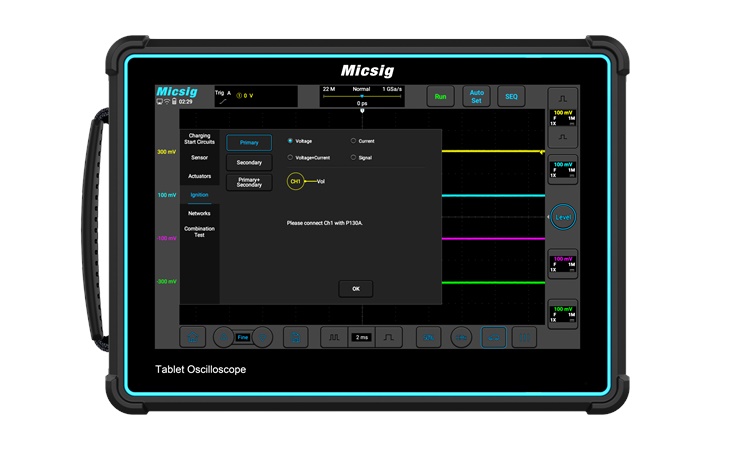
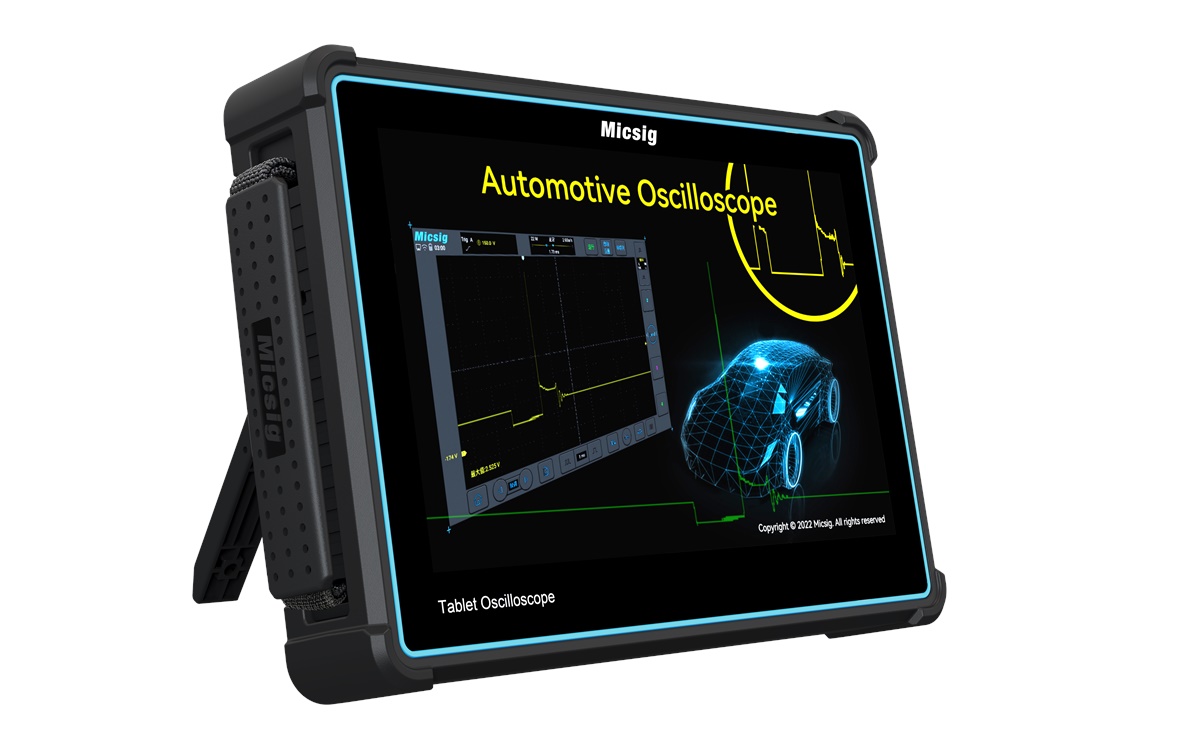
The Micsig ATO2004 Automotive Tablet Oscilloscope combines a four-channel digital oscilloscope, automotive diagnostic software, serial bus analysis and portable battery operation in a tablet-style platform.
It is designed for automotive technicians, service centres, vehicle manufacturers, training institutions and diagnostic engineers who need to capture several related vehicle signals simultaneously.
The ATO2004 provides:
- Four analogue input channels
- 200 MHz analogue bandwidth
- Up to 2 GSa/s real-time sampling
- Up to 220 Mpts acquisition memory
- Up to 300,000 waveform captures per second
- Built-in automotive test presets
- Serial bus triggering and decoding
- 10.1-inch capacitive touchscreen
- 32 GB internal storage
- Wi-Fi and mobile-device connectivity
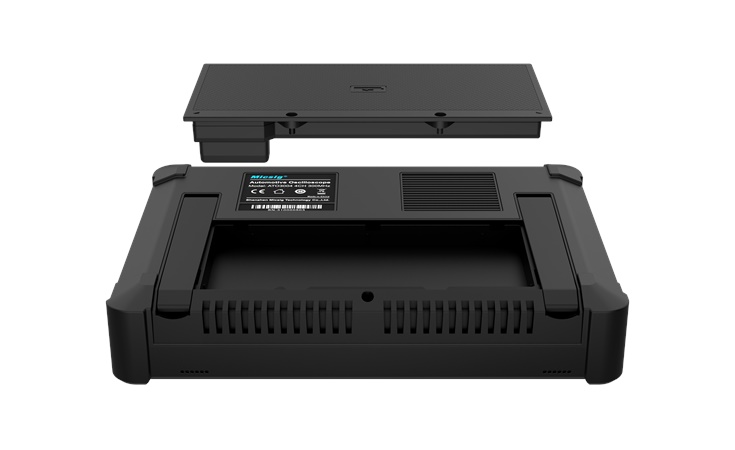
- Replaceable rechargeable battery
The four-channel design supports measurements such as crankshaft, camshaft, injector and ignition signals within the same time-correlated acquisition.
200 MHz Analogue Bandwidth
The ATO2004 provides 200 MHz analogue bandwidth, not 300 MHz. Its typical rise time is approximately 1.75 ns or less.
The bandwidth supports detailed observation of:
- Crankshaft and camshaft sensor signals
- Primary and secondary ignition
- Injector voltage and current
- CAN and CAN FD physical-layer signals
- PWM-controlled actuators
- Fast automotive sensor transitions
- ECU inputs and outputs
- Automotive power-electronics signals
- Switching noise and voltage spikes
- General electronic circuit waveforms
Actual measurement performance also depends on probe bandwidth, source impedance, grounding, connection length and signal rise time.
Four Analogue Channels
The four-channel architecture allows technicians to monitor several related vehicle signals simultaneously.
Typical measurements include:
- Crankshaft, camshaft, injector and ignition correlation
- CAN High and CAN Low
- Voltage and current waveforms
- Sensor input and ECU response
- Primary ignition and injector control
- Battery voltage and cranking current
- Alternator output and ripple
- Multiple actuator-control signals
- Power and ground circuits
- Reference and measured waveforms
Four-channel analysis is particularly useful for diagnosing synchronisation faults, intermittent misfires and problems involving several connected vehicle systems.
Up to 2 GSa/s Real-Time Sampling
The ATO2004 provides a maximum real-time sampling rate of 2 GSa/s. The available rate depends on the number of enabled channels and the selected acquisition configuration.
High-speed sampling helps reveal:
- Ignition transitions
- Injector switching edges
- CAN bus waveform quality
- Narrow control pulses
- Sensor dropouts
- Electrical noise
- Timing variation
- Intermittent voltage disturbances
- Fast power-electronics signals
The page should use up to 2 GSa/s rather than suggesting that each of the four channels always operates at the full sampling rate.
Up to 220 Mpts Acquisition Memory
The ATO2004 provides up to 220 Mpts memory depth. Deep memory allows technicians to capture longer vehicle operating periods while retaining enough sample detail for waveform zoom and post-acquisition analysis.
This is useful for:
- Extended cranking analysis
- Long CAN and CAN FD captures
- Road-test waveform recording
- Intermittent sensor faults
- Vehicle start-up sequences
- Ignition misfire investigation
- Charging-system monitoring
- Long actuator-control events
- Communication-network troubleshooting
Memory allocation may vary with the number of active channels and the selected acquisition mode. The safest headline specification is up to 220 Mpts.
Up to 300,000 Waveforms per Second
The ATO2004 supports waveform capture rates up to 300,000 wfms/s.
Fast capture improves the probability of finding:
- Ignition dropouts
- Communication glitches
- Injector abnormalities
- Runt pulses
- Timing errors
- Intermittent sensor noise
- Unexpected voltage spikes
- Unstable actuator control
- Brief power interruptions
This is valuable when a vehicle fault appears only occasionally or under a specific load, speed or temperature condition.
Dedicated Automotive Diagnostic Presets
The ATO2004 includes built-in automotive test functions that help technicians configure the oscilloscope for common vehicle measurements. The ATO platform supports charging and starting circuits, sensors, actuators, ignition systems, communication networks and combined tests.
Charging-System Tests
Typical applications include:
- 12 V charging systems
- 24 V charging systems
- Alternator AC ripple
- Smart alternator testing
- Battery charging behaviour
- Charging-control signals
These tests can help identify alternator, battery, regulator, cable and charging-control faults.
Starting-System Tests
Starting-system applications include:
- 12 V starting systems
- 24 V starting systems
- Cranking-voltage analysis
- Starter-current analysis
- Starter-motor evaluation
- Battery voltage-drop testing
A compatible current clamp is required for current measurement.
Sensor Tests
Automotive sensor presets cover common signals such as:
- Crankshaft-position sensor
- Camshaft-position sensor
- ABS sensor
- Accelerator-pedal sensor
- Air-flow meter
- MAP sensor
- Coolant-temperature sensor
- Fuel-pressure sensor
- Knock sensor
- Oxygen or lambda sensor
- Throttle-position sensor
- Road-speed sensor
The presets help technicians compare measured signals with expected waveform behaviour.
Actuator Tests
Supported actuator applications include:
- Petrol injectors
- Diesel injectors
- Fuel pumps
- EGR solenoids
- Carbon-canister valves
- Glow plugs
- Idle-air control valves
- Pressure regulators
- Quantity-control valves
- Throttle servomotors
- Variable-speed cooling fans
- Variable-valve-timing systems
Technicians can evaluate switching behaviour, control voltage, current response and timing.
Ignition Tests
The ATO2004 supports:
- Primary ignition analysis
- Secondary ignition analysis
- Coil-on-plug testing
- Dwell-time measurement
- Burn-time analysis
- Ignition timing comparison
- Misfire diagnosis
Suitable ignition probes or secondary-ignition pickups are required for safe testing.
Vehicle Network Tests
Automotive network functions support testing of:
- CAN High
- CAN Low
- CAN FD
- LIN
- FlexRay
- K-line
These tests help diagnose communication-voltage errors, termination faults, noise, timing problems and physical-layer abnormalities.
Combination Measurements
The four-channel configuration supports combined automotive measurements such as:
- Crankshaft and camshaft
- Camshaft and primary ignition
- Primary ignition and injector voltage
- Crankshaft, camshaft and injector voltage
- Crankshaft, camshaft, injector and secondary ignition
- CAN High and CAN Low with power or ground
- Sensor input and ECU-controlled output
These tests help diagnose timing, synchronisation, wiring, ignition and ECU-control problems.
Pressure Testing
With compatible automotive pressure transducers, the ATO2004 can support waveform-based pressure testing for:
- Intake-manifold pressure
- In-cylinder pressure
- Exhaust pressure
- Crankcase pressure
- Fuel pressure
- Hydraulic and pneumatic systems
Pressure transducers and suitable adaptors should be quoted separately.
Standard Serial Bus Triggering and Decoding
The ATO Series supports serial bus triggering and decoding for common automotive and embedded protocols.
Supported protocols include:
- RS232, RS422, RS485 and UART
- CAN
- CAN FD
- LIN
- SPI
- I²C
Automotive diagnostic functions also support FlexRay and K-line physical-layer testing.
Protocol analysis helps identify:
- Corrupted data
- Missing messages
- Communication interruptions
- Timing errors
- Voltage-level abnormalities
- Electrical noise
- Bus termination problems
- Physical-layer faults
These protocol functions should be described as standard unless the actual RevineTech supply configuration differs from Micsig’s published package.
Hardware Digital Filtering
The ATO2004 provides hardware-based filtering to reduce unwanted interference during vehicle measurements.
Filtering is useful for:
- Alternator ripple testing
- Injector analysis
- Ignition testing
- Low-frequency sensor measurements
- Power-supply diagnostics
- Vehicle-network troubleshooting
Users can retain full bandwidth for fast signal transitions or apply filtering when high-frequency noise is not relevant.
Segmented Acquisition
Segmented acquisition stores important events separately instead of using memory for long inactive periods.
Typical applications include:
- Injector pulses
- Ignition events
- CAN messages
- Rare sensor faults
- Repetitive actuator signals
- Extended workshop diagnostic sessions
This improves memory efficiency when important events occur intermittently.
Automatic Measurements
The ATO2004 supports automatic electrical and timing measurements such as:
- Maximum and minimum voltage
- Peak-to-peak voltage
- Average voltage
- RMS voltage
- Frequency
- Period
- Rise and fall time
- Positive and negative pulse width
- Duty cycle
- Overshoot
- Phase
- Delay
Automatic measurements reduce the need for manual cursor calculations during routine diagnostics.
Waveform Mathematics and FFT
Available waveform-analysis functions include:
- Addition
- Subtraction
- Multiplication
- Division
- FFT
- Digital filtering
- Reference waveform comparison
- Cursor measurement
- Measurement statistics
FFT analysis can assist with:
- Alternator ripple investigation
- Switching-frequency analysis
- Harmonic analysis
- Noise-source identification
- Detection of unwanted oscillations
- Automotive power-electronics troubleshooting
-
10.1-Inch Capacitive Touchscreen
The ATO2004 includes a 10.1-inch industrial touchscreen with 1280 × 800 resolution.
Display features include:
- Capacitive multi-point touch
- Tablet-style interface
- Gesture-based waveform control
- Four-channel waveform display
- Automotive diagnostic menus
- Decoded bus information
- Measurement and analysis windows
The large display makes it easier to view several automotive signals together.
Android-Based SigtestUI Platform
The ATO2004 runs Micsig’s SigtestUI multitasking environment and includes approximately 32 GB of internal storage.
The system supports:
- Touch-based oscilloscope control
- Automotive diagnostic applications
- Waveform storage
- Screenshot capture
- Video recording
- File management
- Software updates
- Remote operation
- Multitasking
-
Rechargeable Battery Operation
The ATO Series includes a 7.4 V, 7500 mAh rechargeable lithium-ion battery for portable workshop and field operation.
Portable applications include:
- Under-bonnet diagnostics
- Road testing
- Workshop fault-finding
- Commercial-vehicle maintenance
- Field service
- Mobile technical training
- Remote electronic testing
Battery operating time depends on screen brightness, active channels, Wi-Fi use and connected accessories.
Rugged Workshop Design
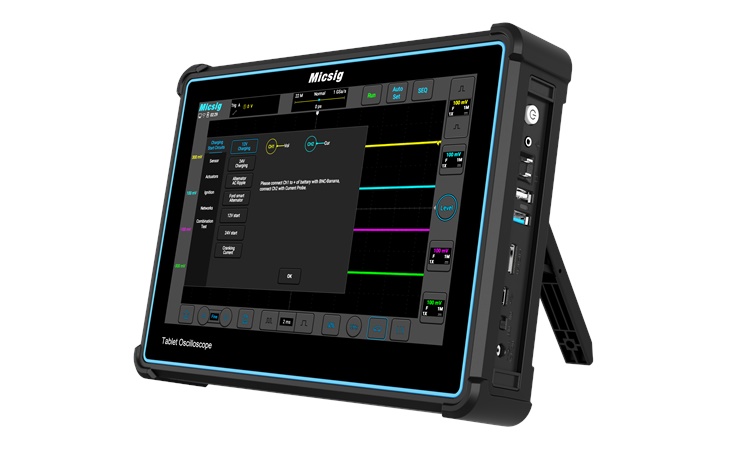
The tablet-style enclosure is designed for portable automotive work and includes a protective housing and hand strap.
The compact form supports:
- In-vehicle testing
- Under-bonnet measurements
- Workshop bench testing
- Road-test recording
- Mobile demonstrations
- Technical training
-
Connectivity and Remote Control
The ATO2004 supports:
- Wi-Fi
- USB 3.0 Host
- USB 2.0 Host
- USB Type-C
- HDMI output
- Trigger output
- PC software
- Android mobile application
- iOS mobile application
- SCPI remote control
These interfaces support waveform transfer, remote viewing, automated control and display on a larger monitor.
Switchable Input Impedance
The ATO2004 provides:
- 1 MΩ input impedance
- 50 Ω input impedance
This allows the instrument to work with general automotive probes and correctly terminated higher-frequency signals.
Maximum permitted voltage depends on the selected impedance, probe attenuation and test configuration.
Applications
The Micsig ATO2004 is suitable for:
- Automotive workshop diagnostics
- Passenger-car electrical testing
- Commercial-vehicle diagnostics
- 12 V and 24 V charging-system testing
- Starting and cranking analysis
- Alternator ripple testing
- Petrol and diesel injector testing
- Primary and secondary ignition testing
- Camshaft and crankshaft correlation
- Sensor and actuator testing
- CAN and CAN FD troubleshooting
- LIN, FlexRay and K-line testing
- Automotive power-electronics testing
- ECU input and output verification
- Intermittent electrical fault diagnosis
- Road-test waveform capture
- Automotive technical training
- General electronic circuit testing