
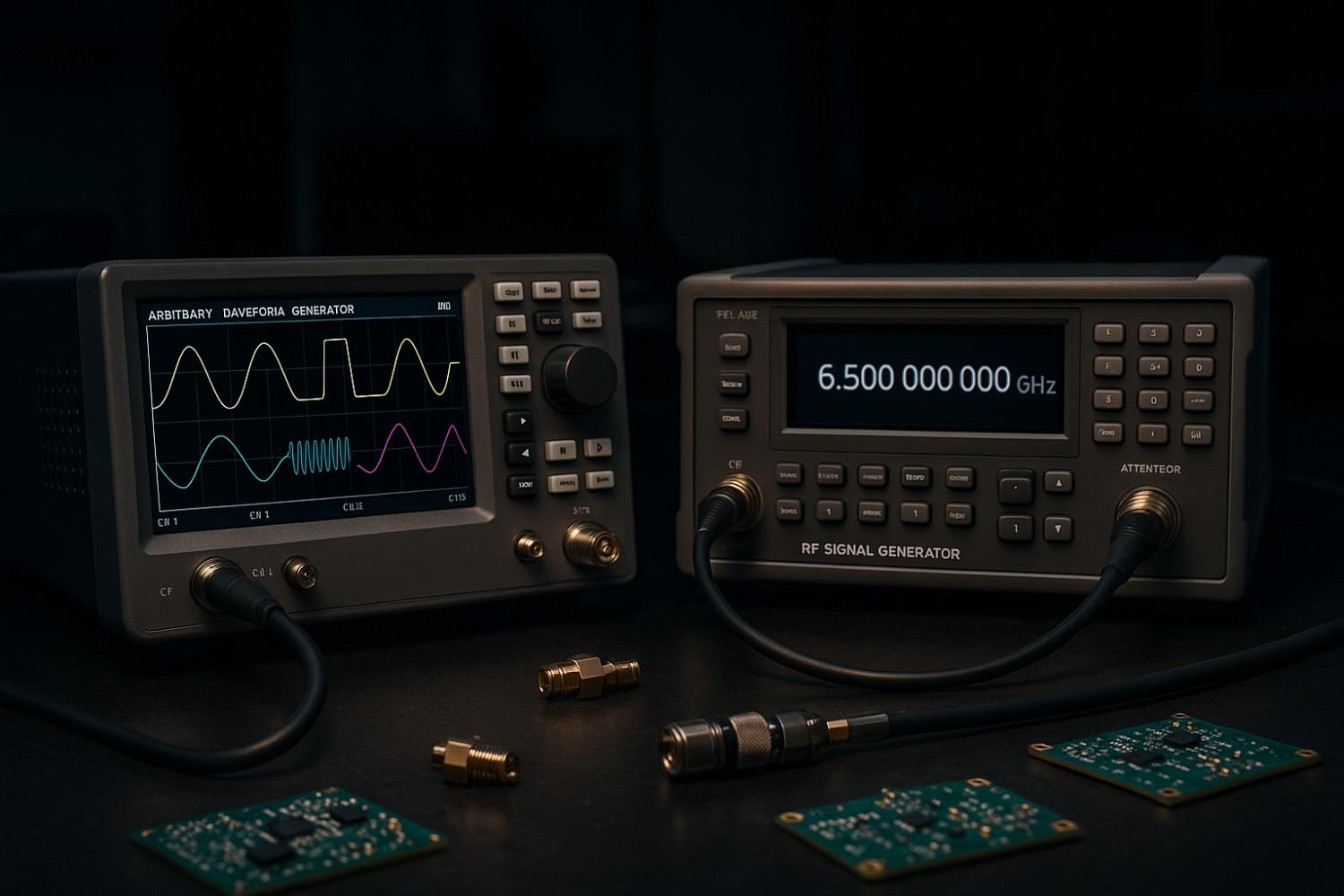
A signal generator is an electronic instrument that produces electrical signals with specific characteristics, used to test, troubleshoot, and design other electronic devices. These signals act as a stimulus, allowing engineers to verify performance and uncover potential flaws before a product ever reaches the market.
In today's complex world of electronics, the lines between different types of signal generators have started to blur. Datasheets are packed with specifications, and it’s easy to get lost in the details of sample rates, phase noise, and modulation bandwidths. But choosing the right instrument isn’t about finding the one with the "best" specs on paper. It's about understanding the core design philosophy behind the instrument and matching it to the job you need to do.
This guide will cut through the noise. We’ll explore the two fundamental philosophies of signal generation, flexibility and purity, and show you how they are embodied in the world-class solutions from our partners, Tabor Electronics and Anritsu. By the end, you'll have a clear, application-driven framework to help you select the perfect tool for your next project.
The Two Philosophies of Signal Generation: What's the Real Difference?
At the highest level, every signal generator creates a signal. But how it creates that signal and what aspects of the signal it prioritizes are what separate the different classes of instruments. The most fundamental distinction is between a Waveform Generator, which is designed for flexibility, and an RF Signal Generator, which is designed for purity.
Think of it like this: a Waveform Generator is a master sculptor's toolkit, capable of creating any shape imaginable, from a perfect sphere to the most intricate, abstract form. An RF Signal Generator, on the other hand, is like a precision-calibrated tuning fork, engineered to produce one perfect, unwavering, and pure note. Both are exceptional tools, but you wouldn't use a tuning fork to sculpt a statue, and you wouldn't use a chisel to tune a piano.
The Waveform Generator: The Architect of "What If?"
The modern Waveform Generator, and specifically the Arbitrary Waveform Generator (AWG), is the ultimate tool for flexibility. Its primary purpose is to generate virtually any waveform you can define.
- Core Technology: AWGs are digital instruments at heart. They use a technique called Direct Digital Synthesis (DDS), where a digital description of the waveform is stored in memory as a series of voltage-time data points. This data is then fed through a high-speed digital-to-analog converter (DAC) to create the final analog signal.
- Primary Virtue: Its strength lies in the time domain. An AWG is optimized to perfectly recreate a specific shape over time. This allows engineers to create complex, non-standard, and real-world signals to test how a device will respond under unpredictable conditions.
- Key Question it Answers: "How does my device perform when I hit it with this specific, complex, or distorted signal that it might encounter in the real world?"
AWGs are essential for research and development, where engineers need to simulate "what if" scenarios, from recreating a noisy communication channel to generating the precise pulse sequences needed to control a quantum computer.
The RF Signal Generator: The Guardian of Purity
In contrast, a Radio Frequency (RF) Signal Generator is built with one primary goal in mind: to produce an exceptionally clean and stable high-frequency sine wave, also known as a carrier wave.
- Core Technology: High-quality RF generators rely on a stable reference oscillator and a Phase-Locked Loop (PLL) circuit to generate a signal with incredible frequency precision. This signal is then carefully amplified and filtered to remove unwanted noise and distortion.
- Primary Virtue: Its strength lies in the frequency domain. An RF generator is optimized for spectral purity, meaning extremely low phase noise, harmonics, and spurious signals.
- Key Question it Answers: "How does my RF component or system perform when stimulated by a perfect, clean, and stable carrier signal?"
RF signal generators are the workhorses for validation and conformance testing. They provide the "golden reference" signal needed to verify that components like amplifiers, mixers, and receivers meet their design specifications and comply with industry standards.
Tabor Electronics: Mastering the Art of the Arbitrary
At Revine Technologies, we partner with global leaders who are true specialists in their domain. When it comes to waveform flexibility and the simulation of complex, real-world environments, Tabor Electronics is an undisputed leader. Their entire design philosophy is centered on creating instruments that can generate any signal imaginable, making them the architects of the arbitrary.
The Proteus Series: More Than a Generator, It's a Reality Simulator
Tabor's flagship Proteus series is the ultimate embodiment of waveform flexibility. It's not just a signal generator; it's a complete signal environment simulator designed for the most demanding R&D applications.
- Direct-to-RF Architecture: The Proteus series is a true RF Arbitrary Waveform Generator. It uses a high-speed DAC and an internal digital up-converter to generate complex modulated RF signals directly. This all-digital approach eliminates the analog impairments like I/Q mismatch that can plague traditional systems, resulting in a cleaner, more accurate output.
- Real-Time Data Streaming: While it has a massive onboard memory, one of its most powerful features is the ability to stream waveform data directly from a PC to the instrument's FPGA in real-time. This allows for the creation of infinitely long, non-repeating, and dynamically changing scenarios, perfect for simulating a real-world electromagnetic environment.
- Arbitrary Waveform Transceiver (AWT): The Proteus can be configured as a transceiver, integrating both a signal generator (DAC) and a digitizer (ADC) in one box. Both are controlled by a single FPGA, enabling a low-latency, closed-loop feedback system. This means the instrument can generate a signal, capture the response from a device under test, and modify its subsequent output in real-time.
When to Choose Tabor: For the Innovators and Explorers
Most experts agree that for cutting-edge research and development, the ability to simulate reality is paramount. The Tabor Proteus series is the ideal choice for applications where you need to create complex, dynamic, and multi-channel environments.
- Quantum Computing: The ability to generate precise, multi-channel, phase-coherent pulse sequences with low jitter is essential for controlling qubits.
- Electronic Warfare (EW) & Radar: The Proteus excels at simulating dense battlefield environments with multiple, overlapping, and dynamically changing threat signals to test the robustness of radar and communication systems.
- Advanced Communications R&D (5G/6G): For researchers developing next-generation wireless standards, the Proteus provides the ultra-wide bandwidth and flexibility needed to experiment with new modulation schemes before standardized test solutions even exist.
The Bottom Line: Choose Tabor when your primary task is simulation and discovery. If you need to answer the question, "How will my system perform in a complex, unpredictable, and dynamic real-world environment?" the Proteus series is your answer.
Anritsu: The Gold Standard for Purity and Precision
For decades, Anritsu has been a pillar of the test and measurement industry, building a global reputation for instruments that deliver uncompromising accuracy, stability, and reliability. When it comes to RF signal generation, Anritsu's design philosophy is focused on one thing: providing the purest, most precise, and most trustworthy signal possible. They are the guardians of the golden standard.
The Rubidium™ Series: When Absolute Purity is Non-Negotiable
For applications where the quality of the stimulus signal is the limiting factor in your measurement, there is no substitute for the Anritsu Rubidium™ MG362x1A series.
- Atomic Clock Stability: Its defining feature is an optional internal rubidium atomic clock, which provides a level of long-term frequency stability that is simply unmatched by conventional oscillators. This virtually eliminates frequency drift, making it an ideal frequency reference for metrology and calibration labs.
- Industry-Leading Phase Noise: The Rubidium series is engineered from the ground up to deliver the lowest possible phase noise (e.g., −140 dBc/Hz at 10 GHz) and best-in-class performance for harmonics and spurious signals. This ensures that when you test a high-performance component, you are measuring the device's performance, not the imperfections of your signal source.
The MG3710E Vector Signal Generator: The Efficiency Expert for Conformance Testing
While the Rubidium series focuses on ultimate purity, the Anritsu MG3710E is a versatile Vector Signal Generator (VSG) optimized for efficient, standards-based testing in validation and manufacturing environments.
- Turnkey Standards Compliance: The MG3710E comes with a vast library of pre-configured waveform patterns for all major wireless standards, including 5G NR, LTE, and WLAN. This allows you to set up complex, standards-compliant tests in minutes, not days.
- Dual RF / Dual Waveform Capability: A single MG3710E can be configured with two independent RF outputs and up to four independent waveform memories. This allows it to replace multiple synchronized signal generators in complex receiver tests (like blocking or intermodulation tests), dramatically simplifying the test setup, reducing costs, and improving measurement speed.
When to Choose Anritsu: For Validation and Conformance
Choose an Anritsu signal generator when your primary task is validation and verification. If you need to prove that your device meets its design specifications and complies with industry standards, Anritsu provides the clean, reliable, and accurate reference signal you need.
- 5G/LTE Conformance Testing: The MG3710E is the perfect tool for running standards-based tests on base stations and mobile devices, providing validated waveforms and the dual-signal capability needed for critical receiver tests.
- High-Performance Component Characterization: When measuring the distortion or noise figure of a high-end amplifier or mixer, the ultra-pure signal from the Rubidium series ensures your measurements are accurate and trustworthy.
- High-Throughput Manufacturing: With its fast switching speed and reliable performance, the MG3710E is ideal for automated test environments where speed and repeatability are key to profitability.
The Application Showdown: Matching the Right Tool to Your Task
To make the choice even clearer, let's look at a few real-world scenarios. The best choice is always driven by the application.
Why Most Signal Generator Choices Go Wrong
A common pitfall we see is engineers choosing a generator based on a single headline specification, like maximum frequency, without considering the instrument's core architecture. Buying a highly flexible and more complex Arbitrary Waveform Generator to perform simple, repetitive conformance tests is often inefficient. Conversely, trying to use a standard RF signal generator for cutting-edge research that requires dynamic, arbitrary signals can be incredibly limiting. The key is to match the instrument's design philosophy to your primary goal.
Here is a decision matrix to help guide your choice:
|
Application / Task |
Primary Signal Requirement |
Tabor Proteus Series Strength |
Anritsu (Rubidium/MG3710E) Strength |
RevineTech's Recommendation |
|
Electronic Warfare / Radar Environment Simulation |
Dynamic, multi-emitter, phase-coherent, wideband arbitrary signals. |
Reality Simulation: Real-time streaming and multi-channel architecture create complex, non-repeating scenarios. |
High-purity signals, but less suited for dynamic, multi-emitter environment creation in a single unit. |
Tabor: For simulating complex, real-world RF environments. |
|
5G/LTE Receiver Conformance Testing |
Standards-compliant, modulated signals (e.g., 5G NR, LTE) and interferers. |
Can generate arbitrary waveforms but requires user creation of standards-based signals. |
Conformance Validation: Turnkey solution with pre-installed, validated waveforms and dual-signal capability for simplified receiver testing. |
Anritsu: For efficient, repeatable, standards-based validation. |
|
Quantum Computing / Physics Research |
Multi-channel, complex, low-jitter pulse sequencing with real-time feedback. |
Ultimate Flexibility: AWT architecture with integrated DAC/ADC and FPGA enables low-latency, closed-loop control. |
Not designed for this level of arbitrary sequencing or real-time feedback control. |
Tabor: For advanced R&D requiring custom pulse control and feedback. |
|
High-Performance Component Characterization (ADC, Mixer) |
Ultra-low phase noise and high spectral purity (low harmonics/spurious). |
Excellent phase noise and spurious performance. |
Golden Reference: Industry-leading phase noise and stability (Rubidium series) ensure the source does not limit the measurement. |
Anritsu: When the absolute purity of the stimulus signal is the most critical parameter. |
|
Automotive Radar Target Simulation |
Generation of multiple, delayed, and Doppler-shifted chirp signals. |
Scenario Generation: Multi-channel and sequencing capabilities are ideal for creating complex, multi-target scenarios. |
Can generate clean chirp signals, but less optimized for simulating complex multi-target environments. |
Tabor: For advanced, multi-target, and clutter simulation in R&D. |
|
High-Throughput Manufacturing Test |
Fast frequency/amplitude switching, high reliability, and repeatable, standard signals. |
High-performance but may be overly complex for simple go/no-go testing. |
Efficiency & Speed: Fast switching speed and turnkey waveform libraries are optimized for reducing test time in production. |
Anritsu: For high-volume manufacturing where speed and reliability are key. |
Your Partner in Precision: How RevineTech Helps You Choose
As you can see, the choice between Tabor and Anritsu isn't about which is "better," it's about which is the right tool for your specific challenge. At Revine Technologies, our role is to be more than just a distributor; we are your technology partner. Our team of experienced application engineers doesn't just sell products; we provide solutions.
We work with you from the very beginning, offering pre-sales consultations to understand your technical needs and industry goals. We help you configure the right system, provide installation and training, and offer comprehensive post-sales support, including calibration and repair services, to ensure your investment delivers value for years to come. Our mission is to empower India's engineers and innovators with the world's best tools, helping you accelerate development, reduce time-to-market, and solve real-world design challenges.
The Final Takeaway: Which Signal Generator is Best for You in 2025?
The decision between a waveform generator and an RF signal generator comes down to a simple question: Is your primary goal simulation or validation?
- If you are in R&D, exploring new technologies, and need to simulate complex, real-world environments with maximum flexibility, a Tabor Proteus Arbitrary Waveform Generator is your ideal solution.
- If you are in the validation or manufacturing phase, verifying performance against standards, and need a "golden reference" signal with the highest purity and reliability, an Anritsu RF Signal Generator is the right choice.
Choosing the right instrument can be the difference between a project that succeeds and one that stalls. Don't make that decision alone.
Is your project focused on simulating the unknown or validating against the known? Contact our application experts at Revine Technologies today. Let's discuss your unique challenge and configure the perfect solution from our world-class Tabor and Anritsu portfolio.