
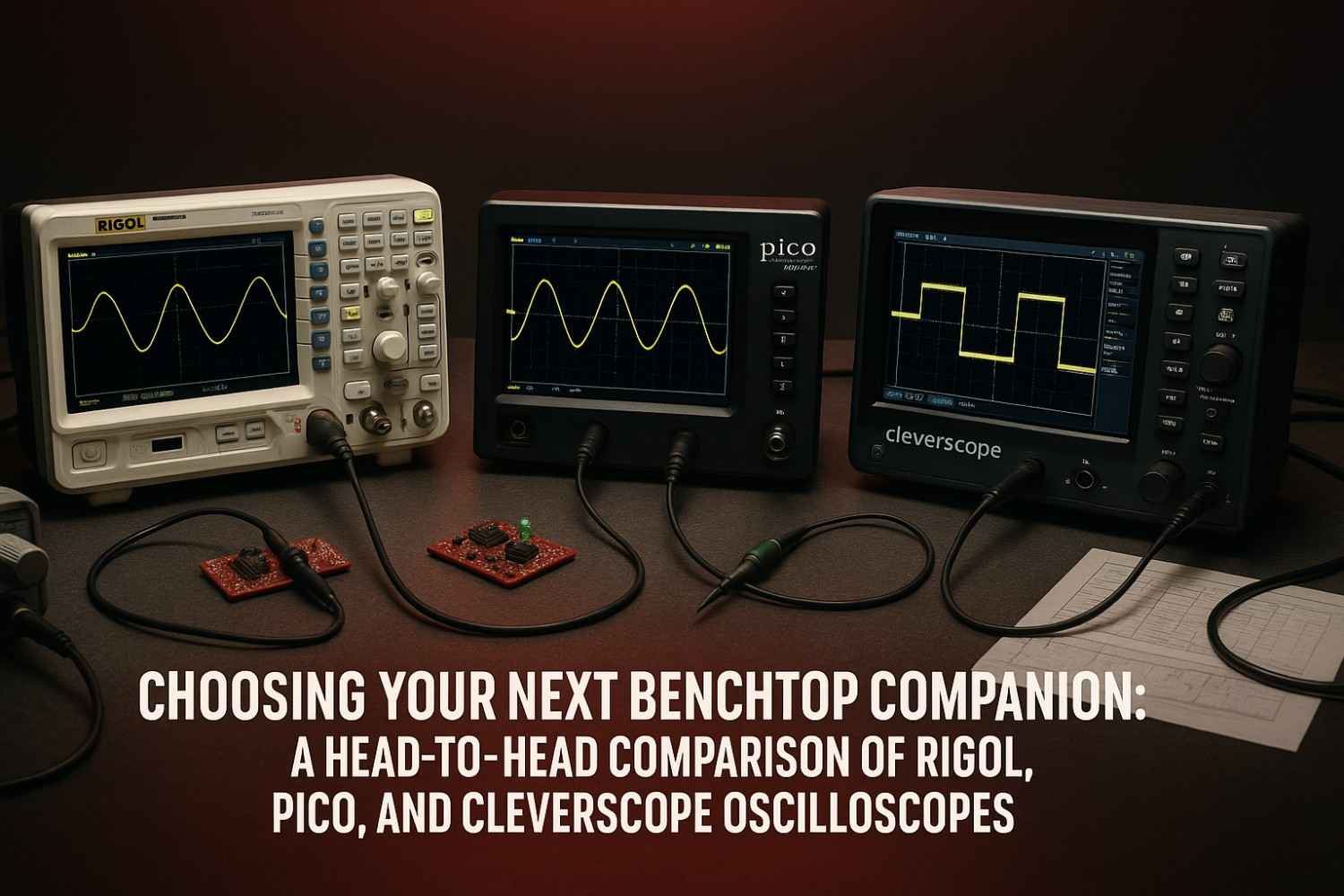
Choosing an oscilloscope used to be simple. You’d look at the bandwidth, the channel count, and the price tag. Today, the decision is far more complex. It's not just about specs; it's about choosing a design philosophy that matches your workflow, your application, and your safety requirements.
This guide is designed to help you navigate this new landscape. We will take a deep, factual dive into three of the most significant players in the market today: Rigol, Pico Technology, and our specialised partner, Cleverscope. Each one represents a different approach to test and measurement, and the "best" choice is the one that is truly the right tool for your specific job.
Three Contenders, Three Philosophies: An Executive Overview
Before we get into the technical details, it's important to understand the core identity of each manufacturer. Most experts in the field would agree that they fall into three distinct categories:
- Rigol: The Value Vanguard. Rigol has built its global reputation on a simple but powerful strategy: deliver an incredible amount of performance and features at a price that is hard to ignore. They excel at making advanced capabilities accessible to everyone, from hobbyists to budget-conscious professional labs, all within the familiar package of a traditional benchtop oscilloscope.
- Pico Technology: The Software-First Innovator. Pico pioneered the PC-based oscilloscope. Their philosophy is that the real power of an instrument lies not just in the hardware that acquires the signal, but in the software that analyses it. They provide a compact hardware device that connects to your computer, unlocking a powerful and constantly evolving software ecosystem that is included for free.
- Cleverscope: The Indispensable Specialist. Here at Revine Technologies, we partner with companies that solve the toughest engineering challenges. Cleverscope is a perfect example. They focus with laser-like precision on one of the most demanding and dangerous areas of modern electronics: high-voltage power electronics. Their instruments are engineered from the ground up with safety and signal integrity features, like true channel-to-channel isolation, that are not just optional extras but fundamental necessities for this line of work.
The Manufacturers: Understanding Their DNA
A company's history and design philosophy directly influence the products they create. Understanding where these brands come from helps explain the tools they offer today.
Rigol: The Value Vanguard
Founded in Beijing in 1998, Rigol Technologies has grown into a major global force in the test and measurement industry. Their mission is clear: to challenge the established order by offering high-performance test equipment at extremely competitive prices. They have successfully captured a huge segment of the market by redefining what engineers can expect for their money.
How do they achieve this? A key part of their strategy is a massive investment in their own technology. Rigol designs its own custom computer chips (ASICs) that form the core of their oscilloscopes. This is similar to how Apple designs its own processors for the iPhone. By controlling the core technology, Rigol can integrate advanced features at a much lower cost than competitors who rely on off-the-shelf parts. This is how they were able to launch the DHO800 series, bringing high-resolution 12-bit measurement capabilities to the entry-level market—a move that has forced the entire industry to take notice.
Beyond oscilloscopes, Rigol offers a complete range of benchtop equipment, including spectrum analysers, power supplies, and waveform generators, making them a popular choice for outfitting entire labs.
Pico Technology: The Software-First Innovator
Pico Technology, a British company founded in 1991, was one of the very first companies to bet on the PC-based oscilloscope. Their core idea was that the computer on every engineer's desk—with its large, high-resolution screen, powerful processor, and massive storage—was a far better platform for analysing signals than the small screen and limited processor inside a traditional scope.
When you buy a PicoScope, you are buying into an ecosystem. The hardware is a compact, USB-powered device that captures the signal, but the magic happens in the PicoScope software, which is free and updated for life. Features that other brands often charge for as expensive upgrades, like decoding for over 20 different communication protocols (such as I2C, SPI, and CAN), are included as standard.
This software-centric approach has allowed them to build a very strong and loyal following. They also provide a free Software Development Kit (SDK), which allows engineers to write their own custom programs to control the scope using languages like Python or tools like MATLAB. This focus on software and automation has made them particularly dominant in the automotive diagnostics field, where they offer specialised kits with guided tests and a huge library of reference waveforms for technicians.
Cleverscope: The Indispensable Power Electronics Specialist
Cleverscope, a New Zealand-based company founded in 2004, was started by engineers with years of hands-on experience in industrial control and power systems. Their design philosophy is simple and direct: "Fitness for purpose". They don't try to compete with everyone on every feature. Instead, they aim to build the absolute best tools for a very specific and challenging niche:
high-voltage, isolated-channel measurements for power electronics.
The rise of new technologies like Gallium Nitride (GaN) and Silicon Carbide (SiC) semiconductors has changed power electronics forever. These components allow for much higher voltages and incredibly fast switching speeds. This is where traditional oscilloscopes, including those from Rigol and other major brands, become not just inadequate, but dangerous.
A standard scope has all its input channels connected to a common ground, which is tied to earth ground. If you try to measure a "high-side" signal (like the gate drive of a MOSFET that is floating at 400 volts), the ground clip of your probe will create a direct short circuit. This can instantly destroy your device under test and your oscilloscope. The standard workaround is to use an expensive external differential probe, but even these can struggle with the extreme noise and high-speed signals in modern power converters.
Cleverscope’s solution was to re-engineer the oscilloscope itself. Their flagship CS548 system has galvanic isolation built into every single channel. This means each channel is electrically separate from all other channels and from ground. This isn't an add-on; it's the core of their design. This architecture makes it possible to safely and accurately measure these difficult signals. For engineers working on electric vehicles (EVs), solar inverters, or advanced power supplies, a Cleverscope isn't just another option; it's often the only tool that is truly fit for the job.
Form Factor Face-Off: The Benchtop vs. The PC-Hosted Paradigm
The physical design of an oscilloscope has a huge impact on how you work. The choice between a classic all-in-one benchtop unit and a compact PC-based system is a choice between two different workflows.
The Traditional Benchtop (Rigol): The Comfort of Knobs and Buttons
The benchtop scope, which is Rigol's entire lineup, is the classic form factor for a reason. Its biggest advantage is its immediacy. Having dedicated physical knobs for volts/div and time/div, and buttons for triggering and measurements, provides a fast, tactile experience that many engineers find very efficient for quick debugging.
It is a self-contained appliance. You press the power button and start measuring in seconds. You don't have to worry about your computer's operating system, software updates, or a virus scan suddenly interrupting your work. This makes it perfect for a shared university lab or a production line where you just need to quickly check if a signal is present and correct.
However, there are downsides. The built-in screens are smaller and lower resolution than a typical computer monitor, making it harder to see fine details. Getting data off the scope for a report often involves a USB stick, which can be a bit clumsy. And, of course, a benchtop scope takes up valuable space on your workbench.
The PC-Based Instrument (Pico, Cleverscope): The Power of Your Computer
The PC-based model, used by both Pico Technology and Cleverscope, treats the scope as a peripheral for your computer. Its greatest strength is leveraging the power of the PC you already own. Waveforms are displayed on your large, high-resolution monitor, which is a massive advantage for inspecting complex signals.
The PC's powerful processor and memory allow for incredibly sophisticated software features, like managing very deep memory captures or decoding multiple serial buses at once without slowing down. Data is already on your PC, so saving it, sharing it with a colleague, or importing it into Excel or MATLAB is incredibly simple. The hardware units themselves are small, lightweight, and often powered by the USB port, making them extremely portable.
This approach has its own challenges. You are dependent on a host PC, which means dealing with software installation and potential driver issues. Using a mouse and keyboard can feel slower for simple adjustments compared to turning a physical knob. A critical safety consideration, especially with non-isolated USB scopes, is the risk of creating a ground loop through the USB cable to your PC, which could damage both the scope and your computer if you're not careful.
A Technical Deep Dive: Comparing the Critical Specs
While philosophy is important, the final decision often comes down to the numbers. Let's compare these brands on the specifications that truly matter in 2024 and beyond.
Why 12-bit is the New 8-bit: The Resolution Revolution
For years, the headline specification for any scope was bandwidth. But a new battleground has emerged: vertical resolution. This determines how precisely the scope can measure voltage.
- 8-bit Resolution: This has been the standard for decades. It divides the vertical range into 28 = 256 levels. This is fine for looking at many digital signals, but it struggles to see small details. Most older scopes and many of Pico's general-purpose lines are 8-bit.
- 12-bit Resolution: This provides 212 = 4096 vertical levels. That's 16 times more detail than an 8-bit scope. It allows you to see tiny signals (like millivolts of ripple) on top of a larger voltage (like a 5V power rail) with stunning clarity. Rigol's DHO800 series made waves by offering 12-bit resolution at an entry-level price. Pico's automotive scopes also feature 12-bit resolution, which is critical for seeing the subtle details in sensor signals.
- 14-bit Resolution: This is the domain of high-precision instruments like the Cleverscope CS548, offering 214 = 16,384 vertical levels. This isn't for general use; it's for applications where extreme accuracy is essential. For example, when calculating the efficiency of a power converter, you need to precisely measure both large voltages and small currents at the same time. The incredible detail and low noise of a 14-bit system are required for these critical measurements.
The Most Important Spec You’re Ignoring: Isolation
This is arguably the most critical and least understood specification, with huge implications for your safety and the accuracy of your measurements.
- Standard Common Ground (Rigol): Like almost all benchtop scopes, Rigol's instruments have all their channel grounds connected together and to the mains earth. This is fine for measuring signals that are already referenced to ground. To measure anything that is "floating," you must use an external (and often very expensive) differential probe.
- Floating Inputs (PicoScope Automotive): Pico's automotive scopes, like the 4425A, have "floating inputs". The ground terminals of the input channels are not connected to the USB ground. This is a fantastic feature for automotive work, as it lets you safely measure things like the voltage drop across a starter motor cable. However, there is a limit to how much voltage can be between the channel grounds (typically 30V), so this is not suitable for high-voltage power electronics.
- True Galvanic Isolation (Cleverscope): The Cleverscope CS548 is in a different league. Each channel is galvanically isolated from every other channel and from ground, rated for up to 2kV. This is achieved using a complex internal design with isolated power supplies and high-speed optical data links for each channel. This true isolation provides the highest level of safety and an incredibly high Common Mode Rejection Ratio (CMRR), which is the ability to reject unwanted noise. This is absolutely essential for getting a clean and accurate measurement of a high-side gate drive in a noisy power converter.
Head-to-Head: A Comparative Specification Matrix
To make things clearer, let's compare three representative models. Each one is a perfect example of its manufacturer's philosophy and target market.
|
Feature |
Rigol DHO804 (Entry/Value) |
PicoScope 4425A (Automotive) |
Cleverscope CS548 (Power Electronics) |
|
Form Factor |
Benchtop |
PC-Based (USB) |
PC-Based (USB/Ethernet) |
|
Bandwidth |
70 MHz |
20 MHz |
200 MHz |
|
Channels |
4 Analog |
4 Analog |
4 Analog (expandable to 16) |
|
Vertical Resolution |
12-bit |
12-bit (16-bit enhanced) |
14-bit |
|
Max Sample Rate |
1.25 GSa/s (1-ch) |
400 MSa/s (1-ch) |
500 MSa/s (per channel) |
|
Memory Depth |
25 Mpts |
250 M samples |
250M Samples |
|
Key Differentiator |
Price/Performance, 12-bit at low cost |
Floating Inputs, PicoBNC+ Smart Probes |
2kV Channel-to-Channel Isolation |
|
CMRR |
N/A (Common Ground) |
N/A (Floating Inputs, 30V limit) |
>100 dB @ 50 MHz |
|
Target Application |
Hobbyist, Education, General Bench |
Automotive Diagnostics |
Power Electronics, EV, Industrial |
|
Approx. Price (USD) |
~$375 |
~$1,635 (Scope only) |
~$10,800 (4-ch system) |
The User Experience: It’s All About the Software
The software is how you interact with your scope. A powerful hardware platform can be let down by a clunky or buggy interface.
- Rigol’s UltraVision II: Rigol's modern platform is a hybrid system, combining a responsive touchscreen with the traditional knobs and buttons engineers know and love. It packs a lot of analysis tools directly into the instrument. However, some users on forums like EEVBlog have noted that new models can have firmware bugs when they are first released, which are usually fixed over time with updates.
- PicoScope 7 Software: The PicoScope software is the company's crown jewel. It is available for Windows, macOS, and Linux and is famous for its power and stability. Users consistently praise how smoothly it handles huge data captures, allowing you to zoom and pan through millions of samples without any lag. It includes a huge number of features as standard, and its automation capabilities are considered by many to be far superior to any benchtop scope in its price class.
- Cleverscope’s Application Suite: The Cleverscope software is a tool for professionals. It is not designed to be flashy; it is designed to be powerful. It includes unique, indispensable features for power electronics engineers, like a built-in Frequency Response Analyser (FRA) for testing the stability of power supplies, and the ability to stream data live into MATLAB or Excel for custom real-time analysis. While some users find the interface a bit "klunky," they agree that its specialised capabilities are unmatched and essential for their work.
The Final Showdown: Which Scope is Right for Your Application?
The best way to choose is to match the instrument to your primary job.
For the University Lab, Hobbyist, and Budget-Conscious Pro
- Recommendation: Rigol (e.g., DHO804)
- Why: For this group, the price-to-performance ratio is king. Rigol is the clear winner here. The legendary DS1054Z was the go-to choice for years, and the new DHO804 continues that legacy by offering 12-bit resolution and a modern touchscreen interface at an incredibly low price. Its all-in-one benchtop form is perfect for a shared lab or home workshop.
For the Automotive Diagnostic Guru
- Recommendation: PicoScope (Automotive Kits)
- Why: This is an easy decision. The PicoScope Automotive platform is a complete diagnostic ecosystem. Hardware features like floating inputs and the smart PicoBNC+ probe system (which automatically configures the scope) save time and prevent errors. This is combined with software that has a massive library of guided tests and reference waveforms built right in. For a professional mechanic, the time saved and the accuracy gained make it a fantastic investment.
For the Power Electronics Design Engineer (EV, GaN, SiC)
- Recommendation: Cleverscope (CS548 System)
- Why: As specialists in this field, we at Revine Technologies can state this unequivocally: for high-voltage, high-frequency power electronics, safety and accuracy are everything. The Cleverscope CS548's architecture, with its true galvanic isolation between channels, is the only way to safely and accurately measure signals like high-side gate drives in modern power converters. Using a standard scope for this work is dangerous and gives you incorrect results. The Cleverscope is not just a tool; it is a required piece of safety and engineering equipment for this demanding field.
For the Embedded Systems & R&D Engineer
- Recommendation: A nuanced choice between a high-end Rigol and a PicoScope.
- Why: This depends entirely on your workflow. If your work involves a lot of interactive, real-time debugging where you are constantly probing and making quick adjustments, the tactile knobs and immediacy of a high-end Rigol benchtop scope will likely make you more efficient. If your work involves capturing long, complex data streams to find intermittent faults and then performing deep analysis on your computer, the huge memory, powerful software, and automation capabilities of a PicoScope are unbeatable.
The Final Verdict: Which Oscilloscope is Best for You in 2025?
There is no single "best" oscilloscope anymore. The best instrument is the one that fits your work.
- Choose Rigol if... your main goal is getting the most hardware performance for your money in a traditional benchtop package.
- Choose PicoScope if... your work revolves around deep data analysis, automotive diagnostics, or you need a portable and highly flexible software-driven solution.
- Choose Cleverscope if... you work with high-voltage power electronics. For these applications, its isolated-channel design is essential for safety and measurement accuracy.
By understanding these core philosophies, you can confidently choose the right benchtop companion that will not just help you get the job done, but will make you better at it.