
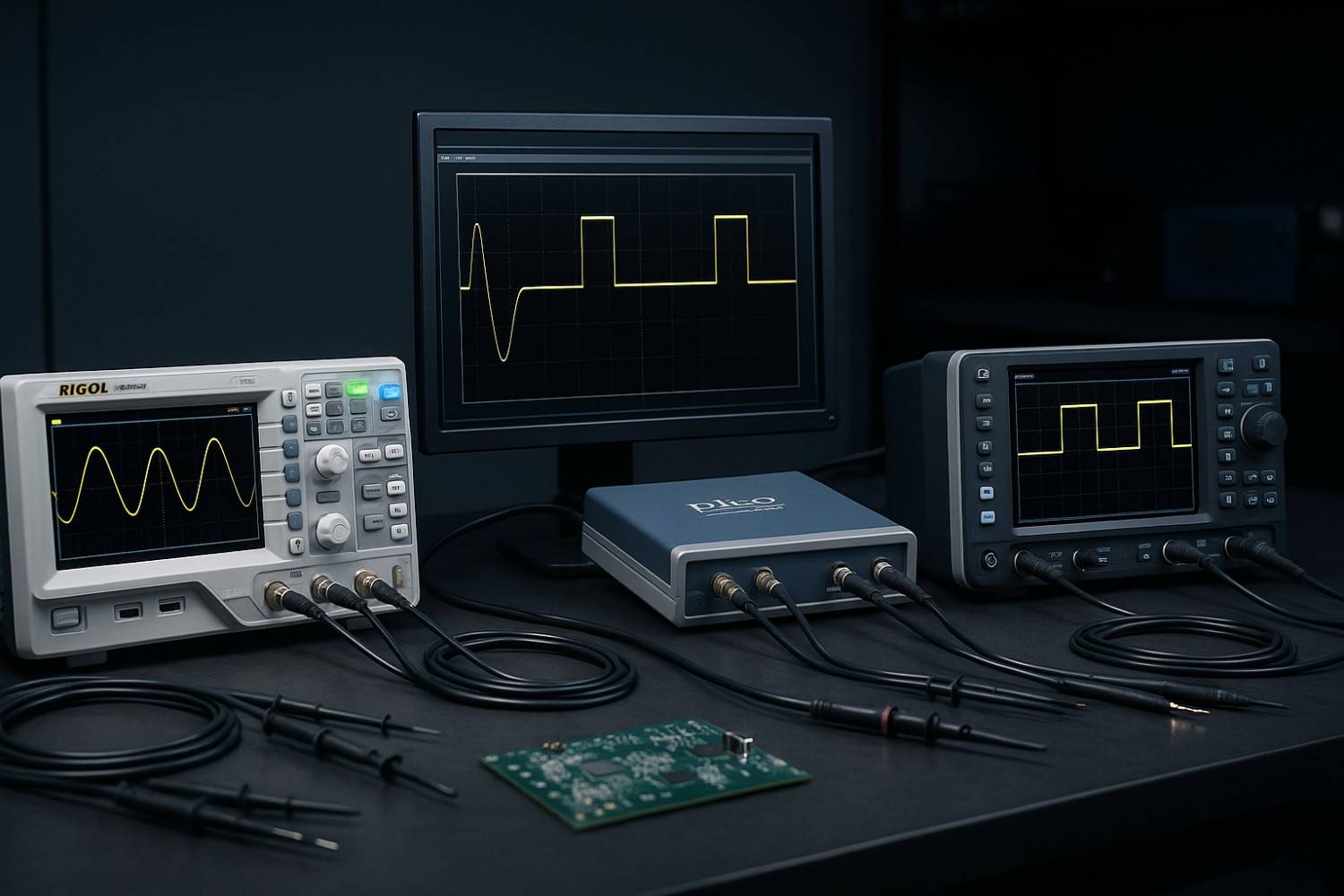
An oscilloscope is an essential tool that graphs electrical signals, allowing engineers to see how voltage changes over time. It's crucial for designing, repairing, and troubleshooting any electronic circuit, from a simple hobby project to a complex automotive system.
Here at Revine Technologies, we talk to engineers across India every single day. Whether they're building the next generation of electric vehicles, designing life-saving medical devices, or teaching in a university lab, one tool is always on their bench: the oscilloscope. It’s the single most important window into the soul of a circuit.
But the test and measurement landscape is growing. According to a 2024 report, the global oscilloscope market is projected to reach US$4.1 billion by 2030, driven by the increasing complexity of electronics in sectors like automotive, telecommunications, and healthcare. For innovators in the Indian market, this means more choices than ever before.
As a one-stop solutions provider for India's engineering challenges, our mission is to do more than just sell equipment. We partner with you to understand your projects, your challenges, and your budget to find the right tool for the job. That’s why we’re breaking down the differences between three distinct and powerful brands we work with: Rigol, Pico Technology, and Cleverscope. This isn't just a list of specs; it's a guide to help you choose the right partner for your workbench.
The First Big Decision: Benchtop vs. PC-Based Oscilloscopes
Before you even look at a brand name, you have to make a fundamental choice that defines your entire workflow. Do you want a traditional, all-in-one benchtop scope, or a compact, PC-based system? This is the philosophical divide that separates these three brands.
The Traditional Benchtop Scope: Hands-On and Immediate (Rigol's World)
The benchtop oscilloscope is the classic instrument you picture in a lab. It’s a self-contained unit with a built-in screen and a front panel full of physical knobs and buttons.
Pros:
- Tactile and Fast: For many engineers, nothing beats the muscle memory of twisting a real knob to adjust the vertical gain or horizontal timebase. It’s fast, intuitive, and ideal for live, interactive debugging.
- Standalone and Reliable: It doesn't need a PC to work. This means less clutter on your bench and no risk of a Windows update or antivirus scan interrupting a critical measurement. The dedicated hardware often gives a perception of being a more robust, "serious" tool.
Cons:
- Higher Cost for Specs: The price includes the screen, processor, and all those physical controls, making it more expensive than a PC-based scope with similar performance.
- Fixed Display: You’re limited to the built-in screen, which is often smaller and has a lower resolution than a modern computer monitor.
- Data Handling Can Be Clumsy: While modern benchtops have USB and LAN ports, getting large waveform datasets off the scope and into a report or analysis software can be more cumbersome than on a native PC system.
The PC-Based USB Scope: Powerful, Portable, and Flexible (Pico & Cleverscope's World)
A PC-based oscilloscope is a compact hardware box that connects to your computer via USB. It offloads the display, processing, and control to your PC, leveraging its power for measurement.
Pros:
- More Power for Your Rupee: By removing the expensive built-in screen and computer, these scopes offer more performance for the price. Their small size also makes them perfect for field work or a crowded bench.
- Big Screen, Big Data: You get to use your large, high-resolution PC monitor. Saving, sharing, and analyzing huge datasets, for example, by exporting directly to MATLAB or Python, is incredibly simple and powerful.
- Future-Proofed by Software: The user experience is defined by the software, which manufacturers update constantly. This means your hardware gets new features, better performance, and more protocol decoders over time, all for free.
Cons:
- Needs a Host PC: You have to factor in the cost, bench space, and maintenance of a dedicated laptop or desktop computer.
- "Clunky" Virtual Controls: For those used to physical knobs, adjusting settings with a mouse and on-screen menus can feel less immediate and more awkward during a fast-paced debug session.
- Performance Can Vary: The responsiveness of the software can depend on your PC's resources and the speed of the USB connection.
The choice comes down to your workflow. A benchtop scope is for the "live tweaker" who needs immediate, hands-on control. A PC-based scope is for the "data analyst" who needs to capture massive amounts of information for deep, offline analysis.
Deep Dive: Rigol – The Undisputed Value Champion
Founded in Beijing in 1998, Rigol Technologies fundamentally changed the test and measurement industry by delivering high-quality, feature-rich equipment at an exceptionally competitive price. This strategy has made advanced capabilities accessible to everyone. A key reason they can do this is their vertical integration, including the in-house development of their own custom ASICs (Application-Specific Integrated Circuits).
What Makes Rigol Stand Out? The UltraVision II Architecture
At the heart of Rigol's modern scopes is the UltraVision II platform, powered by their proprietary "Phoenix" chipset. This technology delivers tangible benefits:
- Deep Memory: UltraVision II provides massive memory buffers (up to 200 Mpts in the MSO5000 series). This is critical for capturing long, complex signals, like a full CAN bus packet, without losing the ability to zoom in on tiny details.
- Fast Waveform Capture Rate: With capture rates over 500,000 waveforms per second, the scope spends less time processing and more time watching the signal. This dramatically increases the chance of catching rare, intermittent glitches that are often the root cause of a system failure.
- Intensity-Graded Display: This feature visually shows how often a signal occurs at any point on the screen. Common signals appear bright, while rare anomalies appear dim, making it easy to spot intermittent problems at a glance.
Rigol's Key Products for the Indian Market
As a key partner for Rigol in India, we see three product lines that perfectly match the needs of our customers:
- DS1000Z Series (The Legend): The four-channel DS1054Z is arguably the most popular entry-level scope in the world. It offers incredible features for its price, making it the "first scope" for a generation of students, hobbyists, and startups. Its huge online community and well-known "hack" to unlock 100 MHz bandwidth create unmatched value.
- DHO800/900 Series (The Modern Contender): This is the evolution of Rigol's value offering. These scopes introduce a 12-bit Analog-to-Digital Converter (ADC), giving you 16 times the vertical resolution of older 8-bit scopes. This is a game-changer for anyone needing to analyze small signal details, like ripple on a power supply. Combined with a large touchscreen and modern USB-C power, the DHO800 series is the new standard for high-resolution at a low cost.
- MSO5000 Series (The Professional's Sweet Spot): This is a 7-in-1 powerhouse, integrating a logic analyzer, protocol analyzer, and more. With up to 350 MHz bandwidth and 16 digital channels, it's a powerful tool for debugging complex mixed-signal systems. It's the go-to choice for our customers in embedded systems, IoT, and automotive who need deep protocol analysis for buses like I2C, SPI, and CAN.
The Rigol Trade-Off: Hardware Power vs. Software Polish
Rigol's strategy is to pack as much hardware power as possible into an affordable package. This is a huge win for users. However, this focus on hardware value sometimes comes at the cost of software refinement. User feedback often points to a slow user interface, noisy fans, or occasional bugs in advanced functions like the FFT. This creates a clear opening for competitors who lead with their software experience.
Deep Dive: Pico Technology – The Software and Portability Pioneer
Pico Technology, a British company founded in 1991, created the PC-based oscilloscope category. Their strategy isn't to copy a benchtop scope on a screen; it's to leverage the PC to build a more powerful and flexible measurement ecosystem. Their dominance in specialized markets, particularly automotive diagnostics, shows how effective this approach is.
What Makes PicoScope Stand Out? The Software Ecosystem & FlexRes
Pico's greatest strength is its software and the innovative hardware that supports it.
- The PicoScope Software Ecosystem: The core of the product is the PicoScope 7 software, which runs their entire range of oscilloscopes. Their business model is revolutionary: all software features, including over 20 serial decoders, advanced math channels, and mask limit testing, are included for free with lifetime updates. This "all-inclusive" approach is a huge contrast to traditional vendors who charge extra for software options. They also provide a comprehensive Software Development Kit (SDK) with excellent support for Python, LabVIEW, and MATLAB, making it perfect for custom automation.
- FlexRes (Flexible Resolution): This brilliant hardware innovation, found in the PicoScope 5000 series, allows the scope's ADCs to be reconfigured. They can be set for maximum speed (e.g., 1 GS/s at 8-bit resolution) for digital signals, or they can be run in parallel to increase the effective vertical resolution up to 16 bits for sensitive analog measurements. This gives you multiple oscilloscopes in one box.
PicoScope's Key Product Lines
Pico's products are designed to scale from simple tasks to complex R&D.
- 2000 Series: These are ultra-compact, pocket-sized 8-bit scopes. They are perfect for hobbyists, educators, and field service technicians who need maximum portability for basic measurements.
- 3000/5000 Series: These are the professional workhorses. The 3000 series offers a great balance of performance and deep memory, while the 5000 series adds the versatile FlexRes technology. These are aimed at R&D and embedded engineers who need powerful software and the flexibility to handle both digital and analog signals.
- Automotive Diagnostic Kits: This is where Pico truly shines. These are not just scopes; they are complete diagnostic solutions. The kits bundle a PicoScope with specialized probes and leads, but the real value is in the software, which contains a massive library of guided tests and reference waveforms for thousands of specific vehicle components. This is why PicoScope is the industry standard for professional automotive technicians.
The Pico Philosophy: Software is the Product
Pico's business model treats the hardware as a high-performance key to unlock their powerful software. User reviews consistently praise the software for its stability, depth of features, and continuous free updates that add value long after the purchase. This focus on total cost of ownership and future-proofing is a powerful alternative to Rigol's focus on upfront hardware value.
Deep Dive: Cleverscope – The Specialist for Power and Isolation
Cleverscope is a highly specialized manufacturer from New Zealand, founded in 2004. They don't try to compete in the general-purpose market. Their philosophy is "Fitness for purpose," focusing on niche applications where mainstream scopes are simply the wrong tool for the job, specifically, the demanding world of power electronics.
What Makes Cleverscope Stand Out? Isolated Channel Architecture
The defining feature of Cleverscope's high-end products is their isolated channel architecture. This solves a fundamental and dangerous problem.
- The Danger of Floating Measurements: Most oscilloscopes, including standard models from Rigol and Pico, have their input channel grounds tied together and connected to earth ground. If you try to measure a "floating" signal (such as the voltage across a high-side MOSFET in a power converter) with a standard probe, you will create a direct short circuit. This can destroy your device under test and your oscilloscope.
- Cleverscope's Solution: The flagship CS548 oscilloscope features individually isolated input channels. Each channel is galvanically isolated from the others and from ground. This allows you to safely connect each probe to any two points in a circuit, regardless of their voltage potential. This is the only safe and accurate way to make simultaneous floating measurements, which is essential for analyzing motor drives, multi-phase inverters, and performing tests like double pulse testing on modern GaN or SiC transistors.
- High Vertical Resolution: To complement the isolation, Cleverscope instruments come standard with high-resolution 12- or 14-bit ADCs. This provides the dynamic range needed to see small details like ripple on top of high-voltage signals.
Cleverscope's Focused Product Line
Cleverscope's products are tightly focused on their core strengths.
- CS548 Isolated-Channel Oscilloscope: This is their flagship, designed as a complete system for power electronics R&D. It's a 4-channel, 14-bit, 200 MHz isolated scope that also includes an isolated signal generator for performing Frequency Response Analysis (FRA) to test control loop stability. The target audience is exclusively professional engineers in power electronics, EV powertrain design, and renewable energy.
- CS328A/CS320A: These are more general-purpose PC-based scopes that still emphasize high analog fidelity, offering 10, 12, or 14-bit resolution options. They are aimed at engineers working on precision analog circuits or audio systems who need better vertical resolution than a standard 8-bit scope can provide.
The Cleverscope Value Proposition: The Cost of Failure
Cleverscope doesn't compete on price; they compete on the "cost of failure." For their target applications, using a standard oscilloscope is not just a bad idea, it's dangerous. The alternative, a standard scope plus several expensive high-bandwidth differential probes, can be cumbersome and less effective. Cleverscope's value is that the upfront investment is far lower than the cost of destroying an expensive prototype or the time lost chasing bad measurements.
Head-to-Head: Making the Right Choice for Your Bench
Choosing between these three brands requires looking beyond the banner specs. The decision depends on how each brand’s philosophy aligns with your primary applications.
Why Your 8-Bit Scope Might Be Lying to You: The Importance of Vertical Resolution
This is one of the most critical, and often overlooked, specifications. It determines your ability to see fine voltage details.
- An 8-bit scope (like a Rigol DS1054Z or PicoScope 3000) divides the vertical screen into $2^8 = 256$ levels.
- A 12-bit scope (like a Rigol DHO800) uses $2^{12} = 4096$ levels.
- A 14-bit scope (like a Cleverscope CS548) uses $2^{14} = 16384$ levels.
For many digital signals, 8 bits is fine. But if you need to measure small amounts of ripple or noise on a larger DC voltage, a higher resolution scope is essential.
- Rigol: Is moving the market forward with its affordable 12-bit DHO800 series.
- PicoScope: The 5000 series with FlexRes offers the ultimate versatility, switching between 8-bit speed and up to 16-bit resolution.
- Cleverscope: Specializes in natively high resolution (12 or 14-bit standard), making them superior for applications where signal fidelity is everything.
Application-Specific Superpowers
- Embedded Systems (I2C, SPI, CAN): Both Rigol (MSO series) and PicoScope are excellent here. PicoScope often gets the edge by including more protocol decoders as standard.
- Power Electronics (Floating Measurements): Cleverscope is the only safe and appropriate choice due to its isolated channel architecture. Using a non-isolated scope for these tasks without proper differential probes is hazardous.
- Automotive Diagnostics: PicoScope is the undisputed leader with its dedicated automotive kits, which provide a complete diagnostic solution, not just a tool.
- Frequency Response Analysis (FRA): Cleverscope integrates this as a core feature, making it a specialized tool for testing the stability of power supplies and control loops.
Our Recommendations: The Right Scope for Your Job
At Revine Technologies, we believe in fitting the tool to the task. There is no single "best" oscilloscope. The right choice depends entirely on what you do.
For the Student, Hobbyist, or Budget-Conscious Startup
- Recommendation: Rigol (DS1054Z or DHO800 series).
- Why: Rigol offers an unbeatable price-to-performance ratio. The DS1054Z is a legendary starting point. For a little more, the DHO800 series brings game-changing 12-bit resolution to the entry-level market, making it perfect for learning and for more sensitive analog projects.
For the Professional Embedded Systems Engineer
- Recommendation: PicoScope (3000/5000 MSO Series) or Rigol (MSO5000 Series).
- Why: This choice depends on your preferred workflow. If you value a polished software experience, deep memory for capturing long digital bus transactions, and powerful automation capabilities, PicoScope is the superior choice. If you prefer a traditional benchtop feel and want the best hardware specs for your money upfront, Rigol's MSO5000 is an incredible value leader.
For the Automotive Diagnostic Specialist
- Recommendation: PicoScope (Automotive Kits).
- Why: This is an easy decision. PicoScope is the industry standard for a reason. They provide a complete diagnostic ecosystem with guided tests, a massive reference waveform library, and specialized probes that dramatically speeds up vehicle diagnostics. It's more than a scope; it's a solution.
For the Power Electronics R&D Engineer
- Recommendation: Cleverscope (CS548).
- Why: In this field, safety and accuracy are non-negotiable. For measuring high-side gate drives, characterizing SiC or GaN devices, or analyzing a live power converter, the isolated channel architecture of the Cleverscope CS548 is a fundamental requirement. It is the right, and only, safe tool for a high-stakes job.
Which Oscilloscope is Best for You in 2025?
Choosing an oscilloscope is a major investment. The right choice can accelerate your innovation, while the wrong one can lead to frustration and missed deadlines. We hope this guide has clarified the unique strengths of Rigol, PicoScope, and Cleverscope.
The world of test and measurement is always evolving, with new models and software updates released regularly. Check back with us every few months for the latest information.
Still not sure which path to take? That’s what we’re here for. Contact the experts at Revine Technologies today, and let our team help you find the perfect oscilloscope for your bench.