
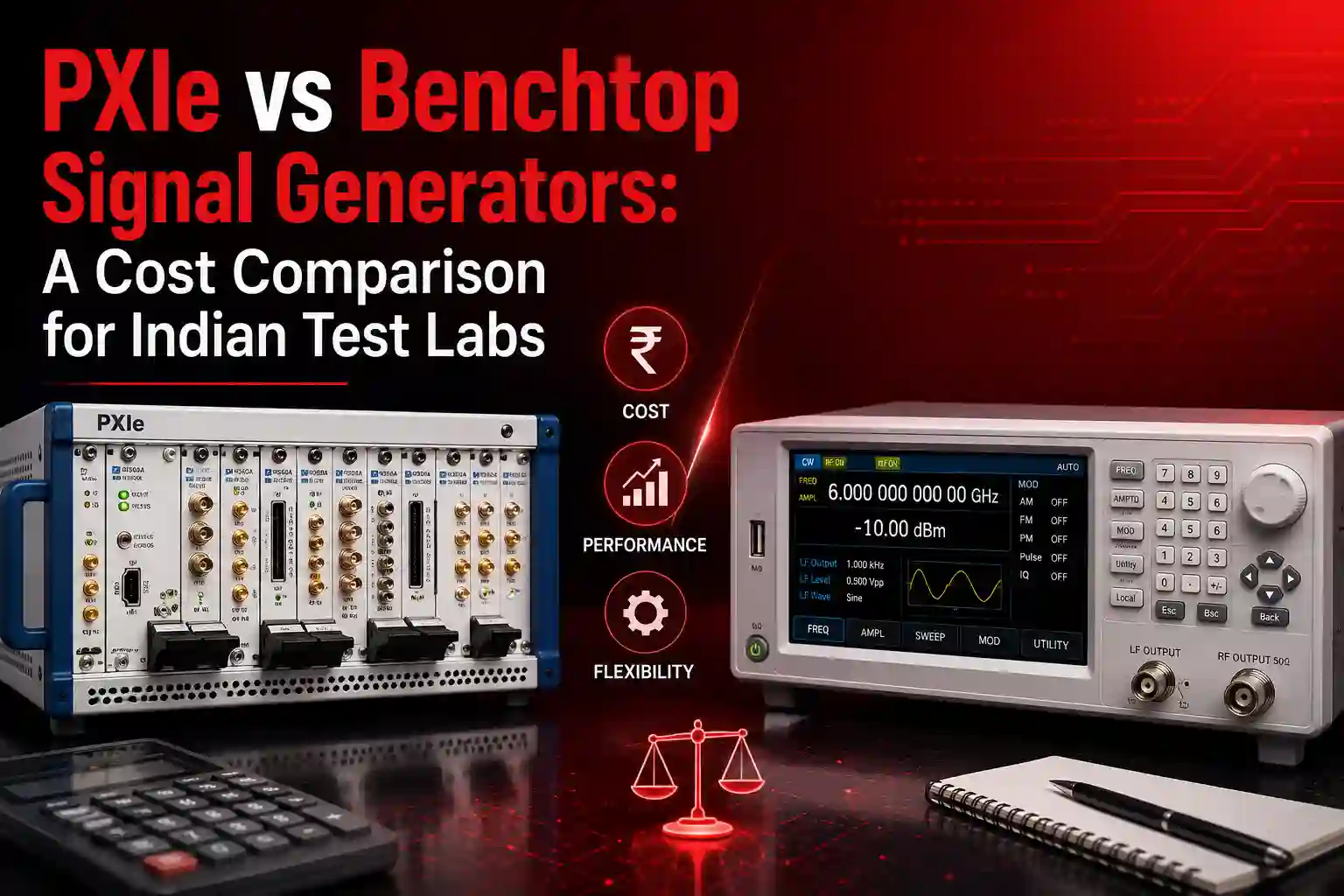
A PXIe signal generator in India can provide high channel density, automation and system-level synchronisation. However, it also requires a chassis, controller, software and integration work.
A benchtop signal generator has a simpler acquisition path. Engineers can place it on a bench and begin testing with limited infrastructure.
The lowest purchase price does not always produce the lowest long-term cost. Indian test laboratories must compare the full system lifecycle.
This guide examines benchtop versus modular instruments using cost, performance, scalability and operational factors.
What Is the Main Difference Between PXIe and Benchtop Instruments?
A benchtop signal generator is a self-contained instrument with its own enclosure, power supply and controls. A PXIe generator is a modular card installed inside a chassis. PXIe systems share power, timing, cooling and data infrastructure. This structure supports dense automated systems but adds chassis and integration costs.
A benchtop generator generally includes:
- Instrument display
- Front-panel controls
- Internal power supply
- Trigger connections
- Remote interfaces
- Standalone firmware
A PXIe module depends on the surrounding system.
That system normally includes:
- PXIe chassis
- Embedded or external controller
- System timing
- Drivers
- Test software
- Cooling
- Trigger and clock infrastructure
NI describes PXI modules as components that acquire data, generate signals and support automated measurement systems. PXI platforms also allow modules to change as test requirements evolve.
PXIe Signal Generator India Upfront Cost Structure
PXIe has a higher entry cost when a laboratory does not already own a compatible chassis and controller. The first deployment must include infrastructure, modules and software integration. Additional PXIe channels can become economical because new cards share the existing chassis, timing, power and controller resources.
The upfront PXIe cost normally includes several separate items.
Chassis Cost
The chassis provides slots, power, cooling and backplane communication.
Slot count affects future expansion. A small chassis may be cheaper initially but limit later growth.
The laboratory should reserve space for digitizers, switches and other modules.
Controller Cost
The system requires an embedded controller or an external computer connection.
An embedded controller keeps processing inside the chassis. An external controller may reduce cost when suitable computers already exist.
The selected architecture must support expected data throughput.
Signal Generator Module Cost
The module cost depends on:
- Frequency range
- Channel count
- Modulation
- Phase noise
- Output power
- Switching speed
- Waveform memory
- Digitizer options
Tabor Proteus PXIe platforms can operate as baseband, IQ or direct-RF generators. Certain configurations also support optional digitizers and FPGA processing.
Software and Driver Cost
Automated systems need stable drivers and test software.
The budget may include development environments, runtime licences, instrument options and deployment licences.
Integration labour should be treated as a project cost.
Fixtures and Signal Distribution
A multi-channel system may need:
- RF cables
- Attenuators
- Power dividers
- Switching
- Amplifiers
- Clock distribution
- Trigger distribution
- Device fixtures
These supporting items can form a significant part of system cost.
Benchtop Signal Generator Cost Structure
A benchtop signal generator usually has a lower initial system cost because it includes its own enclosure, controls and power supply. Laboratories may still require a computer, cables, switching and automation software. Benchtop costs can rise when many independent units require duplicate power, rack space, cabling and synchronisation hardware.
A benchtop instrument can be productive immediately.
This is valuable for R&D teams that frequently change test setups. Engineers can inspect the front panel and adjust settings directly.
Typical costs include:
- Instrument purchase
- Options and licences
- Calibration
- RF accessories
- Rack-mount kits
- Remote-control software
- External timing hardware
Tabor benchtop instruments can provide multi-channel generation and remote control. Some platforms include displays for operation without an external computer.
Benchtop systems become more complex when channel count increases. Each unit adds power, cooling, cabling and asset-management requirements.
Benchtop vs Modular Instruments India Cost Comparison
Benchtop instruments usually win for one to three channels, changing experiments and manual operation. PXIe often becomes more attractive for dense, automated and synchronised systems. The break-even point depends on existing infrastructure, channel count, software reuse and expansion plans. Laboratories should compare five-year ownership rather than purchase price alone.
| Cost Factor | Benchtop Generator | PXIe Generator |
| Initial entry cost | Usually lower | Usually higher |
| Chassis required | No | Yes |
| Controller required | Optional | Required |
| Front-panel operation | Usually included | Usually computer controlled |
| Channel expansion | Add complete instruments | Add modules |
| Synchronisation | External or model-specific | Backplane supported |
| Rack density | Moderate | High |
| Automation integration | Good | Strong |
| Setup flexibility | High | Moderate |
| Production repeatability | Good | Strong |
| Maintenance impact | One instrument at a time | Shared chassis can affect several modules |
| Long-term scaling | Can become expensive | Often efficient after infrastructure exists |
This comparison is directional. Actual quotations depend on frequency, performance and configuration.
A Practical Ownership Formula
Use the following structure:
Five-year cost = acquisition + integration + calibration + maintenance + downtime + expansion + software
Include engineering time in the calculation.
A cheaper instrument can create higher costs when automation requires custom work. An expensive platform can waste capital when the laboratory needs only occasional manual measurements.
When Does PXIe Provide Better Value?
PXIe provides better value when laboratories need many channels, deterministic timing, rapid data transfer or automated sequence execution. It also suits systems combining generators, digitizers and switching. Existing PXIe infrastructure improves the business case because new modules share the chassis, controller, cooling and software architecture.
High-Channel-Count Systems
PXIe increases instrument density.
Tabor Proteus modules can provide multiple generator channels within a limited slot count. The platform also supports synchronised expansion for larger systems.
This density is useful for:
- Phased-array testing
- MIMO validation
- Quantum control
- Multi-device production testing
- Semiconductor validation
- Radar simulation
Automated Test Equipment
ATE systems require repeatable execution and data handling.
PXIe allows the generator, digitizer and switch modules to share a system architecture. Software can control the entire sequence.
This reduces manual setup and operator variation.
Timing and Synchronisation
Backplane clocks and triggers can simplify synchronisation.
The exact timing performance depends on the chassis, modules and system design. Engineers should verify phase coherence and trigger latency.
Do not assume every module provides identical timing behaviour.
Production Expansion
A modular system can expand by adding modules.
This approach may reduce the cost per channel after the first system is deployed.
However, chassis slot limits and controller performance should be planned early.
When Does a Benchtop Generator Cost Less?
A benchtop generator costs less when the laboratory needs limited channels, local controls and frequent configuration changes. It also suits teams without dedicated test-software engineers. A single self-contained instrument avoids chassis costs and reduces integration work. This makes benchtop systems practical for development, education, troubleshooting and low-volume validation.
Manual R&D Work
R&D engineers often prefer visible controls.
They can change frequency, amplitude or modulation without opening test software. This improves speed during troubleshooting.
A benchtop unit can also move between projects.
Independent Laboratory Stations
Several teams may require separate instruments.
Distributed benchtop units can be more practical than one shared modular system. Each team gains direct access without scheduling a central ATE platform.
Field and Service Work
A benchtop or portable unit is easier to deploy outside a fixed rack.
PXIe can be transported, but it requires the complete chassis and controller environment.
Low-Channel-Count Tests
A single-channel or dual-channel requirement rarely justifies a new PXIe chassis.
The economics change when a compatible chassis already exists.
Hidden Costs Indian Test Labs Should Examine
Hidden test-system costs include software development, RF cabling, calibration, operator training and downtime. Laboratories must also consider spare capacity, power, cooling and support. A modular system may create shared failure points. A benchtop system may create duplicated infrastructure. These costs should appear in the procurement comparison.
Software Integration
PXIe projects usually require more initial software work.
The organisation must maintain drivers, test sequences and deployment systems. Version control and validation processes are also important.
Benchtop automation may be simpler, but multiple instruments can create communication complexity.
Calibration
Every signal-generation channel requires calibration control.
PXIe modules may need removal from the chassis for calibration. This process can affect system availability.
Benchtop instruments are easier to replace individually. However, many units create more calibration events.
Downtime and Spares
A chassis failure can affect several modules.
A benchtop failure normally affects one station. The laboratory can reduce risk through spare equipment or service agreements.
The correct strategy depends on production criticality.
Power and Cooling
High-density systems concentrate heat.
Confirm the chassis cooling capacity and laboratory environmental conditions. PXIe slot placement may affect thermal performance.
Multiple benchtop units also require rack power and airflow.
Training
PXIe users need system-level knowledge.
They must understand chassis resources, drivers, timing and software. Benchtop users can often begin with shorter training.
Training cost should be included in project planning.
Tabor PXIe, Benchtop and Rack-Mount Options
Tabor offers PXIe, benchtop and rack-mounted signal-generation formats. PXIe suits dense modular ATE systems. Benchtop instruments suit direct laboratory operation. Rack-mounted units suit fixed installations that need channel density without a PXIe chassis. Indian laboratories can use these formats separately or combine them within a hybrid test architecture.
Review Tabor PXIe modules for automated, modular and multi-channel systems.
PXIe may suit laboratories developing:
- Communication validation systems
- Radar signal simulation
- Semiconductor ATE
- Quantum research setups
- Multi-channel receiver tests
- Hardware-in-the-loop systems
Review Tabor benchtop instruments for manual R&D and flexible laboratory work.
Rack-mounted systems offer another option. Tabor’s Lucid rack platform supports multiple phase-coherent channels in a 19-inch chassis.
Explore Tabor rack-mount modules for fixed test racks and centralised systems.
Should Indian Labs Use a Hybrid Architecture?
A hybrid architecture combines modular and standalone instruments. It works well when core measurements require PXIe speed and synchronisation, while specialised tests need benchtop flexibility. The main challenge is timing and software integration. A common reference clock, trigger plan and control framework should be defined before purchasing equipment.
Many laboratories do not need an all-PXIe or all-benchtop solution.
A PXIe chassis can handle high-speed digitizers and core waveform channels. Benchtop instruments can provide specialised RF or high-voltage functions.
Rack-mounted generators can add channel density without occupying PXIe slots.
The integration plan should cover:
- Reference clocks
- Trigger routing
- Network control
- Driver compatibility
- Error handling
- Test-sequence timing
- Calibration records
Hybrid systems can control cost when designed intentionally.
Conclusion
Benchtop generators offer low entry cost and direct usability.
PXIe systems offer density, synchronisation and scalable automation. Their value increases when a compatible platform already exists.
Indian test laboratories should calculate five-year ownership cost. The assessment must include hardware, integration, calibration, downtime and expansion.
The best platform is the one that supports the required throughput without unnecessary infrastructure.
Frequently Asked Questions
The most common PXIe questions concern cost, channel count and automation. A new PXIe platform requires greater initial investment. It can reduce expansion cost in dense systems. Benchtop instruments remain economical for manual work and limited channels. The decision should consider expected use during the complete system life.
Is PXIe always faster than a benchtop instrument?
No. Performance depends on the specific module and application.
PXIe usually provides faster system communication and stronger backplane integration. Signal-generation quality still depends on the module.
How many channels justify PXIe?
There is no universal number.
PXIe becomes more attractive when channel density, synchronisation and automated throughput create measurable value.
Can benchtop generators support ATE?
Yes. Most professional benchtop instruments support remote control.
PXIe may simplify dense and tightly synchronised systems.
Should cost comparison include engineering time?
Yes. Integration and maintenance labour can exceed hardware savings.
The comparison should include software development, verification and long-term support.