
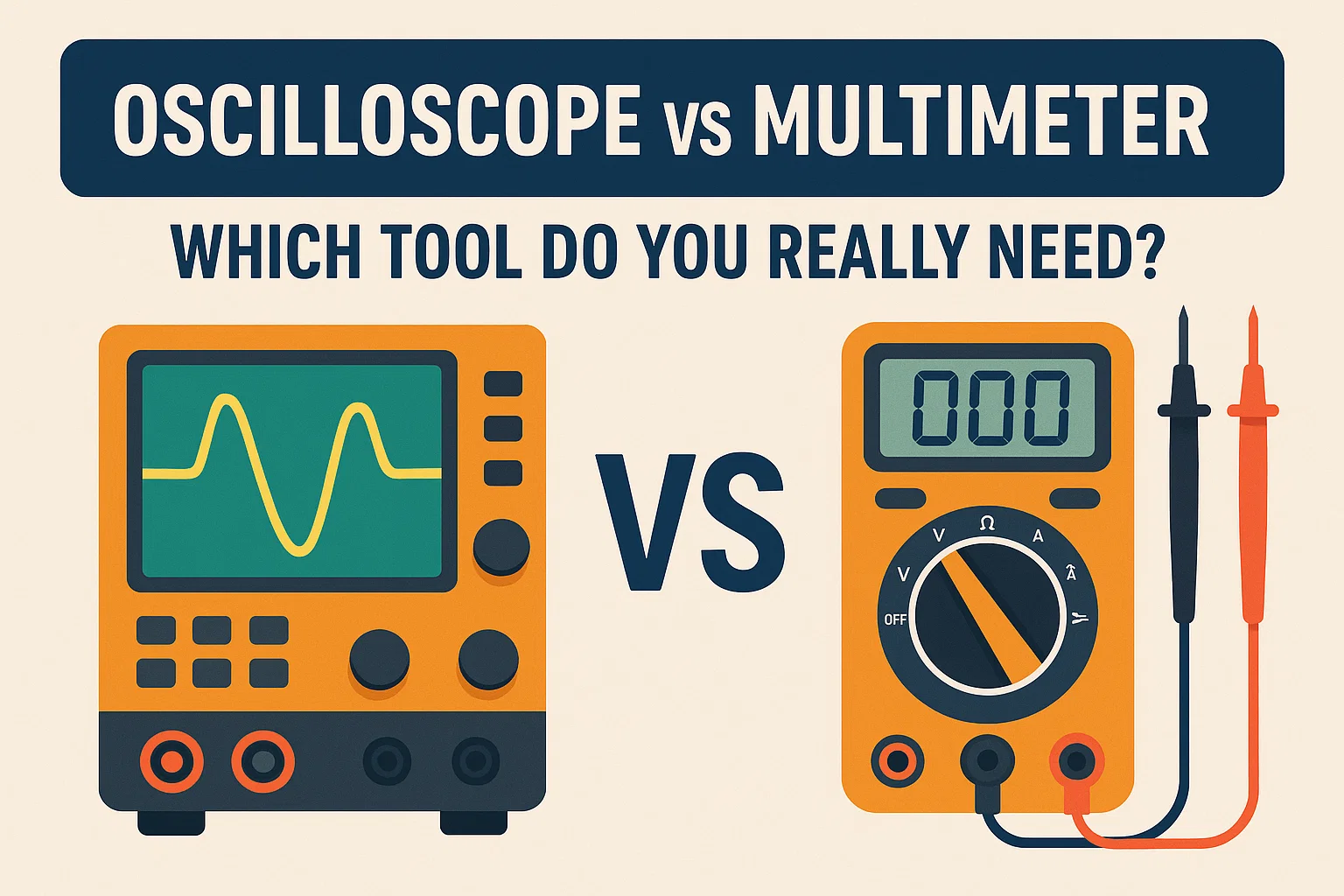
When it comes to electrical testing, two of the most common and essential tools you’ll encounter are oscilloscopes and multimeters. While both are invaluable in their respective applications, choosing the right one can often leave people scratching their heads. After all, they both measure electrical quantities, but they do so in different ways. If you are new to electrical engineering, DIY electronics, or even troubleshooting home appliances, understanding the difference between these two tools is crucial.
In this blog post, we’ll dive deep into the oscilloscope and the multimeter, comparing their features, functionalities, and which one you really need for different tasks. By the end of this guide, you’ll have a clear understanding of which tool will best suit your needs.
What is an Oscilloscope?
An oscilloscope is a device used to observe the changing signal voltages, typically as a waveform. It’s used primarily in electronics and engineering labs for testing and troubleshooting circuits. This tool is particularly useful when you need to visualize the exact waveform of an electrical signal.
How Does an Oscilloscope Work?
Oscilloscopes work by converting analog signals into a visual representation on a screen, showing voltage changes over time. The screen displays the waveform, making it easy to analyze signal patterns, frequency, amplitude, and more. Oscilloscopes can measure complex waveforms that change rapidly, something that a multimeter can’t do effectively.
They’re most commonly used in fields like:
-
Electronics design
-
Telecommunication
-
Automotive diagnostics
-
Biomedical engineering
-
R&D
Common Uses of an Oscilloscope
Oscilloscopes are particularly handy for diagnosing and designing circuits. Some common uses include:
-
Testing signal quality: Checking if the electrical signals are within specifications.
-
Measuring frequency, amplitude, and timing characteristics: Analyzing how voltage behaves over time.
-
Observing complex signals: Helpful when troubleshooting systems with intricate signal patterns.
-
Analyzing noise or distortion: Identifying electrical noise or unwanted signals in circuits.
What is a Multimeter?
A multimeter, on the other hand, is a compact device used to measure electrical properties such as voltage, current, and resistance. Unlike oscilloscopes, multimeters provide straightforward numerical readings and are ideal for simpler, less detailed electrical diagnostics. They’re easy to use, versatile, and essential in every electronics toolkit.
How Does a Multimeter Work?
A multimeter can measure three key electrical properties:
-
Voltage (Volts): Multimeters can measure both AC (alternating current) and DC (direct current) voltages.
-
Current (Amps): Measures the flow of electrical current in a circuit.
-
Resistance (Ohms): Used to test the resistance of components and circuits.
Many multimeters are also equipped with additional functions like continuity testing, diode testing, and the ability to check the battery voltage.
Common Uses of a Multimeter
Multimeters are used for:
-
Measuring voltage: Ensuring circuits are receiving the correct voltage.
-
Testing continuity: Checking if a circuit or wire is complete.
-
Measuring current and resistance: Used for testing batteries, fuses, and components in a circuit.
-
Checking electronic components: Useful for quickly checking resistors, diodes, and transistors.
Key Differences Between an Oscilloscope and a Multimeter
Now that we’ve discussed the basics of both tools, let’s dive into the main differences between an oscilloscope and a multimeter.
1. Measurement Type
-
Oscilloscope: Measures waveforms and gives a visual representation of the signal’s voltage over time. It’s ideal for analyzing complex signals and capturing the shape of the waveform.
-
Multimeter: Measures static values such as voltage, current, and resistance. It provides numerical data but lacks the ability to show dynamic signal variations.
2. Display Type
-
Oscilloscope: Uses a screen to display the waveform of the signal. This makes it useful for identifying fluctuations and anomalies in real-time signals.
-
Multimeter: Shows digital or analog readings for voltage, current, and resistance on a simple display screen.
3. Complexity
-
Oscilloscope: Requires a higher level of expertise to operate effectively. It’s more complex and can be overwhelming for beginners due to the need to interpret waveforms.
-
Multimeter: Extremely easy to use. A beginner can quickly get accurate readings for voltage, current, and resistance with minimal setup.
4. Use Case
-
Oscilloscope: Best for detailed diagnostics of complex signals, such as checking signal integrity, analyzing frequency, and observing changes over time.
-
Multimeter: Ideal for basic electrical measurements, like testing battery voltage, checking continuity, and troubleshooting power supplies in circuits.
5. Cost
-
Oscilloscope: Oscilloscopes tend to be more expensive due to their advanced features and capabilities. Prices can vary depending on bandwidth, channels, and features.
-
Multimeter: Generally more affordable and accessible for both professionals and hobbyists.
Which Tool Do You Really Need?
Choosing between an oscilloscope and a multimeter depends on what you need to measure and how detailed the measurements need to be.
Use a Multimeter If:
-
You are performing simple electrical tests like measuring voltage or current.
-
You need a tool for quick diagnostics and repairs.
-
You are working on home electrical systems, basic circuits, or automotive diagnostics.
-
You need to check the continuity of wires or test simple components.
Use an Oscilloscope If:
-
You need to analyze the waveform of an electrical signal and how it changes over time.
-
You are working with high-frequency signals or complex circuit designs.
-
You need to troubleshoot issues related to signal integrity, noise, or distortion.
-
You are in an R&D or electronics design field where precise and dynamic measurements are crucial.
Combining Both Tools
In many professional settings, both tools are used in tandem to get a complete picture of an electrical system. While a multimeter is excellent for quick checks and measurements, an oscilloscope provides a deeper understanding of how electrical signals behave. By using both, you can ensure the health of your circuits and troubleshoot more effectively.
Conclusion
In summary, oscilloscopes and multimeters are both essential tools for anyone working with electricity or electronics. Oscilloscopes are ideal for deep analysis and understanding of electrical waveforms, making them perfect for engineers and technicians working with complex systems. On the other hand, multimeters are simple, versatile tools that allow you to perform basic diagnostics and measurements quickly and easily.
Ultimately, the right tool depends on the complexity of the tasks you are working on. If you’re just starting out or dealing with basic electrical measurements, a multimeter will likely suffice. However, for more advanced work that requires a deeper understanding of signal behavior, an oscilloscope is an invaluable asset.
If you’re still unsure about which tool is right for you, consider your specific needs. Oscilloscopes are great for detailed work, while multimeters are perfect for everyday measurements. Both tools will make your life as a technician or hobbyist much easier.
Whether you choose an oscilloscope or a multimeter, both are indispensable in the world of electronics, and having both in your toolbox will make you ready for any electrical challenge that comes your way!