
Oscilloscope Meaning: What an Oscilloscope Is, How It Works, and Why It's Used in Electronics & Automotive Diagnostics
Suppose you are working with electronics, test instruments, or embedded systems. In that case, you will eventually reach a point where a normal multimeter cannot help you understand what is happening in a circuit. A multimeter gives you a stable reading, such as 5V, 12V, or a resistance value. But real electronic signals are rarely stable. They move, rise, fall, switch, vibrate, distort, and sometimes behave in unexpected ways. To understand these changes, you need a tool that shows how a signal behaves in real time. That instrument is called an oscilloscope.
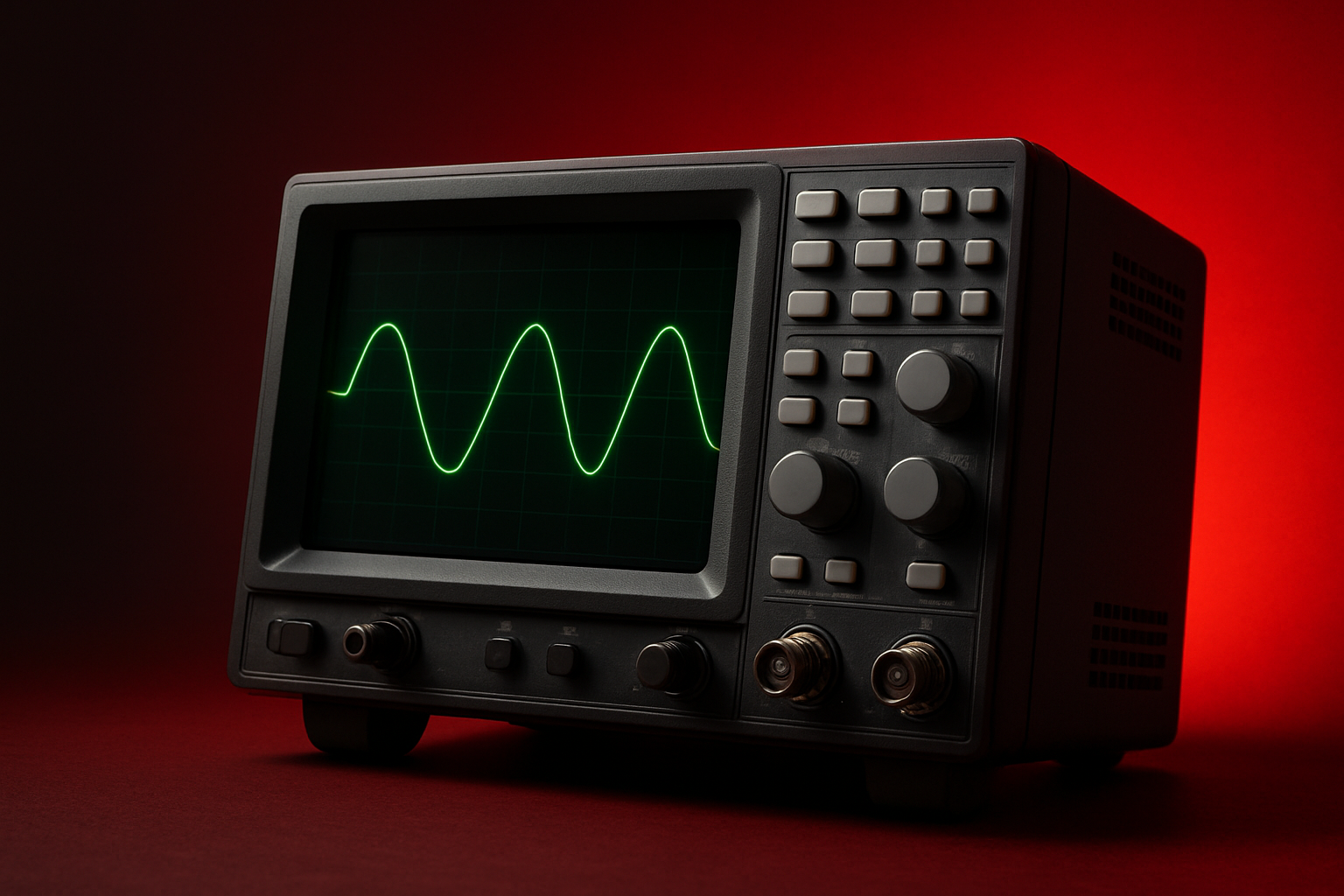
An oscilloscope is a device that converts electrical activity into a visual graph. Instead of giving you a single number, it shows the entire shape of the voltage over time. This shape is called a waveform. Understanding waveforms is a key part of electronics troubleshooting, design, testing, and learning.
This guide is written from scratch, in a simple, clear tone, specifically for the Revinetech audience engineers, technicians, and learners who want a practical explanation without unnecessary jargon.
What Does an Oscilloscope Actually Do?
An oscilloscope shows voltage on the vertical axis and time on the horizontal axis. When you connect a probe to a signal, the oscilloscope tracks every change happening in that signal and draws it as a moving graph. This helps you see precisely how electrical signals behave.
Imagine these examples:
A 1.5V battery will appear as a flat line because the voltage does not change.
A microphone output will appear as a wavy pattern because the voltage changes with sound vibrations.
A digital logic pin from an Arduino switching between HIGH and LOW will appear as a perfect square wave.
In other words, an oscilloscope lets you "see" invisible electrical activity that you otherwise could only guess.
Why Is an Oscilloscope Important?
There are several reasons why oscilloscopes are used almost everywhere—from laboratories to repair shops to manufacturing floors.
1. To Check Whether a Signal Is Working
If a circuit is not behaving correctly, the first step is to see whether signals are present. A microcontroller pin, a sensor output, a clock line, or a power rail may not be producing what they should. An oscilloscope instantly shows whether a signal exists and what it looks like.
2. To Measure Signal Timing
Modern circuits depend on correct timing. For example, digital communication lines such as UART or SPI need precise timing intervals. An oscilloscope helps you measure these timing events, delays, pulses, and patterns.
3. To Inspect Noise and Distortion
Real circuits often suffer from electrical noise. This noise may come from motors, switching power supplies, interference, loose connections, or faulty components. A multimeter cannot show noise, but an oscilloscope clearly reveals/ shows disturbances on the line.
4. To Debug Faulty Circuits
When something stops working, engineers trace waveforms to find the problem. For example, an audio amplifier may distort sound, or a power supply may fluctuate under load. The waveform reveals the fault.
5. To Learn Electronics
Oscilloscopes help beginners understand what actually happens when components switch, oscillate, filter, or amplify signals. It makes learning much more intuitive because you can literally see how the circuit responds.
Basic Parts of an Oscilloscope
Even though different brands and models may look slightly different, all oscilloscopes share the same components.
The Display
This is where waveforms appear. Modern oscilloscopes use digital color screens that display multiple channels, measurements, scales, menus, and more.
Time Base Controls
These control how much time is shown on the horizontal axis. You can zoom in to see tiny, fast events or zoom out to observe longer waveforms.
Voltage Scale Controls
These adjust the waveform's height. If a signal is too small or too large on the screen, the volts-per-division knob lets you scale it to the proper range.
Trigger Controls
Triggering stabilizes the waveform. If proper triggering is done, the waveform may keep moving, making it hard to read. Trigger settings lock the waveform to a fixed point, making it appear steady.
Input Channels
Most oscilloscopes have at least two channels (CH1, CH2). Higher-end models may have 4, 6, or even more. This allows you to compare signals.
Probes
A probe connects the oscilloscope to your circuit. Probes often come with a switchable 1x/10x mode, where 10x mode reduces loading effect on circuits and extends voltage range.
How an Oscilloscope Works Internally (Simple Explanation)
The internal workings can get complex at a deep engineering level, but beginners can understand them more simply.
When you connect a probe to a circuit, the oscilloscope takes thousands or millions of voltage samples every second. It stores these rapid readings in memory. The stored readings are then converted into display pixels. When the screen refreshes, the signal trace appears as a continuous waveform.
The accuracy, speed, and detail of this process depend on:
Sampling rate
Memory depth
Bandwidth
ADC (Analog-to-digital converter) quality
High-end oscilloscopes use high-speed electronics to capture signals that change extremely rapidly. Entry-level scopes are slower but perfectly suitable for basic electronics and hobby projects.
Key Specifications You Should Understand
If you want to buy an oscilloscope or compare models on Revinetech, you should understand these essential specs.
Bandwidth
Bandwidth tells you the highest frequency signal the scope can measure accurately. For example, a 100 MHz oscilloscope can reliably measure signals up to 20–30 MHz without significant distortion (per the general rule that requires at least 4–5× the bandwidth of the actual signal).
Sampling Rate
The sampling rate is the number of samples per second the oscilloscope captures. The higher the sampling rate, the more the waveform. Digital oscilloscopes today usually offer sampling rates of 1 MSa/s (mega samples per second) or 1 GSa/s (giga samples per second).
Channels
More channels let you compare signals. Two channels are standard, four are ideal for debugging microcontrollers, and more are used in advanced applications.
This is the part of the oscilloscope that decides how much signal it can hold at once. When a scope has more memory, it can record longer waveforms without leaving anything out. It also gives you the freedom to zoom in on any portion of the signal and still see everything clearly, even the tiny details.
Update Rate
This tells you how fast the oscilloscope can refresh and display new waveforms. A higher update rate makes it easier to spot quick glitches, momentary drops, or unstable behavior that slower scopes might miss.
Types of Oscilloscopes
Oscilloscopes come in different styles depending on what you need and how advanced your work is.
Analog Oscilloscopes
These are the older, CRT-based models. They show smooth, continuous waveforms, but don't offer the modern features you get in digital scopes.
Digital Storage Oscilloscopes (DSO)
The most common type today. They capture, store, and analyze signals digitally, making them great for electronics, embedded development, and general laboratory use.
Mixed-Signal Oscilloscopes (MSO)
These include both analog and digital channels so that you can view microcontroller logic signals and analog waveforms simultaneously.
USB Oscilloscopes
Small, portable units that plug into a laptop. They're affordable and easy to carry around, but they rely heavily on the software you use with them.
Handheld Oscilloscopes
Designed for technicians and engineers who need to troubleshoot on the go. Compact, battery-powered, and built for field work.
What Can You Use an Oscilloscope For? (Real-Life Applications)
Oscilloscopes are used in a wide range of day-to-day electronics and diagnostic tasks.
Testing Power Supplies
You can check noise, ripple, startup behavior, loads, and other power-related issues.
Debugging Audio Circuits
They help you spot distortion, clipping, DC offset, and issues in the frequency response.
Working with Arduinos, ESP32, and Microcontrollers
Perfect for viewing digital pulses, PWM signals, sensor outputs, and communication lines.
Automotive Diagnostics
Modern cars depend on sensors. Scopes help diagnose injectors, ignition signals, crank sensors, and ECU communication.
Robotics and Motor Control
Motors create electrical noise and need precise waveforms. An oscilloscope shows you precisely what's happening.
Communication Protocol Analysis
Many scopes can decode I²C, SPI, UART, CAN, LIN, and more, displaying decoded data right on the screen.
Simple Example: Reading a Square Wave
If you connect an oscilloscope to a 5V square-wave output from a microcontroller, you'll see the waveform rise to 5V, drop back down, and repeat. The scope lets you check whether the timing, frequency, and shape match your expectations. On the screen, you will see a waveform that jumps up to 5V and drops to 0V at regular intervals. From this display, you can measure:
Frequency
Duty cycle
Rise time
Fall time
Voltage levels
This helps you verify if the microcontroller is producing the correct signal.
Simple Example: Viewing a Noisy Sensor Output
If a sensor output is unstable, the oscilloscope shows the exact noise pattern. You can then decide whether you need filtering, shielding, or grounding fixes.
Common Mistakes Beginners Make
Connecting ground clips incorrectly
Using the wrong probe mode (1x instead of 10x)
Not setting the trigger properly
Misinterpreting the noise caused by the probe
Using too slow a time scale
These mistakes are typical and part of the learning curve. With practice, using an oscilloscope becomes second nature.
FAQs About Oscilloscopes
What does an oscilloscope measure?
It measures voltage over time and displays the waveform. Some models can also measure current, frequency, duty cycle, and more when used with proper probes.
Is an oscilloscope better than a multimeter?
Not better, but different. A multimeter gives a stable reading. An oscilloscope shows how voltage changes. They complement each other.
Do beginners need an oscilloscope?
If you are learning electronics, building circuits, or working with microcontrollers, an oscilloscope is extremely helpful.
Can I use an oscilloscope to measure AC mains?
Only with proper isolation, safety procedures, and a differential probe. Probing the mains without adequate knowledge is dangerous.
What bandwidth do I need for basic electronics?
A 50 MHz or 100 MHz oscilloscope is more than enough for most beginner and intermediate tasks.
Are handheld oscilloscopes good?
They are portable and practical for field work, but not as powerful as benchtop digital scopes.
Final Summary
An oscilloscope is one of the most potent tools in electronics because it turns invisible electrical signals into a visual form you can understand. It helps you measure, troubleshoot, study, and improve circuits with far more clarity than a multimeter alone. Whether you are a beginner learning basic signals or an engineer working on high-speed electronics, an oscilloscope makes your work easier and far more accurate.