
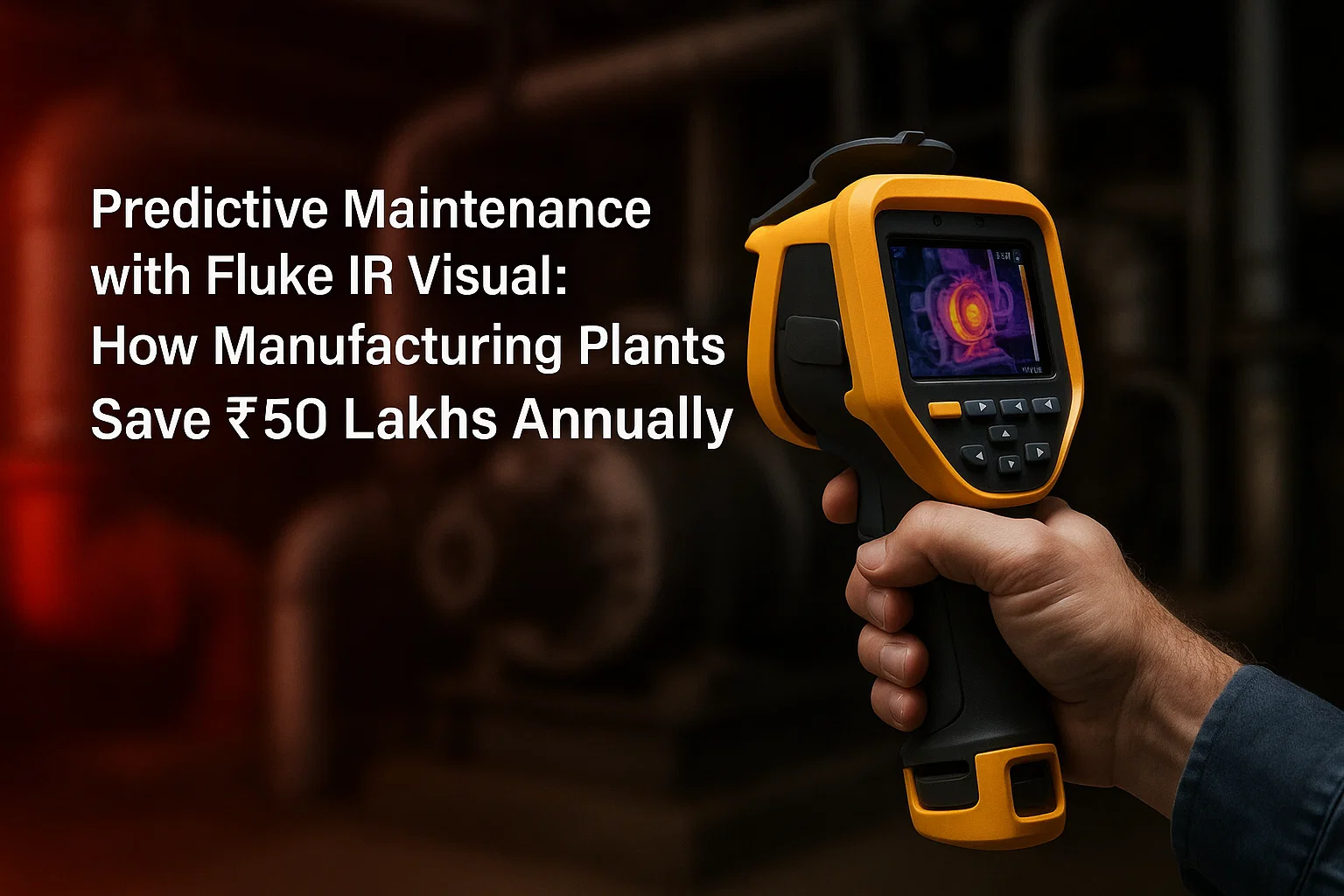
Predictive Maintenance with Fluke IR Visual: How Manufacturing Plants Save ₹50 Lakhs Annually
Manufacturing downtime costs Indian industries billions each year. A single unplanned equipment failure can halt production lines, delay deliveries, and damage expensive machinery. Yet most plants still rely on reactive maintenance fixing equipment only after it breaks.
There's a smarter approach: predictive maintenance using thermal inspection tools like the Fluke IR Visual thermometer.
This isn't just theory. Manufacturing facilities across India are documenting annual savings of ₹50 lakhs or more by implementing systematic thermal monitoring programs. The key difference? They're identifying failures weeks before they happen, scheduling repairs during planned downtime, and eliminating costly emergency breakdowns.
In this comprehensive guide, we'll break down exactly how Fluke IR Visual thermometers enable predictive maintenance, explore real-world cost savings scenarios, and provide a practical implementation roadmap for your facility.
Understanding Predictive Maintenance in Manufacturing
Predictive maintenance (PdM) is a proactive strategy that monitors equipment condition during normal operation to predict when maintenance should be performed. Unlike reactive maintenance (fix when broken) or preventive maintenance (fix on a schedule), predictive maintenance uses real-time data to make informed decisions.
The three maintenance approaches compared:
- Reactive Maintenance: Wait for failure, then repair. High cost, maximum downtime.
- Preventive Maintenance: Replace parts on fixed schedules. Better than reactive, but you're often replacing components that still have useful life.
- Predictive Maintenance: Monitor condition, intervene only when data indicates pending failure. Optimal cost and uptime.
Thermal imaging is one of the most effective predictive maintenance technologies because heat is an early indicator of electrical, mechanical, and process failures. Components typically show temperature changes days or weeks before complete failure.
Why Fluke IR Visual Thermometers Are Ideal for PdM Programs
The Fluke IR Visual series bridges a critical gap in industrial maintenance. Traditional infrared thermometers give you a single temperature reading with no context. Full thermal cameras provide detailed images but come with high costs and require extensive training.
Fluke IR Visual thermometers solve this perfectly:
They capture both a thermal heat map AND a visible light image, then blend them together. You instantly see exactly which component is overheating—no guesswork, no interpretation errors.
Key advantages for manufacturing environments:
- Quick Identification: The blended image shows the overheating fuse, terminal, or bearing in visual context. Technicians know precisely what needs attention.
- Easy Documentation: Captured images serve as undeniable evidence for work orders, making it easier to justify repairs before failure occurs.
- Cost-Effective: Significantly less expensive than thermal cameras while providing the essential diagnostic information needed for most industrial applications.
- Safety First: Non-contact measurement allows inspection of energized equipment from a safe distance, reducing arc flash risks.
- Minimal Training: Intuitive interface means technicians can start conducting productive inspections within hours, not weeks.
The ₹50 Lakh Savings Breakdown: Real Cost Analysis
Let's examine how a mid-sized manufacturing plant achieves annual savings of ₹50 lakhs through thermal inspection programs using Fluke IR Visual thermometers.
1. Avoiding Unplanned Downtime (₹30 Lakhs)
The scenario: A critical motor bearing begins failing. Without thermal monitoring, it runs until catastrophic failure—typically during a production shift.
Costs of reactive failure:
- Production loss: 8-12 hours downtime × ₹75,000/hour = ₹6-9 lakhs per incident
- Emergency labor: Off-shift technicians at premium rates = ₹50,000
- Expedited parts shipping: ₹30,000-1 lakh
- Secondary damage: Failed bearing damages motor shaft = ₹2-4 lakhs additional
Total per incident: ₹8-15 lakhs
With thermal monitoring: Bearing temperature rises are detected 2-3 weeks before failure. Maintenance is scheduled during planned weekend downtime. Parts are ordered at regular pricing. No production impact.
Conservative estimate: Preventing just 2-3 major failures annually = ₹16-30 lakhs saved.
2. Electrical System Optimization (₹10 Lakhs)
Loose electrical connections and failing components create resistance, which generates heat and wastes energy.
Typical findings in electrical panels:
- Loose terminal connections: 15-30°C above ambient
- Failing contactors: 40-60°C temperature rise
- Overloaded circuits: 20-35°C above rating
- Corroded connections: 25-50°C elevation
Each of these issues wastes electrical energy. A single loose 100A connection can waste 3-5 kW continuously—that's ₹2-3 lakhs annually in wasted electricity for just one connection.
Documentation from a 500 kW facility:
- 18 hot connections identified during first thermal survey
- Average energy waste per connection: 2.5 kW
- Total waste: 45 kW × 8,760 hours/year × ₹7/kWh = ₹2.7 lakhs
- Plus 12 failing contactors replaced before catastrophic failure = ₹7 lakhs in prevented downtime
Annual electrical savings: ₹10 lakhs
3. Extended Equipment Life (₹8 Lakhs)
Operating equipment at elevated temperatures dramatically shortens component life. The "10-degree rule" in electronics states that every 10°C temperature increase halves component lifespan.
Example calculation for motor systems:
- 20 critical motors in facility
- Average replacement cost: ₹3 lakhs each
- Normal lifespan at proper temperature: 15 years
- Lifespan when running 20°C hot: 7-8 years
By maintaining proper operating temperatures:
- Motors reach full design life instead of premature failure
- Annual capital expense reduction: ₹8-12 lakhs
4. Reduced Insurance and Safety Incidents (₹2 Lakhs)
Electrical fires and equipment failures impact insurance premiums and create safety risks.
Documented benefits:
- Some insurers offer 5-10% premium reductions for facilities with active thermal monitoring programs
- Reduced safety incidents means lower workers' compensation costs
- Fewer OSHA/safety violations and associated penalties
Conservative annual benefit: ₹2 lakhs
Implementing a Fluke IR Visual Predictive Maintenance Program
Success with thermal monitoring requires more than just buying equipment. Here's a systematic implementation approach that manufacturing plants use to achieve documented results.
Phase 1: Baseline Documentation (Month 1)
Start by establishing baseline thermal signatures for all critical equipment.
Step 1 - Equipment Prioritization: Create a list of critical assets based on:
- Impact on production if failed (high/medium/low)
- Historical failure frequency
- Repair/replacement cost
- Safety implications
Step 2 - Initial Thermal Survey: Using your Fluke IR Visual thermometer, document normal operating temperatures for:
- All electrical panels and distribution equipment
- Motor control centers
- Critical motors, pumps, compressors
- Process equipment with thermal characteristics
- HVAC systems supporting production areas
Pro tip: Conduct baseline surveys under normal load conditions. Temperature readings during low production periods won't reflect actual operating stress.
Step 3 - Create Reference Database: Store all baseline images with notes on:
- Equipment ID and location
- Operating load at time of measurement
- Ambient temperature
- Normal temperature range observed
This database becomes your comparison reference for future inspections.
Phase 2: Inspection Route Development (Month 2)
Design efficient inspection routes that technicians can complete regularly without disrupting operations.
Route planning considerations:
- Group equipment by location to minimize walking time
- Schedule inspections during normal operating loads
- Allocate 15-20 minutes per major electrical panel
- Plan 5-10 minutes per motor or rotating equipment
- Target 2-3 hour routes that one technician can complete
Recommended inspection frequency:
- Critical electrical distribution: Weekly
- Motor control centers: Bi-weekly
- Production motors/drives: Monthly
- HVAC and support equipment: Quarterly
Just like Spectrum Analyzers help identify RF anomalies through regular monitoring, thermal inspections reveal equipment health trends over time.
Phase 3: Action Threshold Development (Month 2-3)
Establish clear criteria for when thermal findings trigger maintenance action.
Sample threshold guidelines:
| Temperature Rise Above Baseline | Action Required | Timeline |
|---|---|---|
10-15°C |
Document and monitor | Next scheduled inspection |
| 15-25°C | Schedule maintenance | Within 2-4 weeks |
| 25-40°C | Priority repair | Within 1 week |
| >40°C or rapid change | Immediate action | Same day evaluation |
Important note: These are starting guidelines. Refine based on your equipment types, operating environment, and experience with thermal patterns.
Phase 4: Integration with CMMS (Month 3-4)
Connect thermal inspection findings to your Computerized Maintenance Management System (CMMS).
Key integration points:
- Automatically generate work orders when thresholds are exceeded
- Link thermal images to equipment records
- Track trending over time—is a component getting progressively warmer?
- Schedule follow-up inspections after corrective maintenance
Without CMMS integration: Thermal findings might be documented but not consistently acted upon.
With CMMS integration: Every thermal anomaly automatically enters your maintenance workflow with appropriate priority and tracking.
Phase 5: Continuous Improvement (Ongoing)
Successful programs evolve based on operational data.
Monthly reviews should analyze:
- How many thermal anomalies were detected?
- What percentage led to actual maintenance interventions?
- Were any equipment failures missed by thermal monitoring?
- Are inspection frequencies appropriate, or should they be adjusted?
- What's the average time from detection to corrective action?
Quarterly reviews should calculate:
- Documented cost savings from prevented failures
- ROI on thermal monitoring program
- Training needs for inspection technicians
- Equipment additions or removals from inspection routes
Common Applications Across Manufacturing Sectors
Fluke IR Visual thermometers deliver value across diverse manufacturing environments.
Electrical Distribution Systems
Critical inspection points:
- Main switchgear and breaker panels
- Bus bar connections—these carry high current and develop hot spots from loosening over time
- Transformer terminations
- Motor control center contactors
- Cable terminations at equipment
Typical findings: Loose connections account for 60-70% of thermal anomalies in electrical systems. These are usually quick fixes—tightening a connection takes minutes but prevents failures that cost lakhs.
Motor-Driven Equipment
What to monitor:
- Bearing housings—temperature rise indicates lubrication issues or bearing wear
- Motor housings—hot spots suggest winding issues or cooling problems
- Drive couplings—misalignment creates friction and heat
- VFD heat sinks—inadequate cooling reduces component life
Early warning signs: Bearings typically show 15-25°C temperature rise 2-4 weeks before audible noise develops. By the time you hear bearing noise, damage is already extensive.
Process Equipment
Applications vary by industry:
- Plastics/Extrusion: Die temperature uniformity, heater band performance
- Food Processing: Steam trap operation, refrigeration system efficiency
- Textiles: Dryer temperature distribution, bearing temperatures on high-speed machinery
- Automotive: Weld gun temperature monitoring, paint booth heating systems
Similar to how Digital Multimeters provide essential electrical measurements, thermal inspection reveals process consistency issues that affect product quality.
HVAC Systems
Manufacturing facility HVAC systems are often neglected until they fail, yet they're critical for both worker comfort and product quality.
Thermal inspection benefits:
- Duct leakage detection
- Heat exchanger performance evaluation
- Compressor bearing condition monitoring
- Electrical connection integrity in roof-top units
Technical Considerations for Accurate Thermal Measurements
Getting reliable data from your Fluke IR Visual thermometer requires understanding key technical factors.
Emissivity Settings
Emissivity is a material's ability to emit infrared energy. Different surfaces have different emissivity values, and incorrect settings lead to inaccurate temperature readings.
Common emissivity values:
- Painted surfaces (any color): 0.90-0.95
- Oxidized metals: 0.70-0.85
- Polished metals: 0.10-0.30
- Plastics and rubber: 0.90-0.95
- Concrete and brick: 0.85-0.95
Practical tip: For most electrical panel inspections, default emissivity of 0.95 works well since terminals and connections are usually painted or oxidized. For polished metal surfaces like bare bus bars, you may need adjustment or surface treatment.
Distance-to-Spot Ratio
The D:S ratio determines measurement accuracy at various distances. A 10:1 ratio means at 10 feet distance, you're measuring a 1-foot diameter spot.
Why this matters: If you're trying to measure a 1-inch terminal from 3 feet away with a 10:1 D:S ratio, your measurement spot is 3.6 inches—you're averaging temperature across the terminal, surrounding panel, and air. This dilutes the reading.
Best practice: Get as close as safety permits. For energized electrical equipment, maintain appropriate working distances per safety standards, but avoid unnecessarily large distances that compromise measurement accuracy.
Reflective Surfaces and Background Temperature
Shiny metal surfaces can reflect infrared energy from surrounding objects, giving false readings.
The problem: You might be measuring the reflection of a hot light fixture rather than the actual surface temperature.
Solutions:
- Apply high-emissivity tape or paint to measurement locations
- Change viewing angle to minimize reflections
- Be aware of hot background objects that could affect readings
Environmental Factors
Ambient conditions affect thermal measurements:
- Wind/Airflow: Moving air cools surfaces, potentially masking thermal issues. Indoor inspections are more reliable than outdoor equipment surveys on windy days.
- Solar Loading: Direct sunlight heats surfaces well above their actual operating temperature. Conduct outdoor inspections early morning or evening when practical.
- Ambient Temperature: Record ambient temperature during inspections. A 50°C reading means something different on a 20°C day versus a 40°C day.
Training Your Maintenance Team
Equipment is only as effective as the people using it. Successful thermal monitoring programs invest in proper training.
Basic Thermography Training (4-8 Hours)
Core topics technicians need:
- Basic infrared theory—what are we actually measuring?
- Fluke IR Visual operation and settings
- Safety considerations for energized equipment inspection
- Recognizing thermal patterns indicating specific failure modes
- Proper documentation and reporting procedures
Hands-on exercises:
- Identifying loose connections in practice panels
- Measuring bearing temperatures on operating equipment
- Documenting findings with proper context and notes
- Practicing threshold evaluation and action prioritization
Intermediate Training (16-24 Hours)
For lead technicians or PdM coordinators:
- Advanced thermal pattern interpretation
- Severity assessment and trending analysis
- Integration with other condition monitoring techniques (vibration analysis, Power Supplies load testing)
- Report generation and management communication
- Program development and continuous improvement
Ongoing Skill Development
Monthly practice sessions:
- Review interesting findings from recent inspections
- Discuss missed issues or false alarms
- Share lessons learned across shifts
- Practice with new equipment types added to inspection routes
Annual calibration:
- Verify technician competency through practical assessments
- Update training materials based on program evolution
- Cross-train backup inspectors to ensure program continuity
ROI Calculation: Building the Business Case
Securing management buy-in requires demonstrating clear return on investment.
Initial Investment
Equipment costs:
- Fluke IR Visual thermometer: ₹80,000 - ₹1.5 lakhs (depending on model)
- Spare batteries and accessories: ₹10,000 - ₹15,000
- Total equipment investment: ₹90,000 - ₹1.65 lakhs
Program setup costs:
- Technician training: ₹30,000 - ₹50,000
- Initial survey time (40-60 hours at loaded labor rate): ₹40,000 - ₹60,000
- CMMS integration (if needed): ₹20,000 - ₹1 lakh
- Total setup costs: ₹90,000 - ₹2.1 lakhs
Total first-year investment: ₹1.8 lakhs - ₹3.75 lakhs
Ongoing Costs
Annual operating expenses:
- Inspection labor (4 hours/week × 50 weeks × ₹500/hour): ₹1 lakh
- Equipment calibration/maintenance: ₹10,000
- Consumables and accessories: ₹5,000
- Total annual operating cost: ₹1.15 lakhs
Conservative Savings Estimate
Even with conservative assumptions, ROI is compelling:
Year 1 savings (conservative):
- 2 major equipment failures prevented: ₹16 lakhs
- Energy savings from electrical repairs: ₹4 lakhs
- Extended equipment life: ₹4 lakhs
- Insurance/safety benefits: ₹1 lakh
- Total Year 1 benefit: ₹25 lakhs
Year 1 ROI: (₹25 lakhs - ₹5 lakhs investment/operating costs) / ₹5 lakhs = 400% return
Years 2+ annual ROI: (₹40-50 lakhs savings - ₹1.15 lakhs operating costs) / ₹1.15 lakhs = 3,400% return
Most manufacturing facilities achieve payback within 2-4 months of program implementation.
Integration with Other Predictive Technologies
Thermal monitoring is most effective when combined with other condition monitoring techniques.
Vibration Analysis
Complementary relationship:
- Thermal imaging detects bearing temperature rise early
- Vibration analysis confirms bearing damage and identifies specific failure modes
- Together, they provide complete picture of rotating equipment health
Practical workflow: Monthly thermal inspections catch temperature anomalies. Quarterly vibration analysis on flagged equipment provides detailed diagnosis.
Oil Analysis
For hydraulic and lubrication systems:
- Thermal inspection identifies overheating hydraulic components
- Oil analysis confirms contamination, oxidation, or additive depletion
- Combined data determines whether issue is mechanical or fluid-related
Ultrasonic Testing
Perfect pairing for electrical inspections:
- Fluke IR Visual identifies hot spots visually
- Ultrasonic detectors hear corona discharge and arcing
- Some electrical issues produce arcing before significant heating
Power Quality Analysis
Similar to how RF Signal Generators enable precise signal testing, power quality analyzers reveal electrical system problems that create thermal issues.
Integration value:
- Harmonics and voltage imbalances cause excessive heating
- Thermal imaging identifies the hot equipment
- Power Quality Analyzer identifies the root electrical cause
Common Mistakes to Avoid
Even experienced maintenance teams make these thermal inspection errors:
Mistake #1: Inspecting Only When Problems Are Suspected
The error: Using thermal imaging only for troubleshooting known issues.
Why it's wrong: The real value comes from routine inspections that catch problems before anyone suspects them.
Correct approach: Establish regular inspection routes and stick to the schedule regardless of whether equipment seems to be running fine.
Mistake #2: Inadequate Documentation
The error: Taking thermal images without proper notes on equipment ID, operating conditions, or ambient temperature.
Impact: Six months later, you can't meaningfully compare current readings to historical data because you don't know what conditions existed during baseline measurement.
Best practice: Every thermal image should include:
- Exact equipment identification
- Date and time of measurement
- Operating load/conditions
- Ambient temperature
- Inspector name
- Any relevant observations
Mistake #3: Setting Unrealistic Thresholds
Two common errors:
Too aggressive: Every 5-degree temperature rise triggers maintenance actions, overwhelming the maintenance team with low-priority work orders.
Too conservative: Only catastrophic temperature elevations trigger action, missing the early intervention window.
Solution: Start with moderate thresholds and refine based on your facility's failure patterns and maintenance capacity.
Mistake #4: Ignoring Trending Data
The scenario: A motor bearing measures 65°C during monthly inspection. Technician notes "within acceptable range" and moves on.
What's missed: Last month it was 52°C. The month before, 48°C. This 17-degree rise over two months is far more significant than the absolute temperature.
Correct approach: Always review historical trending. Progressive temperature increase, even within "acceptable" ranges, indicates developing problems.
Mistake #5: Poor Safety Practices
Critical safety requirements for energized equipment inspection:
- Maintain appropriate working distance per NFPA 70E or local electrical safety standards
- Wear required PPE even for non-contact thermal inspection
- Remove cabinet doors only if qualified and wearing appropriate arc-rated PPE
- Never compromise safety to get better thermal images
Real-World Implementation Case Study
The Facility: 250,000 sq ft automotive component manufacturer, Pune industrial zone.
Challenge: Experiencing 8-12 unplanned equipment failures annually, costing ₹60-80 lakhs in lost production and repairs.
Implementation Timeline:
Month 1: Purchased Fluke VT08 IR Visual thermometer, trained three maintenance technicians, completed baseline thermal survey of 180 critical assets.
Month 2: Established weekly inspection routes covering all electrical distribution and motor control centers, bi-weekly routes for production equipment.
Month 3: Integrated thermal findings with existing CMMS, established action thresholds, scheduled first round of corrective maintenance based on initial survey findings.
First Year Results:
- 47 thermal anomalies identified before failure
- 6 major equipment failures prevented (compared to 10 the previous year)
- Documented production loss avoidance: ₹32 lakhs
- Electrical efficiency improvements: ₹7 lakhs annual savings
- Emergency maintenance calls reduced 60%
Year Two Results:
- Only 2 unplanned failures (both non-critical equipment not yet included in inspection routes)
- Total documented savings: ₹48 lakhs
- Program expanded to include process equipment thermal monitoring
- Management approval granted to add second thermal imaging device for satellite facility
Lessons Learned:
- Initial baseline survey took longer than expected but proved invaluable for trending analysis
- Integration with CMMS was critical—findings documented but not tracked in workflow were often forgotten
- Technician buy-in improved dramatically after first prevented failure validated the program
- Mobile device integration allowed field technicians to instantly share findings with engineering team
Selecting the Right Fluke IR Visual Model
Fluke VT06 - Entry Level:
- 10:1 Distance-to-Spot ratio
- Best for: Small to mid-size facilities, electrical panel inspections, HVAC maintenance
- Ideal when: Budget is constrained, inspections are primarily electrical distribution
Fluke VT08 - Advanced:
- 28:1 Distance-to-Spot ratio
- Data logging and trending capabilities
- Best for: Larger facilities, comprehensive PdM programs, applications requiring greater distance measurement
- Ideal when: You need trending analysis, work with larger equipment, or require better measurement accuracy from distance
Both models deliver the essential blended thermal/visual imaging that makes Fluke IR Visual thermometers effective for predictive maintenance.
The Future of Thermal Monitoring in Manufacturing
Predictive maintenance technology continues evolving rapidly.
Emerging trends:
- AI-Assisted Analysis: Machine learning algorithms automatically identify thermal anomalies and predict failure timelines
- Continuous Monitoring: Fixed thermal sensors on critical equipment provide 24/7 data, supplementing portable inspection programs
- IoT Integration: Thermal data flows directly into enterprise asset management systems alongside data from Logic Analyzers, vibration sensors, and other monitoring tools
- Cloud-Based Trending: Multi-site manufacturers compare thermal patterns across facilities to identify systemic issues
Despite these advances, the fundamental principle remains unchanged: thermal inspection identifies developing problems early, allowing intervention before costly failures occur.
Frequently Asked Questions
Q: How long does it take to see ROI from a thermal monitoring program?
Most manufacturing facilities achieve positive ROI within 3-6 months. The first prevented major failure—which typically happens within the first quarter usually covers the entire program investment. Conservative estimates show 400% first-year ROI, with even higher returns in subsequent years once setup costs are absorbed.
Q: Do I need certified thermography training to use Fluke IR Visual thermometers?
No formal certification is required, though basic thermography training significantly improves results. The Fluke IR Visual's intuitive blended imaging makes it accessible for maintenance technicians with 4-8 hours of training. However, facilities with comprehensive programs often send lead technicians for Level I thermography certification to enhance interpretation skills and program development.
Q: How often should thermal inspections be performed?
Frequency depends on equipment criticality and failure history. Recommended starting points: critical electrical distribution weekly, motor control centers bi-weekly, production motors monthly, and support equipment quarterly. Adjust based on trending data and your facility's failure patterns. Consistency is more important than frequency—monthly inspections done reliably beat weekly inspections done sporadically.
Q: Can thermal imaging detect all types of equipment problems?
No. Thermal imaging excels at identifying electrical resistance issues, bearing problems, mechanical friction, and process temperature anomalies. However, it won't detect: purely mechanical problems without heat generation (looseness, alignment issues in cool components), internal electrical issues in sealed components, or problems in equipment that's not energized or operating. Combine thermal monitoring with vibration analysis, oil analysis, and electrical testing for comprehensive condition monitoring.
Q: What's the difference between Fluke IR Visual thermometers and traditional thermal cameras?
Traditional thermal cameras produce high-resolution thermal images (often 320×240 pixels or higher) and are essential for detailed facility surveys and complex analysis. Fluke IR Visual thermometers capture lower-resolution thermal data blended with visible images—perfect for routine maintenance inspections where you need to quickly identify and document overheating components. IR Visual units are significantly more affordable and require less training, making them ideal for daily use by maintenance technicians.
Q: How do I justify the program investment to management?
Build a business case using your facility's historical data: calculate annual costs from unplanned downtime, emergency repairs, and equipment replacements. Then demonstrate how thermal monitoring detects 60-80% of these issues before failure. Most facilities with moderate equipment failure history can document 10X+ ROI in the first year. Offer to start with a pilot program on your most critical production line to prove value before facility-wide rollout.
Q: Can thermal inspections be performed on energized electrical equipment?
Yes, and this is one of the key advantages. Fluke IR Visual thermometers enable non-contact inspection of energized electrical panels from a safe distance, significantly reducing arc flash risk compared to contact-based measurements. However, always follow proper electrical safety protocols, maintain appropriate working distances per NFPA 70E or local standards, and use required PPE. Some facilities require cabinet doors open for detailed inspection—this requires qualified personnel with arc-rated PPE.
Q: What temperature rise indicates a serious problem?
It depends on baseline conditions and equipment type, but general guidelines: 10-15°C above baseline warrants monitoring, 15-25°C requires scheduled maintenance within 2-4 weeks, 25-40°C needs priority repair within one week, and anything exceeding 40°C or showing rapid temperature increase demands immediate evaluation. More important than absolute temperature is trending—a component rising 15-20 degrees over several weeks indicates progressive failure even if current temperature seems acceptable.
Q: How does thermal monitoring integrate with existing maintenance programs?
Thermal monitoring complements rather than replaces existing maintenance activities. It works alongside scheduled PM tasks, vibration analysis, and other condition monitoring. The key is CMMS integration—thermal findings automatically generate work orders, schedule follow-up inspections, and track corrective actions. Similar to how Function Generators integrate into broader test workflows, thermal monitoring becomes another data point in your predictive maintenance strategy.
Q: What if my facility runs 24/7 with no planned downtime?
Thermal monitoring is especially valuable for continuous operations because it enables condition-based maintenance decisions. By identifying problems 2-4 weeks before failure, you can plan minimal-disruption interventions: redundant equipment allows hot-swapping, off-peak hours enable quick repairs, or you can coordinate maintenance with production slowdowns. The goal is replacing forced emergency shutdowns with brief, planned interventions at operationally convenient times.