
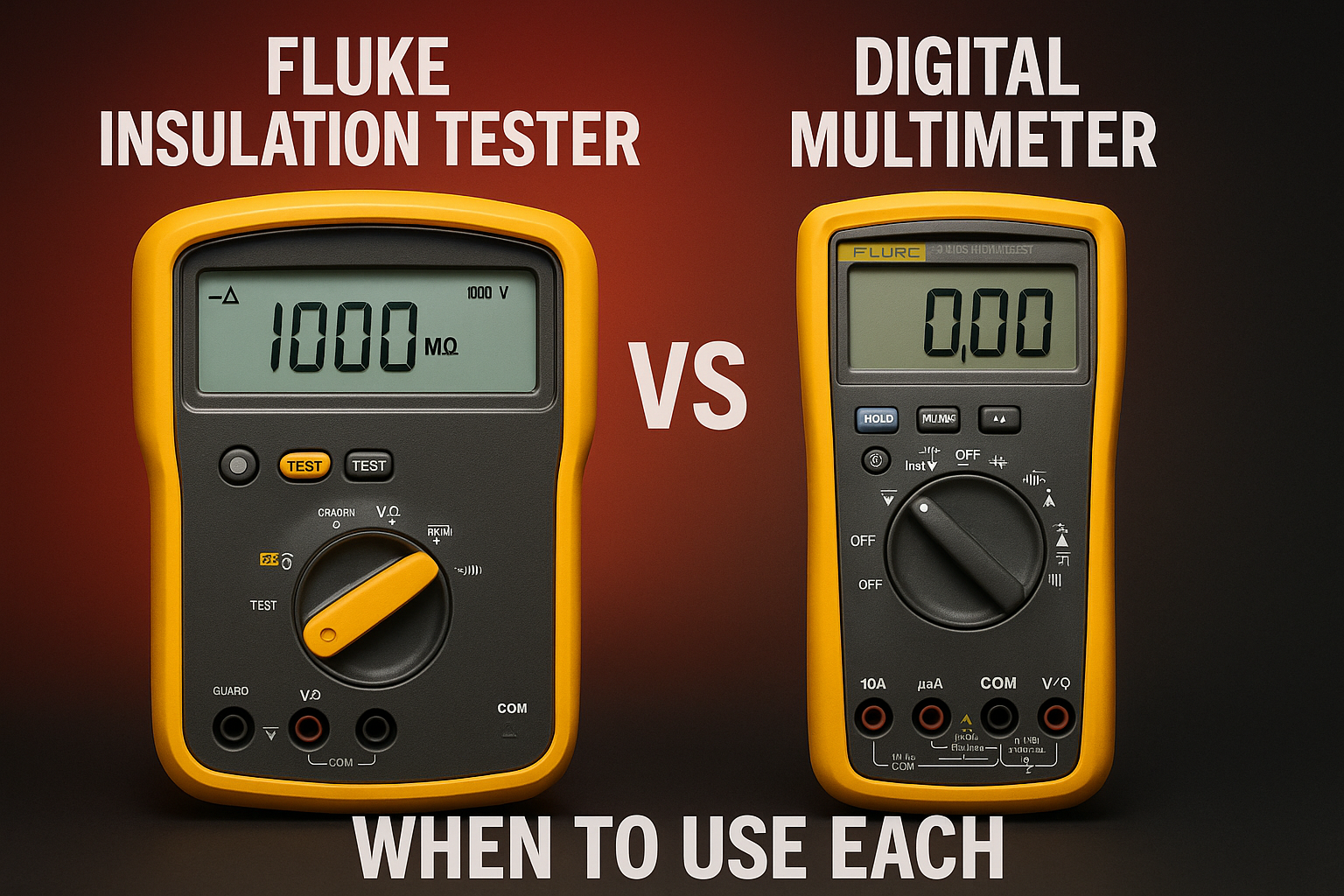
Fluke Insulation Tester vs Digital Multimeter: When to Use Each
Choosing the right electrical testing tool is crucial for engineers and technicians. In modern labs and fieldwork, common Digital Multimeters (DMMs) and Oscilloscopes handle most low-voltage measurements, and Power Supplies provide controlled voltages. However, detecting insulation faults in motors, cables or switchgear requires a specialized instrument – a Fluke insulation tester (also known as a megohmmeter). An insulation tester applies high DC voltages to measure insulation resistance (often in megaohms or gigaohms). In contrast, a digital multimeter measures voltage, current, and low-range resistance in circuits. This article explains what each tool does, how they differ, and when to use each in test & measurement work.
What Is a Fluke Insulation Tester?
An insulation tester (megohmmeter) is designed to check the quality of electrical insulation. It works by applying a high-voltage DC test signal (commonly 100V, 250V, 500V, 1000V or more) to the equipment under test. The tester then measures the tiny leakage current through the insulation and uses Ohm’s law to calculate resistance. Because insulation is expected to resist current, a good result is a very high resistance reading (often in the MΩ or GΩ range). Fluke insulation testers often include multiple test voltages and diagnostic features – for example, built-in discharge of test voltage and time-based tests like Dielectric Absorption Ratio (DAR) or Polarization Index (PI) to spot moisture or aging in insulation. These features make insulation testers ideal for preventive maintenance and commissioning of motors, transformers, generators, cables and other high-voltage equipment, where insulation faults can lead to dangerous leaks or failures.
What Is a Digital Multimeter?
A digital multimeter (DMM) is a versatile handheld instrument used for general electrical measurements. It can measure AC/DC voltage, current, and resistance (often up to a few megaohms), and usually includes continuity testing (with an audible beep) and sometimes diode checks or capacitance. DMMs use a small internal battery to source a low test current for resistance measurements, so they operate at very low voltages (typically under 10V) on the test leads. This makes them perfect for troubleshooting circuits, verifying power rails, checking fuse continuity, measuring component values, and other everyday tasks. For example, engineers often use RevineTech’s Digital Multimeters for quick checks of circuit voltages and resistances. However, because a DMM’s test voltage and sensitivity are limited, it cannot detect high-value insulation leakage that an insulation tester reveals. In short, a DMM is ideal for low-voltage diagnostics but not a substitute for high-voltage insulation testing.
Key Differences Between Insulation Testers and Multimeters
Understanding the core differences helps decide which tool to use. Below is a comparison of their main characteristics:
| Feature | Insulation Tester (Megohmmeter) | Digital Multimeter (DMM) |
|---|---|---|
| Test Voltage | High-voltage DC output (typically 100V–5000V) | Very low voltage (battery-powered, <10V) for resistance mode |
| Resistance Range | Very high (up to MΩ or GΩ) | Lower range (often up to tens of MΩ) |
| Measurement | Insulation resistance (leakage current) | Voltage, current, low-range resistance, continuity |
| Use Cases | Insulation resistance testing on motors, cables, switchgear | Circuit and component testing, AC/DC measurements |
| Safety | Requires de-energized equipment; uses built-in discharge; higher shock risk if mishandled | Can often be used on live circuits (for voltage/current); lower shock risk (no HV) |
| Diagnostics | Time-based tests (PI, DAR), insulation fault detection | Continuity beep, diode test, simple resistance readings |
These differences underline that an insulation tester is essentially a high-voltage extension of an ohmmeter, specialized for spotting insulation faults. As one expert notes, “a megohmmeter uses higher voltages (500V, 1000V, or more) to test insulation,” whereas a multimeter “measures lower resistances” and cannot reveal hidden insulation issues. Likewise, “a multimeter is useful for basic continuity and low-resistance checks, [but] lacks the voltage range, sensitivity, and diagnostic features required for reliable insulation testing”.
Use Cases and Workflows
-
Insulation Tester Use Cases: Engineers and technicians use insulation testers for electrical maintenance and safety checks. Typical scenarios include: testing motor windings before start-up, verifying cable insulation in switchgear, quality control of electrical installations, and periodic preventive maintenance of transformers or generators. In these cases, the target is finding insulation faults caused by moisture, dirt, ageing or mechanical damage. For example, before commissioning a high-voltage cable, a technician will use a Fluke insulation tester to ensure its insulation resistance is above a safe threshold (often several MΩ per kV) – a measurement a DMM cannot provide. Insulation testers are also common in manufacturing lines for electrical equipment as a quality control tool and during commissioning to confirm proper insulation.
-
DMM Use Cases: Digital multimeters are used for general-purpose electrical testing. In a lab or bench environment, an engineer might use a DMM alongside an Oscilloscope and Function Generator to design and debug circuits. Common tasks include measuring supply voltages, checking battery levels, verifying the continuity of PCB traces, and testing component resistances or diodes. A DMM is often the first tool used in troubleshooting. For instance, if a board isn’t powering up, a DMM checks the voltage at key nodes. If an insulation issue is suspected (for example, leakage to chassis), then an insulation tester would be used instead.
-
Laboratory and Test Bench: In electronics test & measurement workflows, DMMs, Oscilloscopes, Function Generators, Embedded Tools, etc., form the core lab instruments for signal and circuit testing. These tools cannot measure insulation resistance, however. For power electronics or high-voltage lab setups, an insulation tester would be added to the toolkit. For example, after designing a power supply with a bench Power Supply and verifying its output with a DMM, an engineer might still use an insulation tester to check the safety of its high-voltage sections during final validation.
Common Mistakes and Safety Insights
-
Using a DMM for Insulation Tests: A frequent mistake is trying to measure insulation resistance with a standard multimeter. Because a DMM applies only a small voltage, it may show a misleadingly high resistance on a deteriorating cable. This can give a false sense of security. Always use a proper insulation tester for high-resistance measurements.
-
Testing Live Equipment: Insulation testing must be done on de-energized circuits. Forgetting to disconnect power or to discharge capacitors after a test can be dangerous. Most insulation testers (like Fluke models) have a discharge function, but the operator should still wait for the voltage to bleed off and verify zero voltage before touching the device.
-
Safety Gear: Since insulation testers use high voltages, users should wear appropriate personal protective equipment (insulated gloves, eye protection) and follow lock-out/tag-out procedures. The RS Online guide notes that during insulation testing one should “wear proper PPE, including gloves and insulated tools” and handle connections carefully to avoid shock.
-
Wrong Test Voltage: Insulation testers often allow selecting different test voltages. Using too high a voltage on weak insulation can damage the insulation (even causing failure). Conversely, too low a test voltage may not reveal faults. For critical equipment, follow standards or manufacturer recommendations for test voltage (e.g., 500–1000V for motors).
-
Misinterpreting Results: Understand normal vs. abnormal values. A small value on an insulation tester (e.g. <1 MΩ) usually indicates a fault. On a DMM, a similar reading might just mean a small resistor or near short-circuit. Always interpret results in context: for example, residential appliances often require >2 MΩ insulation to be considered safe.
Conclusion
In summary, a Fluke insulation tester and a digital multimeter are complementary tools in electrical testing. Use a digital multimeter (e.g. from RevineTech’s Digital Multimeters line) for everyday tasks: measuring voltages, currents, and checking continuity or component resistance in circuits. Use a Fluke insulation tester when you need to measure insulation resistance or find leakage faults in motors, cables, or high-voltage equipment. Remember that insulation testers apply high voltages to reveal hidden defects, whereas DMMs do not. By understanding their strengths and limitations—and by following safety best practices—you can diagnose electrical issues accurately.
FAQs
Q: Can I measure insulation resistance with a digital multimeter?
A: No. A standard DMM cannot reliably measure high insulation resistance. Insulation testers (megohmmeters) use much higher voltages (hundreds or thousands of volts) and can detect leakage currents in the megohm or gigohm range. A multimeter only applies a low-voltage test signal, so it will not reveal weak or deteriorated insulation. Using a DMM for this purpose can miss faults and give unsafe readings.
Q: When should I use a Fluke insulation tester instead of a multimeter?
A: Use an insulation tester when checking any system’s insulation quality – for example, testing the winding insulation of motors, the jackets of high-voltage cables, or the insulation of transformers and switchgear. If the goal is to ensure no dangerous leakage currents, only an insulation tester will apply the necessary high voltage and measure the resulting high resistance. For general voltage or low-resistance measurements in circuits, stick with a digital multimeter.
Q: What insulation resistance values are considered good?
A: It depends on voltage levels and standards, but generally higher is better. For many systems, insulation resistance in the tens or hundreds of megaohms (MΩ) is good. For example, wiring for 240VAC might require ≥2 MΩ. In industrial settings, equipment rated for higher voltages often expects even higher insulation resistance. Any value that is only a few megaohms on a high-voltage test usually indicates an issue. Always refer to industry standards or manufacturer guidelines (e.g. IEC or IEEE standards) for pass/fail criteria.
Q: What safety precautions are needed when using an insulation tester?
A: Always de-energize and isolate the equipment before testing. Disconnect any parallel or sensitive circuits. Wear insulating gloves and glasses. Use the tester’s built-in discharge function after the test before touching anything. Ensure test leads and the device are rated for the voltage being used. Avoid contact with live parts, and follow lock-out/tag-out procedures. Never attempt an insulation test on energized equipment. These precautions prevent shock or damage during high-voltage testing.