
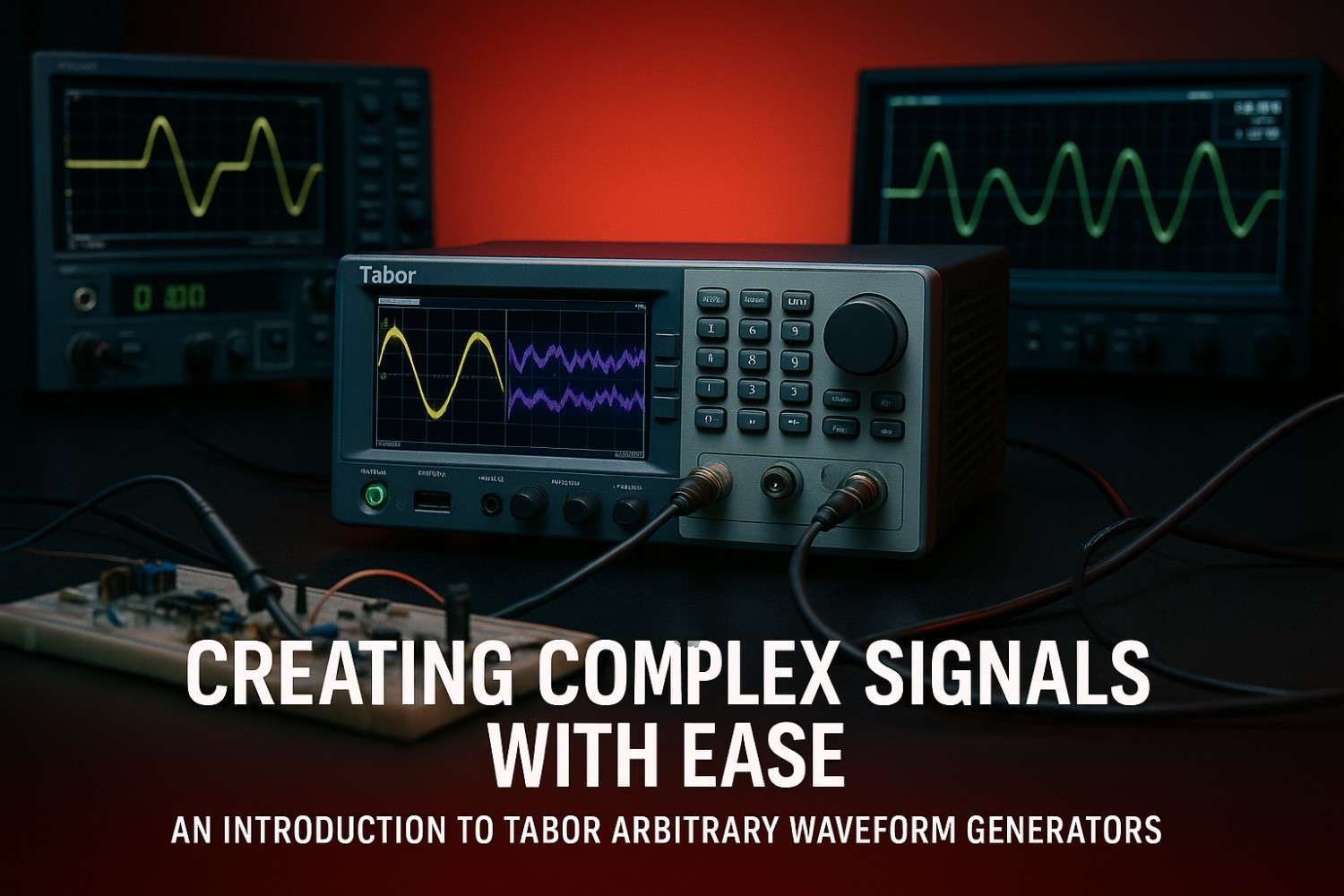
An Arbitrary Waveform Generator (AWG) is an advanced electronic test instrument that can produce virtually any user-defined electrical waveform. Unlike basic function generators, AWGs offer unparalleled flexibility to create complex, high-precision signals for modern engineering challenges.
From the 5G networks connecting our cities to the advanced radar systems protecting our skies and the quantum computers promising to solve humanity's biggest challenges, one thing is constant: the need for complex, precise, and realistic electronic signals.
Here in India, our engineers and researchers are at the forefront of this global innovation race. At Revine Technologies, our mission is to empower this incredible talent by providing the world-class tools they need to succeed. We are committed to "Making Indian Electronics Stand Out," and a crucial part of that is equipping our labs with the best test and measurement solutions.
That’s why we’ve partnered with Tabor Electronics, a global leader in high-performance signal sources. If your work involves creating or testing with complex signals, you’ve likely felt the limitations of older equipment. This guide is for you. We’ll break down what an Arbitrary Waveform Generator (AWG) is, why it’s essential for modern applications, and how Tabor’s innovative solutions make generating even the most complex signals surprisingly easy.
The Problem: Why Your Old Function Generator Can't Keep Up
For years, the humble function generator has been a staple on every engineer's workbench. It’s great for producing the basics: a clean sine wave, a sharp square wave, or a steady triangle wave. These are the fundamental building blocks of electronics, and for simple circuit testing or educational purposes, they are perfectly adequate.
But modern technology doesn’t speak in simple sine waves anymore.
From Simple Tones to Real-World Scenarios
Think about the signal your smartphone receives. It’s not a simple tone; it’s a highly complex, digitally modulated waveform like OFDM, packed with data from thousands of other users, all layered on top of each other. Or consider the signals needed to test an advanced driver-assistance system (ADAS) in a car, which must simulate intricate radar echoes bouncing off multiple objects.
These real-world signals are noisy, complex, and often non-repeating. Trying to test a sophisticated modern device with a simple square wave is like testing a Formula 1 engine with a bicycle pump—you’re simply not getting the full picture. This is where the limitations of traditional signal sources become a major roadblock to innovation.
Why Most Signal Generators Fail Modern Engineers
Most experts agree that as systems become more complex, the test stimuli must evolve to match. Your old function generator is likely holding your research back for a few key reasons:
- Limited Waveform Library: It’s restricted to a handful of built-in shapes. You can’t create the custom, mathematically-defined, or captured real-world signals needed for accurate testing.
- Lack of Precision: The fidelity, or accuracy, of the signal is often not high enough for sensitive applications. This can introduce errors that come from your test equipment, not the device you’re testing.
- Inadequate Complexity: It cannot generate long, non-repeating sequences or the complex modulation schemes that are the backbone of modern communications and radar systems.
To overcome these challenges, you need a tool designed from the ground up for flexibility and precision. You need an Arbitrary Waveform Generator.
|
Feature |
Standard Function Generator |
Arbitrary Waveform Generator (AWG) |
|
Waveform Types |
Limited to standard shapes (sine, square, etc.) |
Can generate any user-defined or custom waveform |
|
Flexibility |
Low; parameters like frequency and amplitude are adjustable |
High; complete control over the waveform's shape, sequence, and timing |
|
Precision |
Moderate to Low |
Very High; defined by resolution and sample rate for superior accuracy |
|
Primary Use Case |
Basic circuit testing, education, troubleshooting |
Advanced R&D, comms, radar, quantum computing, high-speed serial test |
|
Real-World Simulation |
Poor; cannot replicate complex, noisy, or modulated signals |
Excellent; can generate signals captured from the real world or defined by complex math |
The Solution: Understanding the Arbitrary Waveform Generator (AWG)
So, what makes an AWG so special? The magic lies in its architecture.
Imagine you want to draw a very specific, complex shape. Instead of being limited to a few stencils (like a function generator), an AWG gives you a massive sheet of graph paper and a pencil. You can define the exact value (voltage) of your signal at millions or even billions of tiny time intervals ("waypoints"). These digital points are stored in a large memory bank.
When you’re ready to generate the signal, a high-speed clock reads these points and sends them to a Digital-to-Analog Converter (DAC), which translates each digital point into a precise analog voltage. The result? A perfect, high-fidelity reconstruction of the exact waveform you designed. This fundamental difference gives the AWG its superpower: the ability to generate
any waveform you can imagine.
Key Specs That Matter: A Buyer's Guide for 2025
When choosing an AWG, it’s easy to get lost in a sea of specifications. But a few key parameters truly define the instrument's performance and its suitability for your application.
- Sample Rate (GS/s): Measured in Giga-samples per second, this is how fast the DAC can produce voltage points. A higher sample rate allows you to generate higher-frequency signals. According to the Nyquist theorem, you need a sample rate at least twice your highest desired frequency, but for high fidelity, a rate of four times or more is often recommended.
- Vertical Resolution (Bits): This is one of the most critical—and often overlooked—specifications. It defines the precision of the DAC. An 8-bit AWG can produce 28 (256) distinct voltage levels, while a 16-bit AWG can produce 216 (65,536) levels. This massive difference in resolution leads to cleaner signals, lower noise, and a much higher dynamic range, allowing you to create tiny signal details on top of a large signal with incredible accuracy.
- Bandwidth (GHz): This is an analog specification that describes the frequency range the AWG’s output components can handle without distorting the signal. Your bandwidth must be high enough to pass the highest frequencies you intend to generate, especially for signals with sharp edges like high-speed digital pulses.
- Memory Depth (GSa): Measured in Giga-samples, this is the size of the "graph paper" you have to define your waveform. Deeper memory allows you to create longer, more complex, non-repeating waveforms. The maximum playback time of a unique signal is simply the memory depth divided by the sample rate.
Introducing Tabor Electronics: The Leader in Signal Fidelity
At Revine Technologies, we partner with the best because our customers deserve the best. When it comes to signal generation, Tabor Electronics is a world-leading company that has carved out a reputation for innovation and precision, especially in the most demanding fields.
Tabor focuses on the technological frontiers where signal quality is not just a preference but a necessity:
- Quantum Physics: Providing the ultra-precise control signals needed to manipulate qubits.
- Aerospace & Defense: Delivering high-performance solutions for complex radar and electronic warfare (EW) simulation.
- Wireless Communications: Enabling the development of next-generation standards like 5G, 6G, and Wi-Fi 7.
This focus means their instruments are designed to solve the hardest problems, making them an ideal choice for Indian researchers and companies aiming for global leadership.
The Proteus Series: More Than Just a Signal Generator
The flagship of the Tabor lineup is the Proteus Series. This isn’t just an AWG; it’s a scalable, modular platform designed for the future. Built on the latest technology, the Proteus series stands out with several game-changing features.
- Market-Leading 16-Bit Resolution: While many competitors offer 8 or 10-bit resolution, the Proteus series provides a true 16-bit DAC across its range, up to a 9 GS/s sample rate. This delivers unparalleled signal purity and dynamic range, which is absolutely critical for sensitive applications.
- Arbitrary Waveform Transceiver (AWT): Proteus models can be configured with a high-speed digitizer (input) alongside the generator (output). This transforms the instrument into a transceiver that can generate a signal, capture the response from a device, and adapt the next signal in real-time—all with minimal latency. This is a game-changer for closed-loop feedback applications like quantum error correction or adaptive radar.
- Real-Time Data Streaming: Instead of being limited by the onboard memory, you can stream waveform data directly from a PC to the AWG. This allows for the generation of effectively infinite, non-repeating, and dynamic signal scenarios—perfect for realistic environment simulation.
- User-Programmable FPGA: For advanced users, the onboard FPGA is open for customization. This allows you to implement your own real-time signal processing, filtering, or decision-making algorithms directly on the instrument, enabling ultra-low-latency responses.
The Proteus series is available in PXIe, desktop, and benchtop form factors, offering a scalable solution for everything from a single research experiment to a massive, multi-channel synchronized system with hundreds of channels.
Creating Complex Signals with Ease: Practical Applications
The true power of an AWG is seeing how it solves real-world problems. Let’s look at how the Tabor Proteus series simplifies challenges in today's most advanced fields.
Powering the 5G and 6G Revolution
Modern wireless standards like 5G NR rely on complex modulation schemes like Orthogonal Frequency-Division Multiplexing (OFDM). An OFDM signal is composed of thousands of individual subcarriers, creating a waveform with a high peak-to-average power ratio that is very difficult to generate cleanly.
The Proteus AWG’s 16-bit resolution is perfect for accurately reproducing these complex signals without distortion. Furthermore, its integrated Digital Up-Converter (DUC) allows you to generate these signals directly at their final RF frequency, completely eliminating the signal impairments (like IQ mismatch and carrier leakage) that plague traditional systems using external mixers. This means you get a cleaner, more accurate test signal with a much simpler setup.
Simulating the Unseen: Advanced Radar and EW Scenarios
Testing modern radar systems requires the generation of complex waveforms like Linear Frequency Modulated (LFM) pulses, also known as "chirps," and long, agile pulse trains. In electronic warfare, you need to simulate a dense, dynamic threat environment that evolves over time.
The deep memory and advanced sequencer in the Proteus AWG make it easy to build these complex radar scenarios. For EW, the real-time streaming capability is invaluable, allowing you to generate non-repeating threat simulations that are far more realistic than a simple looping waveform. The AWT configuration can even be used to create a sophisticated Digital Radio Frequency Memory (DRFM) system, which can digitize a threat signal, modify it, and re-transmit it to confuse an enemy radar, all within a single instrument.
The Quantum Leap: Precision Control for Quantum Computing
Perhaps the most demanding application for an AWG today is quantum computing. The quantum bits, or "qubits," at the heart of a quantum computer are controlled by applying incredibly precise microwave pulses. Any noise, distortion, or timing jitter in these control pulses can destroy the fragile quantum state and ruin the computation.
This is where the Tabor Proteus series truly shines. According to a 2024 report by leading quantum labs, signal fidelity is the most critical parameter for qubit control. The 16-bit resolution of the Proteus provides the fine amplitude control needed for precise qubit rotations, while its excellent spectral purity and low phase noise ensure the control signals are exceptionally clean, minimizing decoherence. The platform's ability to scale to hundreds of phase-coherent channels makes it the ideal solution for building the large-scale quantum computers of the future.
The "Ease" Factor: Tabor's Software Ecosystem
A powerful instrument is only useful if you can control it effectively. Tabor understands that creating complex signals shouldn't be a complex process. They have invested heavily in a software ecosystem that makes their AWGs accessible to everyone, from lab technicians to advanced automation engineers.
Wave Design Studio (WDS): Your Command Centre
For the Proteus series, Tabor developed Wave Design Studio (WDS), a modern, intuitive software with a graphical user interface (GUI). WDS simplifies the entire workflow:
- Visual and Intuitive: It provides a clear visual preview of your signal scenario across multiple channels, so you can see exactly what you’re creating before you generate it.
- Offline Mode: You can create and save entire experimental setups on your PC without being connected to the instrument, saving valuable lab time.
- Application-Specific Tools: WDS includes add-ons for creating common signals for radar, communications, and other applications with just a few clicks.
- Bridge to Automation: A fantastic feature for those learning to automate is the SCPI command logger. You can perform an action in the GUI, and WDS shows you the exact programming command it sent to the instrument. It’s like having a built-in tutor.
Seamless Integration with Your Workflow (Python, MATLAB, LabVIEW)
Most advanced labs rely on programmatic control and automation. Tabor provides comprehensive support for all major engineering environments:
- Python: Full control is available using standard VISA libraries, and Tabor provides tutorials and examples to get you started quickly.
- LabVIEW: Dedicated IVI drivers allow for easy drag-and-drop integration into existing LabVIEW test sequences.
- MATLAB: Seamlessly transfer waveforms designed and simulated in MATLAB directly into the AWG’s memory.
This dual approach of a user-friendly GUI and robust programmatic support truly delivers on the promise of creating complex signals "with ease."
How Tabor Stacks Up: A Market Comparison
As your trusted partner, we believe in helping you make an informed decision. The high-performance AWG market includes other excellent manufacturers like Tektronix and Keysight. However, they often prioritize different aspects of performance, leading to a fundamental trade-off.
Speed vs. Precision: The Great AWG Trade-off
Many AWGs on the market focus on achieving the highest possible sample rate. While speed is important, it often comes at the cost of precision. The Tabor Proteus series makes a different choice, prioritizing the highest signal fidelity.
|
Specification |
Tabor Proteus P908x |
Tektronix AWG70001B |
Keysight M8195A |
|
Max Sample Rate |
9 GS/s |
50 GS/s |
65 GSa/s |
|
Vertical Resolution |
16-bit |
10-bit |
8-bit |
|
Analog Bandwidth |
>4.5 GHz |
Up to 15 GHz |
25 GHz |
|
Key Differentiator |
Highest Fidelity & System Integration (AWT) |
High Speed & Deep Memory |
Highest Speed & Bandwidth |
As the table shows, if your application demands the absolute fastest signal, other options exist. But if your priority is the cleanest, most accurate, and most precise signal possible, the 16-bit resolution of the Tabor Proteus series offers a decisive advantage. For sensitive applications like quantum computing, receiver testing, or advanced materials science, higher fidelity means more reliable and repeatable results.
Conclusion: The Right Tool for India's Innovators
The message is clear: the complexity of modern technology demands a new class of signal source. The Arbitrary Waveform Generator is no longer a niche instrument for advanced research; it is a fundamental tool for anyone serious about developing the next generation of electronics.
The Tabor Proteus series stands out not just for its impressive specifications, but for its intelligent design philosophy. By combining market-leading 16-bit fidelity with a flexible, system-level architecture and an easy-to-use software ecosystem, it provides a complete solution that empowers engineers rather than overwhelming them.
Which Tabor AWG is Right for You in 2025?
At Revine Technologies, we don't just sell boxes. We provide solutions. Our team of experienced professionals can help you understand your specific needs and configure the perfect Tabor AWG system for your application and budget.
Ready to stop fighting with your old signal generator and start creating the signals you really need?
Contact the experts at Revine Technologies today for a consultation or a product demonstration. Let us help you find the perfect Tabor AWG for your project and continue "Making Indian Electronics Stand Out."