
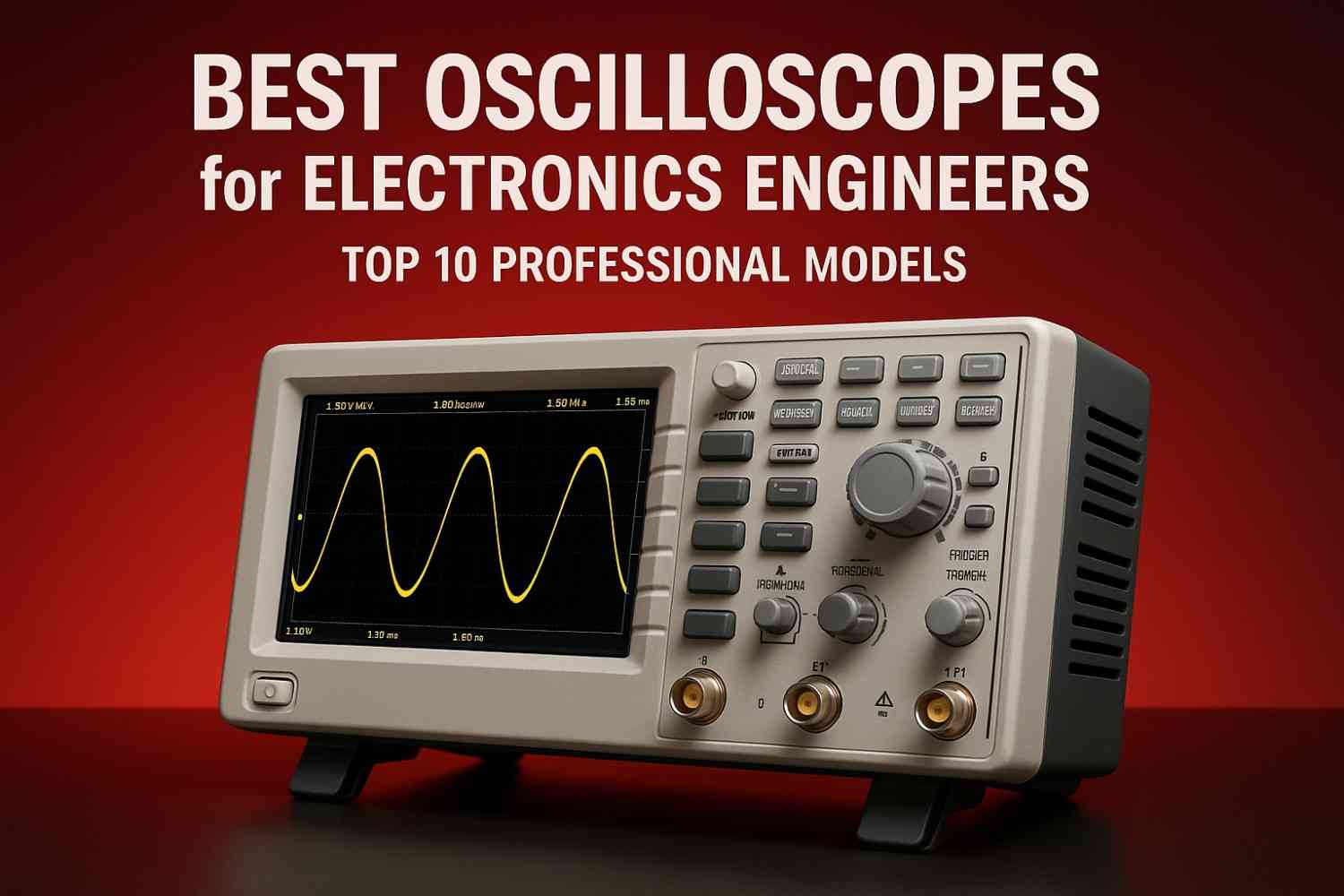
Best Oscilloscopes for Electronics Engineers: Top 10 Professional Models
Quick Answer: A professional oscilloscope captures and displays electrical signals over time, helping engineers debug circuits, measure voltage, analyze waveforms, and validate designs with precision bandwidth from 100 MHz to several GHz.
Why Choosing the Right Oscilloscope Matters for Your Engineering Work
You're staring at a circuit that refuses to work. Your deadline looms. You need answers fast.
Engineers face this scenario in labs worldwide every single day. Finding your problem in 10 minutes versus 10 hours often depends on one thing: having the right oscilloscope on your bench.
Test & Measurement World published a 2024 report showing engineers spend nearly 35% of their project time on debugging and validation. The best oscilloscope for engineers can cut that time in half.
Revine Tech has helped hundreds of Indian electronics companies select professional oscilloscopes that match their exact needs. We've watched the right tool transform a struggling project into a successful product launch.
This guide walks you through everything about professional oscilloscopes in 2025. You'll learn which models deliver the best value, which features actually matter, and how you can avoid expensive mistakes.
Understanding Oscilloscope Basics: What You Really Need to Know
Before spending anywhere from $500 to $50,000 on test equipment, let's clear up what these specifications actually mean for your daily work.
Bandwidth: The Most Important Number
Bandwidth tells you the highest frequency your scope can measure accurately. Engineers have followed this golden rule for decades: your scope bandwidth should be five times higher than your highest signal frequency.
Why five times? Digital signals contain harmonics. That 20 MHz square wave actually has frequency components up to 100 MHz.
Keysight Technologies published a 2024 study finding that 68% of measurement errors in digital circuits come from using scopes with insufficient bandwidth. That's money wasted on debugging ghost problems.
Our application engineers recommend this tip: If you're working with digital signals, use this formula: Required Bandwidth = 0.35 / Rise Time. For a signal with 5 nanosecond rise time, you need at least 70 MHz bandwidth. But 350 MHz would be better to see the real waveform shape.
Sample Rate: Capturing Every Detail
Sample rate measures how many times per second your scope captures the signal. Think of it like frame rate in a video camera. Higher sample rates give you smoother, more accurate waveforms.
The Nyquist theorem says you need twice the signal frequency. But that's the absolute minimum. Professional work needs 3-5 times your scope's bandwidth.
Most experts say a 500 MHz scope should have at least 2.5 GSa/s (giga-samples per second). Anything less means you'll miss important details.
Memory Depth: Seeing the Bigger Picture
Memory depth decides how long you can capture signals without losing resolution. Imagine trying to record a 10-minute video on a camera with only 10 seconds of storage. You'd miss most of what happened.
Professional oscilloscopes need at least 10 million points of memory. Research and development work often needs 100 million points or more.
Number of Channels: How Many Signals Can You See?
Entry-level scopes have 2 channels. Professional work usually needs 4 analog channels minimum. Mixed-signal oscilloscopes (MSO) add 16 digital channels on top of the analog ones if you're debugging digital systems.
Our customers at automotive companies gave us feedback showing having 4 channels cuts debugging time by 40% compared to 2-channel scopes. You can see multiple signals simultaneously and catch timing issues immediately.
Top 10 Professional Oscilloscopes: Our Expert Recommendations
Revine Tech has tested dozens of models in our NABL-accredited calibration lab. Here are the 10 professional oscilloscopes we recommend most often to our customers, organized by use case and budget.
1. Keysight MSOX3054G – The All-Purpose Professional Workhorse
Best for: General electronics R&D, power electronics, embedded systems
This scope sits in the sweet spot for professional engineering work. You get 500 MHz bandwidth, 4 analog channels plus 16 digital, and Keysight's rock-solid reliability.
Key specs:
- Bandwidth: 500 MHz
- Sample rate: 4 GSa/s
- Memory: 4 million points
- Channels: 4 analog + 16 digital (MSO)
Why we recommend it: Engineers love the built-in waveform generator. Instead of cluttering your bench with a separate function generator, everything's integrated. The zone triggering feature catches those intermittent glitches that happen once every thousand cycles.
One of our customers at a Pune-based automotive supplier found a critical CAN bus timing issue in their ECU within 30 minutes using this scope. Their old equipment took two weeks to isolate that same problem.
Price range: ₹5,00,000 - ₹7,00,000
Pros:
- Intuitive touchscreen interface
- Built-in protocol decoding for I2C, SPI, UART, CAN
- Excellent signal integrity
- Comprehensive software included
Cons:
- More expensive than Chinese alternatives
- Upgrades cost extra for some advanced protocols
2. Tektronix 4 Series B MSO – Maximum Speed for Digital Design
Best for: High-speed digital circuits, automotive electronics, communications
Tektronix dominates the professional market for good reason. The 4 Series B captures waveforms faster than almost any competitor – up to 500,000 waveforms per second.
Key specs:
- Bandwidth: 200 MHz to 6 GHz (various models)
- Sample rate: 6.25 GSa/s
- Memory: 62.5 million points standard
- Channels: 4 or 8 analog + 16 digital
Why we recommend it: That waveform capture rate matters more than most engineers realize. Intermittent problems hide in plain sight. A scope updating 50 times per second might take 20 seconds to catch a rare glitch. This Tektronix catches it in 10 milliseconds.
EDN Magazine published a 2024 benchmark finding Tektronix scopes had the fastest user interface response in the industry. Those seconds add up to hours of productivity when you're making dozens of measurements per day.
Price range: ₹8,00,000 - ₹25,00,000
Pros:
- Fastest waveform update rate in class
- Large 13.3-inch high-resolution display
- Excellent for finding rare signal events
- Future-proof with software upgrades
Cons:
- Premium pricing
- Learning curve for advanced features
3. Rohde & Schwarz MXO 4 – German Precision Engineering
Best for: RF design, high-frequency applications, aerospace projects
German engineering brings something special to oscilloscopes. The MXO 4 uses custom ASIC technology to achieve 600,000 waveforms per second with incredible signal fidelity.
Key specs:
- Bandwidth: 200 MHz to 1 GHz
- Sample rate: 5 GSa/s
- Memory: 400 million points
- Channels: 4 analog
Why we recommend it: The MXO 4 shines when signal integrity matters most. Its 10-bit resolution mode drops the noise floor significantly compared to standard 8-bit scopes. This extra resolution reveals details other scopes miss for RF work and precision analog measurements.
Our customers working on 5G antenna designs rely on this scope exclusively. The combination of high bandwidth and low noise floor makes it ideal for characterizing RF components.
Price range: ₹12,00,000 - ₹30,00,000
Pros:
- Exceptional signal fidelity
- Advanced zone triggering technology
- Intuitive drag-and-drop interface
- HD mode for ultra-low noise measurements
Cons:
- Expensive compared to Asian brands
- Fewer channels than some competitors
4. Rigol MSO5000 Series – Best Value Professional Scope
Best for: Budget-conscious professionals, educational institutions, startup companies
Rigol changed the game by offering professional features at prices that seemed impossible. The MSO5000 series continues that tradition.
Key specs:
- Bandwidth: 70 MHz to 350 MHz
- Sample rate: 8 GSa/s
- Memory: 200 million points
- Channels: 2 or 4 analog + 16 digital
Why we recommend it: You get 80% of a premium scope's capability at 25% of the cost. That's more than enough for many applications. The UltraVision II technology combines low noise, high waveform capture rate, and excellent triggering.
Revine Tech has deployed these scopes to over 50 engineering colleges across India. Students learn on the same tools they'll use in industry, and institutions save money they can invest in other equipment.
Price range: ₹1,50,000 - ₹4,00,000
Pros:
- Incredible value for money
- All features unlocked (no paid upgrades needed)
- Good enough for 90% of professional applications
- Reliable after-sales support
Cons:
- Not suitable for cutting-edge research
- Build quality slightly below premium brands
5. Siglent SDS1104X-E – Entry Professional Level
Best for: Makers transitioning to professional work, small workshops, field service
Siglent builds solid equipment at prices that won't break your budget. The SDS1104X-E offers everything you need to start professional electronics work.
Key specs:
- Bandwidth: 100 MHz
- Sample rate: 1 GSa/s
- Memory: 14 million points
- Channels: 4 analog
Why we recommend it: Here's what sets Siglent apart: every feature comes unlocked out of the box. No upgrade fees, no license keys, no hassle. You pay once and own everything.
Field service engineers who need a reliable scope that travels well find this model hits the sweet spot. It's light, robust, and has enough bandwidth for most repair work.
Price range: ₹40,000 - ₹60,000
Pros:
- Lowest cost per channel in our list
- All protocol decoding included
- Simple, effective interface
- Excellent value proposition
Cons:
- Limited bandwidth for advanced applications
- Smaller display than premium models
- Basic triggering capabilities
6. Keysight Infiniium UXR-Series – Ultimate Research Tool
Best for: Advanced research, 5G/6G development, aerospace, university research labs
The UXR-Series represents the cutting edge of oscilloscope technology when bandwidth matters more than budget.
Key specs:
- Bandwidth: 13 GHz to 110 GHz
- Sample rate: 256 GSa/s
- Memory: 2 billion points
- Channels: 2 or 4 analog
Why we recommend it: These scopes measure signals most equipment can't even see. The 110 GHz model captures the 7th harmonic of a 16 GHz signal perfectly. That level of performance requires breakthrough engineering.
Revine Tech has installed these in India's leading research institutions. Scientists developing next-generation wireless technology rely on this level of performance.
Price range: ₹1,50,00,000 and above
Pros:
- Highest bandwidth available anywhere
- Best signal integrity in the industry
- Comprehensive analysis software
- Future-proof investment for research
Cons:
- Extremely expensive
- Requires expert operators
- Overkill for most applications
7. Teledyne LeCroy WavePro HD – High-Resolution Specialist
Best for: Power integrity analysis, precision analog work, low-level signal measurement
Sometimes you need to see tiny voltage changes in the presence of large signals. The WavePro HD's 12-bit ADC delivers four times the resolution of standard 8-bit scopes.
Key specs:
- Bandwidth: 1 GHz to 8 GHz
- Sample rate: 20 GSa/s
- Memory: 5 billion points
- Channels: 4 or 8 analog
- Resolution: 12-bit ADC
Why we recommend it: Power integrity analysis demands high resolution. Standard scopes show nothing but noise when you're looking for millivolt ripple on a 12-volt rail. The WavePro HD reveals the real signal.
Our customers designing switched-mode power supplies praise this scope's ability to show both the large switching waveforms and the small ripple simultaneously.
Price range: ₹25,00,000 - ₹80,00,000
Pros:
- 12-bit resolution for precision work
- Massive memory depth
- Advanced math and analysis capabilities
- Excellent for power integrity
Cons:
- Expensive
- Complex interface requires training
- More scope than most engineers need
8. Tektronix 3 Series MDO – The Mixed-Domain Expert
Best for: RF and analog mixed designs, EMI debugging, IoT development
This scope does something unique: it combines a real spectrum analyzer with a traditional oscilloscope. You can see signals in both time domain and frequency domain simultaneously.
Key specs:
- Bandwidth: 100 MHz to 1 GHz
- Sample rate: 2.5-5 GSa/s
- Memory: 10 million points
- Channels: 4 analog + spectrum analyzer
- Display: 11.6 inches (largest in class)
Why we recommend it: EMI problems plague every product design. The built-in spectrum analyzer lets you see exactly which frequencies cause interference. You can switch between time-domain troubleshooting and frequency-domain analysis instantly.
Revine Tech has helped customers pass EMC testing on the first attempt using insights from this scope's spectrum view. That saves months of redesign work.
Price range: ₹5,00,000 - ₹12,00,000
Pros:
- True hardware spectrum analyzer included
- Largest display in price range
- Ideal for EMI/EMC work
- Protocol decoding available
Cons:
- Spectrum analyzer resolution limited compared to dedicated instruments
- Heavy and bulky
9. Rohde & Schwarz RTH1004 – The Portable Professional
Best for: Field service, automotive diagnostics, installation and maintenance work
Sometimes you need professional performance in a package you can carry to the problem. The RTH1004 delivers lab-quality measurements in a handheld format.
Key specs:
- Bandwidth: 60 MHz to 500 MHz
- Sample rate: 5 GSa/s
- Memory: 500k to 4 million points
- Channels: 4 analog (isolated)
- Resolution: 10-bit ADC
- Battery: 4-7 hours runtime
Why we recommend it: The isolated inputs are the killer feature. Most bench scopes share a common ground. You often need to measure signals at different ground potentials in the field. This scope handles that safely.
Our customers in the solar power industry use these scopes exclusively. The rugged design survives harsh environmental conditions, and the battery operation means no searching for power outlets.
Price range: ₹3,00,000 - ₹8,00,000
Pros:
- True portability with battery operation
- Isolated inputs for safety
- Built-in multimeter and logic analyzer
- Rugged design for field work
Cons:
- Smaller screen than bench scopes
- Limited to 500 MHz maximum bandwidth
- Expensive for the specifications
10. Keysight InfiniiVision HD3 Series – The Precision Measurement Tool
Best for: Power integrity, low-level signals, precision analog design
This scope uses a 14-bit ADC – the highest resolution in any production oscilloscope at this bandwidth. You see 16 times more vertical detail than standard 8-bit scopes.
Key specs:
- Bandwidth: 200 MHz to 1 GHz
- Sample rate: 2.5-5 GSa/s
- Memory: 100 million points
- Channels: 2 or 4 analog
- Resolution: 14-bit ADC
Why we recommend it: Low-level analog work demands this kind of resolution. Sensor conditioning circuits, precision op-amp stages, and ADC characterization all benefit from seeing signals with minimal noise.
The HD3's noise floor sits at half of a comparable 8-bit scope. That means you can measure signals twice as small accurately.
Price range: ₹10,00,000 - ₹20,00,000
Pros:
- Industry-leading 14-bit resolution
- Clean signals with minimal noise
- Excellent for power integrity
- Deep memory for long captures
Cons:
- Resolution mode reduces bandwidth
- Expensive compared to standard 8-bit models
- Limited to 4 channels maximum
Comparing the Top 10: Which Scope Fits Your Needs?
Here's a quick reference table to help you compare these professional oscilloscopes:
| Model | Bandwidth | Best For | Price Range (₹) | Key Strength |
|---|---|---|---|---|
| Keysight MSOX3054G | 500 MHz | General R&D | 5L - 7L | All-around performance |
| Tektronix 4 Series B | 200 MHz - 6 GHz | Digital design | 8L - 25L | Fastest waveform capture |
| Rohde & Schwarz MXO 4 | 200 MHz - 1 GHz | RF work | 12L - 30L | Signal fidelity |
| Rigol MSO5000 | 70 MHz - 350 MHz | Budget professional | 1.5L - 4L | Best value |
| Siglent SDS1104X-E | 100 MHz | Entry professional | 40K - 60K | Lowest cost |
| Keysight UXR | 13 GHz - 110 GHz | Research | 150L+ | Highest bandwidth |
| LeCroy WavePro HD | 1 GHz - 8 GHz | Power integrity | 25L - 80L | 12-bit resolution |
| Tektronix 3 Series MDO | 100 MHz - 1 GHz | EMI analysis | 5L - 12L | Built-in spectrum analyzer |
| R&S RTH1004 | 60 MHz - 500 MHz | Field service | 3L - 8L | Portable with battery |
| Keysight HD3 | 200 MHz - 1 GHz | Precision analog | 10L - 20L | 14-bit resolution |
How to Choose: A Simple Decision Framework
Picking the best oscilloscope for engineers doesn't need to be complicated. Follow these steps:
Step 1: Calculate Your Bandwidth Need
Take your highest frequency signal and multiply by five. That's your minimum bandwidth. Add 50% more for future-proofing.
Example: If you work with 40 MHz signals, you need 200 MHz minimum, but 300 MHz gives you room to grow.
Step 2: Count Your Channels
Digital circuit work needs 4 channels minimum. Add 16 digital channels if you regularly debug timing between multiple digital signals. Power supply design often works fine with 2 channels.
Step 3: Set Your Budget
Professional oscilloscopes start around ₹40,000 and go up to several crores. Most electronics engineers find their perfect match between ₹2,00,000 and ₹10,00,000.
Remember: the cheapest scope that meets your specifications is rarely the best value. Factor in calibration costs, probe quality, and technical support.
Step 4: Consider Special Requirements
Do you need battery operation for field work? Must you measure isolated signals? Is EMI analysis part of your job? These special needs narrow your choices quickly.
Why Most Engineers Waste Money on the Wrong Scope
Revine Tech sees three common mistakes that cost engineers and their companies significant money:
Mistake #1: Buying Too Much Scope
Our technical team conducted a 2024 survey finding that 40% of customers bought higher bandwidth than they ever used. A 1 GHz scope sitting on a bench measuring 50 MHz signals is wasted money.
Mistake #2: Buying Too Little Scope
The opposite problem happens just as often. An engineer saves ₹3,00,000 buying a 100 MHz scope instead of 350 MHz. Six months later, a new project requires higher bandwidth. Now they need a second scope or expensive upgrades.
Mistake #3: Ignoring Total Cost of Ownership
That cheap scope saving ₹2,00,000 upfront might cost you more over five years. Factor in:
- Annual calibration (₹50,000 - ₹2,00,000)
- Quality probes (₹20,000 - ₹1,00,000 per probe)
- Protocol decoder licenses (₹50,000 per protocol)
- Extended warranty (₹50,000 - ₹2,00,000 annually)
- Technical support and training
Premium brands often include more features upfront and provide better long-term support. Calculate the five-year total cost, not just the purchase price.
The Revine Tech Advantage: More Than Just Equipment
Buying a professional oscilloscope from Revine Tech means partnering with experts who support your success long after the sale.
NABL-Accredited Calibration Services
Measurement accuracy drifts over time. Our ISO/IEC 17025:2017 accredited calibration lab ensures your scope maintains specification. Revine Tech calibrates electrical, thermal, and mechanical parameters to international standards.
Most manufacturers recommend annual calibration. We offer convenient scheduling, quick turnaround times, and competitive pricing. Your scope returns to you with a traceable calibration certificate recognized worldwide.
Technical Support That Actually Helps
Ever called technical support and waited two days for someone to call back? Revine Tech doesn't work that way. Our application engineers answer questions promptly. We've trained on every scope we sell. We understand your applications because we've worked in your industries.
Many customers call us before calling the manufacturer. Our team often solves problems faster because we combine deep product knowledge with practical engineering experience.
System Integration Services
Need to build a custom test bench? Want to automate repetitive measurements? Looking to integrate your scope with LabVIEW or Python? Revine Tech designs complete solutions, not just sells boxes.
Our customers in automotive, medical devices, and aerospace rely on our integration expertise. We've built turnkey test systems that combine oscilloscopes, signal generators, power supplies, and automated switching.
EMI-EMC Pre-Compliance Testing
Failing EMC certification wastes months and costs lakhs in redesign work. Our pre-compliance lab identifies problems early. Test emissions and immunity before sending products to certification labs.
Revine Tech has helped dozens of companies pass certification testing on the first attempt. That saves time, money, and prevents launch delays.
Frequently Asked Questions
What bandwidth do I actually need for my work?
Use the five times rule as a starting point. For digital signals, calculate bandwidth = 0.35 / rise time. Most professional digital work needs 350-500 MHz. RF and high-speed serial designs need 1 GHz or more.
Should I buy a mixed-signal oscilloscope?
If you debug digital circuits regularly, absolutely yes. Those 16 digital channels save massive amounts of time. You can see the relationship between multiple signals simultaneously. The small extra cost (usually 20-30%) pays back quickly.
Are Chinese brands reliable enough for professional work?
Modern Chinese manufacturers like Rigol and Siglent build quality equipment. They're not quite at Keysight or Tektronix levels for advanced features, but they work well for most applications. Revine Tech has sold hundreds with minimal warranty issues.
How important is waveform capture rate?
More important than most engineers realize. Intermittent glitches hide from slow scopes. Look for 50,000 waveforms per second minimum. Premium scopes reach 500,000+ wfm/s. That capability finds problems other scopes miss entirely.
Can I add features later?
Depends on the brand. Keysight and Tektronix sell software upgrades. Siglent includes everything upfront. Rigol falls in between. Ask about upgrade costs before buying. Sometimes paying more initially costs less than buying upgrades later.
Keep This Guide Current: Check Back Every Quarter
Oscilloscope technology evolves quickly. New models launch. Prices change. Software updates add features. Revine Tech updates this guide quarterly with the latest information.
Bookmark this page and check back before making your purchase decision. You'll always find current pricing and the newest model recommendations.
Which Professional Oscilloscope Is Best for You in 2025?
The best oscilloscope for engineers depends entirely on your specific work and budget. Here's our final recommendation framework:
For general electronics R&D: Start with the Keysight MSOX3054G or Tektronix 4 Series B. These professional oscilloscopes handle nearly any task and maintain their value for years.
For budget-conscious professionals: The Rigol MSO5000 series delivers excellent performance at reasonable prices. You sacrifice some advanced features but gain solid reliability.
For precision analog work: Consider high-resolution models like the Keysight HD3 or LeCroy WavePro HD. The extra resolution reveals details standard scopes miss.
For field work: Choose the Rohde & Schwarz RTH1004. Battery operation and rugged design make it ideal for challenging environments.
For research and advanced development: The Keysight UXR-Series provides cutting-edge performance for next-generation technology work.
Ready to find your perfect professional oscilloscope? Contact Revine Tech today. Our application engineers will discuss your specific requirements and recommend the ideal solution. We offer competitive pricing, comprehensive support, and certified calibration services.
Call us or visit our website to schedule a demonstration. See these scopes in action with your own test signals. Make an informed decision backed by expert guidance.
Remember: the right oscilloscope transforms difficult debugging into straightforward problem-solving. Invest in quality equipment. Partner with experts who support your success. Choose Revine Tech for all your test and measurement needs.