
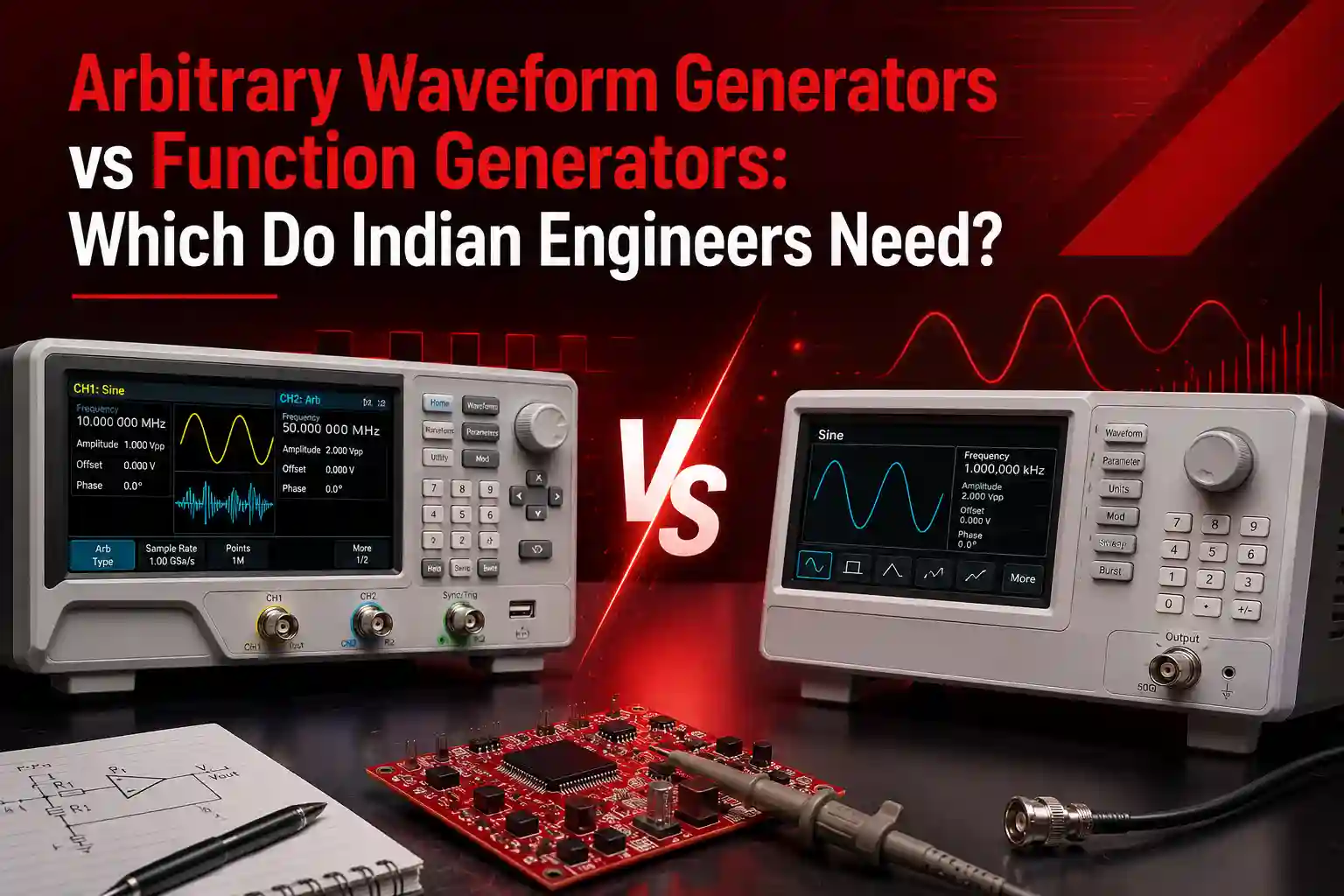
Selecting an arbitrary waveform generator in India requires a clear understanding of the application. Many engineers buy more waveform capability than they need. Others select simple generators that cannot reproduce real operating conditions.
A function generator creates standard periodic waveforms quickly. An arbitrary waveform generator creates user-defined waveforms from stored digital samples.
Both instruments can support electronics development. However, they solve different testing problems.
This guide explains the function generator versus AWG decision for Indian R&D, manufacturing, education and automated test laboratories.
What Is the Difference Between a Function Generator and an AWG?
A function generator produces standard mathematical waveforms such as sine, square, triangle and pulse signals. An AWG produces waveforms from digitally stored sample values. This allows an AWG to create custom pulses, modulation, distortion, transients and real-world signal patterns that a conventional function generator cannot reproduce accurately.
A function generator is optimised for commonly used periodic signals.
Typical outputs include:
- Sine waves
- Square waves
- Triangle waves
- Ramp signals
- Pulse signals
- Basic modulation
- Frequency sweeps
The operator selects a waveform and sets frequency, amplitude and offset.
An AWG stores a sequence of digital values. A digital-to-analogue converter transforms those values into an analogue output.
The waveform can contain almost any shape within the instrument’s bandwidth, memory and output limits.
Tabor explains that arbitrary waveform segments can be programmed and combined in sequences. This approach supports loops, jumps and complex generation scenarios.
Function Generator vs AWG: Core Technical Differences
Function generators are simpler, faster to configure and usually more economical. AWGs provide greater control over waveform shape, timing, sequencing and modulation. The correct choice depends on bandwidth, sample rate, memory, resolution, channel synchronisation and waveform complexity. Instrument labels alone do not reveal whether a model suits the application.
| Parameter | Function Generator | Arbitrary Waveform Generator |
| Primary purpose | Standard waveforms | Custom and complex waveforms |
| Waveform creation | Mathematical generation | Stored digital samples |
| Setup complexity | Low | Moderate to high |
| Waveform memory | Limited or unnecessary | Important selection parameter |
| Sequencing | Basic | Advanced |
| Custom distortion | Limited | Strong capability |
| Multi-channel timing | Model dependent | Often more precise |
| Application focus | General electronics | Advanced R&D and validation |
| Typical cost | Lower | Higher |
| Automation depth | Basic to advanced | Usually advanced |
Many modern instruments combine both functions. They may be marketed as arbitrary function generators.
However, arbitrary memory depth and sample performance can vary significantly.
A basic generator with a small arbitrary-memory option should not be treated as a high-performance AWG.
When Is a Function Generator Sufficient?
A function generator is sufficient when the device requires standard repetitive signals. It suits basic circuit testing, education, amplifier checks, sensor simulation and low-complexity production tests. Engineers should choose it when waveform shape is predictable and precise custom sequencing is unnecessary. This avoids paying for unused AWG performance.
Basic Analogue Circuit Testing
Function generators are suitable for testing:
- Operational amplifiers
- Audio amplifiers
- Active filters
- Comparator circuits
- Transistor stages
- Power supply control circuits
A sine wave can measure frequency response. A square wave can reveal rise-time and stability behaviour.
Electronics Education
Teaching laboratories often need simple controls and quick setup.
Students can learn frequency, amplitude, duty cycle, phase and modulation without building waveform files.
A function generator also provides enough capability for many undergraduate analogue and digital experiments.
Sensor and Control Input Simulation
Many sensors produce slowly changing voltage or current signals.
A function generator can simulate periodic sensor output. It can also test threshold circuits, analogue inputs and control loops.
Custom noise patterns or irregular events may require an AWG.
Basic Production Testing
A standard waveform may be enough for pass-or-fail verification.
For example, a production station may apply a fixed sine wave and measure output amplitude. The generator must provide suitable stability, remote control and repeatability.
Advanced arbitrary capability may add no practical value.
When Does an Indian Laboratory Need an AWG?
An Indian laboratory needs an AWG when it must reproduce custom, transient or protocol-like signals. Common applications include radar pulses, communications research, semiconductor validation, power electronics, quantum control and hardware-in-the-loop testing. AWGs also support controlled impairments, timing sequences and multi-channel waveforms that represent realistic operating conditions.
Communications and Modulation Research
Wireless systems use complex modulation and time-varying signals.
An AWG can generate in-phase and quadrature data, shaped pulses and digitally modulated waveforms. Engineers can test receivers using repeatable signal conditions.
High-speed systems may require direct RF generation or an external IQ modulator.
Radar and Pulsed RF Testing
Radar development requires precise pulse width, repetition interval and phase control.
An AWG can generate chirps, pulse compression waveforms and controlled signal sequences. Multi-channel synchronisation supports phased-array and beamforming research.
Tabor AWG platforms support waveform sequencing and modulation functions for complex generation tasks.
Power Electronics Testing
Power converters operate under switching, load and fault conditions.
An AWG can reproduce:
- Switching transients
- Voltage sags
- Harmonic distortion
- Current ripple
- Irregular control signals
- Sensor faults
- Start-up and shutdown profiles
The generator may require an external high-voltage or high-current amplifier.
Automotive Electronics
Automotive controllers receive signals from sensors, networks and actuators.
An AWG can simulate crankshaft patterns, wheel-speed signals and analogue sensor behaviour. It can also reproduce missing pulses, noise and timing faults.
Functional safety testing often requires repeatable fault injection.
Semiconductor and Mixed-Signal Validation
Semiconductor validation requires precise stimulus generation.
An AWG can test data converters, clock circuits, interfaces and mixed-signal devices. Resolution, sample rate and clock quality become critical.
The instrument should integrate with oscilloscopes, digitizers and automated analysis software.
Medical and Scientific Research
Scientific systems may require shaped pulses and tightly synchronised channels.
Applications include imaging, spectroscopy, quantum control, ultrasonics and experimental physics.
These laboratories should examine trigger latency, channel skew and phase coherence.
How to Select an Arbitrary Waveform Generator India Configuration
AWG selection should begin with the required analogue bandwidth, sample rate, vertical resolution and waveform duration. Engineers must also define channel count, output level, memory, triggering and synchronisation. The selected instrument should reproduce the required signal without relying on specifications that do not apply simultaneously.
Sample Rate
Sample rate defines how many waveform points are generated each second.
A higher rate provides more samples across fast waveform features. However, sample rate alone does not define signal quality.
The analogue output path must support the required bandwidth.
Analogue Bandwidth
Bandwidth limits the highest frequency content reaching the output.
A high sample rate with restricted analogue bandwidth cannot reproduce very fast edges accurately.
Engineers should examine the bandwidth specification for the selected output mode.
Vertical Resolution
Vertical resolution describes the number of amplitude levels available from the converter.
More bits can provide finer amplitude steps. Effective performance also depends on noise, linearity and output architecture.
A nominal bit count should not be evaluated alone.
Waveform Memory
Memory determines how many waveform samples can be stored.
Long records are useful for non-repeating signals and protocol-like sequences. Sequencing can reduce memory consumption by repeating waveform segments.
Tabor AWGs can combine programmed segments in defined sequences.
Channel Count and Synchronisation
Multiple channels may be required for differential signals, IQ generation or multi-device stimulation.
Check:
- Channel-to-channel skew
- Phase adjustment
- Common clock support
- Trigger distribution
- Multi-instrument synchronisation
- Phase-coherent operation
A four-channel generator may cost less than several independently synchronised units.
Output Voltage and Impedance
Most high-speed AWGs use 50-ohm outputs.
The available voltage can change with the selected output mode or load. Engineers should verify whether the specification applies into 50 ohms or high impedance.
External amplification may be required for power electronics, piezoelectric devices or actuator testing.
Triggering and Sequencing
Advanced triggering allows the AWG to respond to external events.
Useful features include:
- Trigger delay
- Trigger hold-off
- Conditional jumps
- Sequence loops
- Burst generation
- Gated output
- Marker outputs
- Event-based waveform changes
Tabor’s WX2181B includes advanced sequencing, triggering and programmable marker functions.
Choosing Tabor Waveform Generators for Indian Labs
Tabor offers waveform-generation platforms for standard bench testing, high-speed arbitrary signals and modular systems. Indian laboratories should choose a configuration based on bandwidth, channels, memory and automation. The product category should follow the test architecture. Benchtop, desktop and PXIe formats serve different deployment and scaling requirements.
Engineers can compare available waveform generators before selecting a product family.
A benchtop unit is practical for manual R&D work. It provides front-panel control and direct laboratory access.
Review available Tabor benchtop signal generators for communication, RF and general laboratory applications.
The broader Tabor benchtop instrument range can support laboratories requiring accessible controls and integrated displays.
Tabor also provides models with remote interfaces and automation support. The WX2181B, for example, supports LAN, USB and GPIB control.
Common AWG Buying Mistakes
Common AWG buying mistakes include selecting by sample rate alone, ignoring analogue bandwidth and underestimating waveform memory. Engineers may also overlook output voltage, load impedance, trigger behaviour and software licensing. A complete evaluation should test the intended waveform using the same settings, cables, loads and automation methods planned for deployment.
Buying the Highest Sample Rate
A high sample rate may look impressive.
However, the laboratory may gain more value from better resolution, memory or output performance.
The sample rate must support the required waveform, not an unrelated benchmark.
Ignoring Software Workflow
Complex waveforms require reliable software.
Check whether the system supports:
- Mathematical waveform creation
- CSV or binary import
- MATLAB data
- Python control
- Sequence editing
- Real-time parameter changes
- Instrument-driver availability
Software limitations can reduce the practical value of strong hardware.
Ignoring Clock Quality
Clock jitter affects high-frequency and high-speed waveform generation.
Low-jitter clocks are important for communications, converter testing and phase-sensitive applications.
External reference-clock support can improve integration across instruments.
Overlooking Calibration and Support
An AWG must maintain amplitude and timing performance.
Indian buyers should confirm calibration availability, turnaround time, warranty support and replacement options.
Technical training is also valuable for complex waveform and sequencing applications.
Conclusion
The function generator versus AWG decision should follow the waveform requirement.
Choose a function generator for standard periodic signals and routine electronics testing. Choose an AWG for custom waveforms, fault injection and advanced validation.
Indian engineers should evaluate the complete signal path. Sample rate, bandwidth, memory and output performance must work together.
The right generator should reproduce the real operating condition of the device under test.
Frequently Asked Questions
Engineers often ask whether they need an AWG, a function generator or a combined instrument. The answer depends on waveform complexity. Standard repetitive signals favour a function generator. Custom signals, fault injection, advanced modulation and precise sequencing favour an AWG. Combined instruments are useful when both workflows are regularly required.
Can an AWG work as a function generator?
Yes. Most AWGs can produce standard sine, square, triangle and pulse waveforms.
However, setup may be more complex than using a dedicated function generator.
Is an AWG always more accurate?
No. Accuracy depends on amplitude specifications, bandwidth, noise, linearity and clock quality.
A high-end function generator may outperform an entry-level AWG for standard waveforms.
How much waveform memory is enough?
Required memory depends on sample rate and waveform duration.
A one-second non-repeating waveform needs one second of samples. Sequencing reduces memory needs when sections repeat.
Should an Indian lab buy a benchtop or PXIe AWG?
Benchtop units suit manual development and smaller setups.
PXIe systems suit automated, synchronised and multi-channel test platforms.