
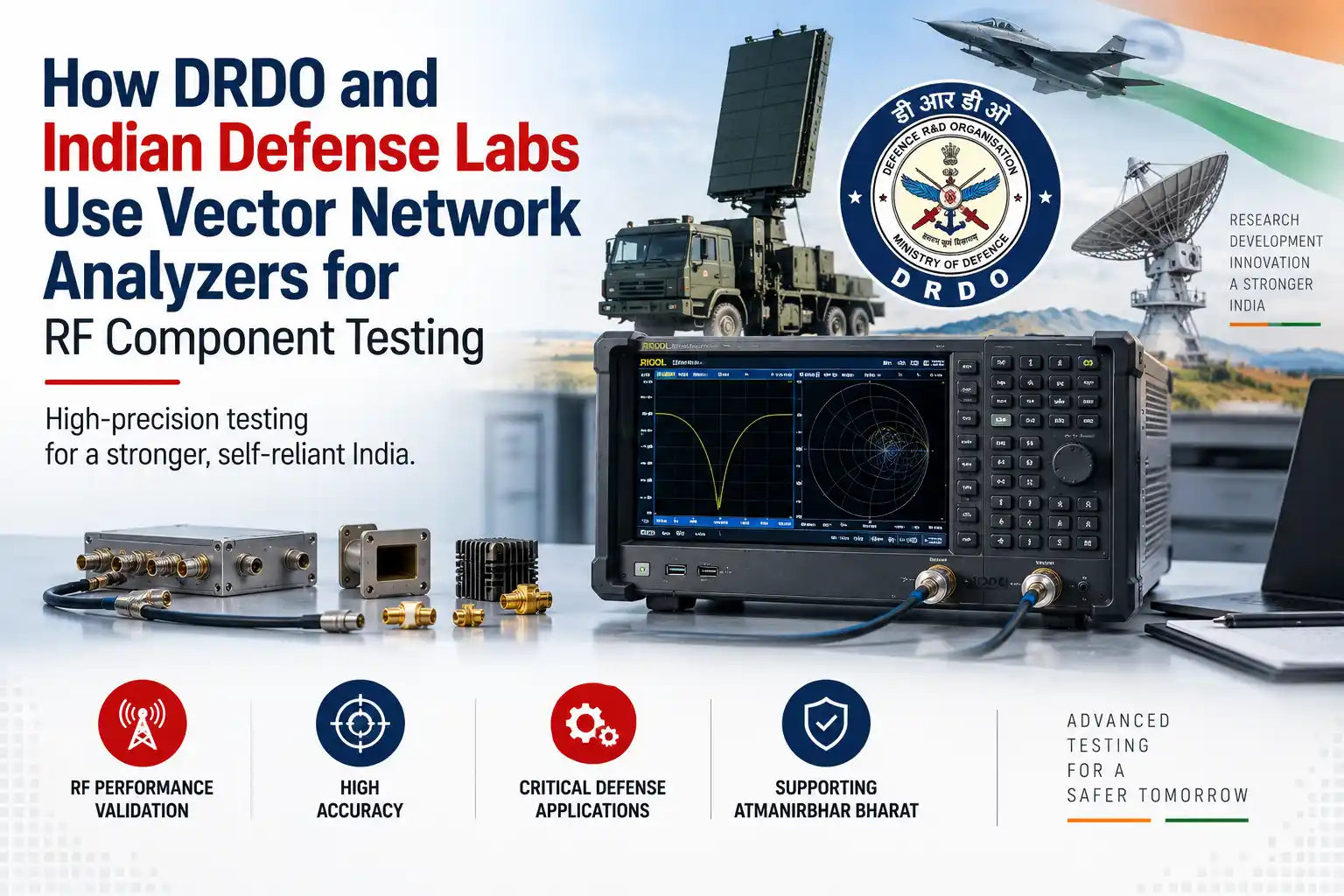
A VNA defense India laboratory uses vector network analysis to measure how RF and microwave components transmit and reflect energy across frequency.
These measurements are central to antennas, filters, couplers, transmission lines, radomes and radar-related subsystems.
DRDO operates dedicated electronics, radar and communications laboratories, including LRDE, DLRL and DEAL. DRDO's Electronics and Communication Systems cluster publicly lists these organisations among its laboratories.
Public DRDO-sponsored research also references hands-on use of vector network analyzers for RF and microwave measurement. A 2026 DRDO-sponsored IIT Kanpur project specifically sought experience using VNAs, spectrum analyzers and signal generators.
This article explains typical VNA workflows relevant to Indian defense laboratories. It does not imply that a specific Anritsu VNA model is installed at a named DRDO facility unless publicly documented.
Why VNA Defense India Testing Is Important
VNA defense India measurements are important because RF systems depend on impedance, transmission loss and phase behaviour.
A radar or electronic warfare subsystem can contain many components whose individual performance affects the complete signal path.
A vector network analyzer measures both magnitude and phase.
This enables engineers to work with scattering parameters, commonly called S-parameters.
For a two-port device:
- S11 measures input reflection
- S21 measures forward transmission
- S12 measures reverse transmission
- S22 measures output reflection
These parameters describe far more than whether a component simply passes a signal.
They help engineers quantify matching, gain or insertion loss, isolation and phase response.
That information is essential when designing microwave signal chains.
DRDO Test Equipment and RF Research Requirements
Publicly available DRDO test equipment references show that RF research programmes use instrumentation such as VNAs, spectrum analyzers and signal generators.
The 2026 DRDO-sponsored IIT Kanpur project on active tunable electromagnetic structures requested practical VNA experience for electromagnetic measurement work.
DRDO also maintains specialist laboratories focused on electronics, radar, electronic warfare and communication systems.
In March 2026, LRDE inaugurated a Microwave Units Integration Test Facility for assembly, integration and functional testing of microwave subsystems.
DRDO's newsletter identifies T/R modules, active phased-array antenna units, exciter-receiver units and high-power transmitters among the facility's target subsystems.
These systems require extensive RF measurement across development and integration.
A VNA forms one part of the broader defense RF instrumentation set.
Other instruments may include:
- Spectrum analyzers
- Signal generators
- Power meters
- Oscilloscopes
- Noise-figure systems
- Antenna measurement systems
- RF power sensors
- Phase-noise measurement equipment
Each instrument answers a different measurement question.
RF Testing Defense India: How Are VNAs Used for Antenna Development?
In RF testing defense India, antenna development is one of the most important VNA applications.
Antenna engineers use reflection measurements to understand how well the antenna matches its intended impedance.
S11 can be displayed as return loss or on a Smith chart.
Poor impedance matching increases reflected energy.
The measurement can reveal whether an antenna resonates within its intended operating band.
VNA measurements can support development of:
- Radar antennas
- Phased-array elements
- Communication antennas
- Electronic warfare antennas
- Satellite communication antennas
- Telemetry antennas
- Embedded platform antennas
Anritsu's current ShockLine VNA documentation includes near-field and far-field antenna measurements among supported application areas.
Antenna testing may require additional positioners, chambers and calibration methods.
The VNA is the RF measurement source and receiver within the larger setup.
Microwave Component Testing India for Filters and Duplexers
Microwave component testing India often involves passive devices such as filters, couplers, attenuators and diplexers.
These components shape the RF spectrum and control signal routing.
A VNA can measure insertion loss across the passband.
It can also measure stopband rejection and return loss.
High dynamic range becomes important when measuring deep filter rejection.
Anritsu lists filters, switches, couplers, isolators and circulators among current ShockLine VNA applications.
Defense systems can use filters to reject unwanted frequencies and protect sensitive receivers.
A filter that meets its centre frequency but has excessive loss can reduce system sensitivity.
Phase response may also matter.
The VNA allows engineers to evaluate several characteristics within one measurement platform.
VNA Testing of RF Cables, Connectors and Transmission Paths
Cables and connectors can become major sources of RF performance loss.
A damaged cable may still pass a signal while introducing excessive insertion loss or mismatch.
VNAs allow laboratories to characterize transmission paths.
Engineers can measure insertion loss, return loss and phase response.
Time-domain options can also help identify discontinuities along a transmission path.
This capability is useful for:
- Aircraft RF cabling
- Radar interconnects
- Antenna feed networks
- Test fixtures
- Coaxial assemblies
- Microwave connectors
- Waveguide transitions
Anritsu offers time-domain functions on selected ShockLine configurations.
The exact VNA and calibration approach should match the connector type and operating frequency.
How VNAs Support Radome and Radar Testing
Radomes protect antennas while allowing RF energy to pass through.
Their material and geometry can affect transmission magnitude and phase.
Anritsu specifically identifies radome and aircraft-maintenance testing as defense and aerospace applications for ShockLine VNAs.
Radar systems also rely on components such as:
- T/R modules
- Phase shifters
- Amplifiers
- Filters
- Couplers
- Antenna arrays
- Frequency converters
A VNA can characterize many linear RF components within these signal chains.
For active devices, engineers must consider device power and receiver protection.
Not every active radar measurement can be performed using the same configuration.
The test plan should define power, bias, frequency and calibration requirements before connection.
Anritsu VNA Defense Applications
Anritsu VNA defense products include ShockLine systems designed for RF and microwave network analysis.
Anritsu explicitly positions the ShockLine family for defense, aeronautics and space applications.
Current models cover several performance levels.
For example, the ShockLine MS46524B supports four-port measurements with frequency options reaching 43.5 GHz.
Anritsu lists passive multiport component testing, antenna measurements and amplifier characterization among its applications.
The broader ShockLine portfolio includes instruments extending into millimetre-wave ranges.
The correct VNA should be selected from:
- Required frequency range
- Number of ports
- Dynamic range
- Measurement speed
- Source power
- Phase performance
- Time-domain requirements
- Automation needs
- Fixture and calibration requirements
Indian RF laboratories can review Anritsu vector network analyzers for available configurations.
Why VNA Calibration Matters in Defense RF Measurement
High-performance RF measurement is only useful when systematic errors are controlled.
Cables, adapters and test fixtures introduce their own reflection and transmission effects.
Calibration moves the measurement reference plane closer to the device under test.
Common calibration approaches include SOLT and TRL.
The correct method depends on connectors, fixtures and frequency.
Engineers should also inspect RF connectors carefully.
A damaged precision connector can affect repeatability and potentially damage calibration standards.
Cable movement after calibration can also change phase and amplitude.
Defense and aerospace testing often demands strong repeatability because measurements may be compared across prototypes, environmental tests and production units.
The calibration procedure should therefore become part of the controlled test method.
How Anritsu Signal Generators Complement VNA Measurements
A VNA is not the only RF source required in a defense laboratory.
Signal generators support receiver, radar and subsystem testing under controlled stimulus conditions.
Anritsu's current MG362x1A Rubidium signal generator covers configurations up to 70 GHz and includes applications for pulsed radar testing.
The manufacturer specifically lists radar receiver, transceiver and RF component testing use cases.
A signal generator can create controlled CW or pulsed stimulus.
It can also support blocking, interference and nonlinear measurements depending on the test setup.
Defense laboratories often combine several instruments within one RF test system.
Explore Anritsu RF and microwave signal generators for signal-source requirements.
For a wider RF bench, review Anritsu RF and microwave test instruments.
Selecting a VNA for an Indian Defense RF Laboratory
The correct VNA should be based on the actual component programme.
Buying the maximum available frequency without a measurement requirement can increase cost unnecessarily.
Frequency Range
The VNA should cover the fundamental operating band and required characterization range.
Future programmes may justify additional margin.
Dynamic Range
High dynamic range is valuable for high-rejection filters and high-isolation components.
The requirement should be defined from expected device performance.
Port Count
Two ports are enough for many filters and amplifiers.
Four-port systems can simplify multiport and differential measurements.
Test Speed
Production environments may require rapid sweeps and automation.
Research laboratories may prioritise flexibility and analysis features.
Security and Network Architecture
Defense laboratories may have strict IT requirements.
Instrument remote control, removable storage and network interfaces should be assessed according to site policy.
Automation
SCPI control can integrate VNAs with switches, positioners and other equipment.
Automation improves repeatability for repetitive test sequences.
Conclusion
A VNA defense India laboratory depends on accurate S-parameter measurements to understand RF components before they become part of larger defense systems.
Publicly available DRDO and DRDO-sponsored material shows active work in RF, microwave, radar and electromagnetic measurement. VNAs are part of that broader measurement environment.
For antennas, filters, cables and microwave subsystems, vector network analysis provides magnitude and phase information that other RF instruments do not replace.
Anritsu offers VNA and signal-generation platforms specifically positioned for defense and microwave applications.
The correct instrument should be chosen from the actual frequency, dynamic-range, port-count and automation requirements of the laboratory.
Frequently Asked Questions
Does DRDO Use Vector Network Analyzers?
Yes, publicly available DRDO-sponsored research references VNA use for RF and microwave measurement, although specific equipment models may vary by programme.
What Defense Components Can a VNA Test?
A VNA can test defense RF components such as antennas, filters, cables, connectors, couplers, isolators and other microwave networks.
Is an Anritsu VNA Suitable for Defense Applications?
Yes, Anritsu VNAs are designed for RF and microwave measurements used in defense, aerospace and space applications, with model selection based on testing requirements.
Why Is Dynamic Range Important?
Dynamic range is important because it determines how effectively a VNA can measure small transmitted signals in high-rejection filters and high-isolation RF devices.
Do Defense Labs Need Signal Generators Alongside VNAs?
Often, yes, because signal generators support radar, receiver and subsystem testing that extends beyond the linear S-parameter measurements performed by a VNA.